I had the pleasure of being a guest on Gnet Radio to talk about the German occupation of the Channel Islands, the blog and various other projects. Including one project that the shows host Keith Pengelley and myself are working on at the moment.
If you missed it and would like to listen you can listen to it here, I am on from 38:45 for an hour.
I hope that you have enjoyed reading the blog post.
I also co-host a podcast with Keith Pengelley in which we talk about the occupation of the Channel Islands month by month using first hand accounts, diaries and our research in the archives. You can find us on all the major podcast services. Just search “Islands at War” or visit our podcast page here.
You can also follow the blog on Twitter at @Fortress_Island where I share other information and photographs. If you prefer Facebook I also have a page there.
If you would like to receive email notifications of future blogs, you can sign up to the right of this blog post or here. Feel free to look around the website, where I have categorised posts to make them easier to find and other resources such as tours, places to visit and films that may be of interest.
You can also find articles, podcasts, TV appearances and other social media etc here.
I will be adding more as time permits. Thank you for taking the time to read this, and I hope you enjoyed it. Please share it on social media or add a comment if you did. Feedback is always appreciated.
Also happy to be contacted with questions about the war in the Channel Islands, media appearances, podcasts etc.
Having caused a bit of a kerfuffle in various history forums and on social media, particularly locally, with my look at Churchill’s “Let’em Starve” comment, see here if you missed it, I thought I would follow up with a look at the proposed warning to the commander of the Channel Islands in March 1945.
Churchill’s comment was made in September 1944 based on information available at the time to the British Government. Their concern being that any relief effort for the civilian population would lead to the Germans taking additional food supplies from the islands. This would of course result in no improvement of the position of the civilian population of the islands but would improve the position of the occupying forces.
The British Government did of course change their mind later in 1944 and allowed the International Red Cross to send supplies following an appeal from the Bailiffs of Jersey and Guernsey. The International Red Cross ship the SS Vega made five trips to the Islands prior to the liberation in May 1945. The first arriving in Guernsey on 27 December 1944. A further visit was made in June 1945 after the liberation.
The ship delivered food parcels designed to supplement the meagre food supplies of Islanders. The parcels were designed to provide an additional 462 calories a day. To give some context that is the equivalent of eating two Snickers bars or slightly less than one Big Mac.
The Germans managed a few flights after D-Day bringing in limited supplies by air. The first of which arrived on 11 October 1944.
Western Morning Press 12 October 1944
As the war on mainland Europe progressed the supply line became longer and longer. Eventually these limited flights, if they made it through, required a round trip of almost 1.000 miles. I will be blogging about these flights in the future.
If you want to understand how cut off the Channel Islands were after D-Day and haven’t read it yet I wrote about it on the post below.
So having set the scene we fast forward to March 1945 when the War Cabinet were considering the position as it stood then. The Channel Islands remained essentially cut off from supplies from anywhere except from those flights and the International Red Cross.
By this time the commander of the Channel Islands was Vizeadmiral Friedrich Hüffmeier a thoroughly nasty individual who was an ardent Nazi. You can read about the extreme lengths he went to and the trouble he caused in the blog below.
Given the above serious consideration was given to sending a message to him that if he were to neglect his obligations to the civilian population he would be treated as a war criminal. A warning had been given in September 1944 about their obligations under the Geneva Convention as an occupying force.
Having considered the report, which you can read below, the War Cabinet decided on the 28th March 1945 not to issue the warning.
The rationale being that there was no information from the International Red Cross officials that the civilian population had their Red Cross supplies interfered with. The other consideration was that the Germans would point out that the offer to the British Government of evacuation of Channel Islanders not of military age in September 1944 would be thrown back at them. Have a read of the document below for the full detail.
Hopefully the above will shed a bit more light on why they did not pursue this course. It does of course not answer the debate of whether he should have been treated as a war criminal for other actions. That is a blog for another day.
I hope that you have enjoyed reading the blog post.
I also co-host a podcast with Keith Pengelley in which we talk about the occupation of the Channel Islands month by month using first hand accounts, diaries and our research in the archives. You can find us on all the major podcast services. Just search “Islands at War” or visit our podcast page here.
You can also follow the blog on Twitter at @Fortress_Island where I share other information and photographs. If you prefer Facebook I also have a page there.
If you would like to receive email notifications of future blogs, you can sign up to the right of this blog post or here. Feel free to look around the website, where I have categorised posts to make them easier to find and other resources such as tours, places to visit and films that may be of interest.
You can also find articles, podcasts, TV appearances and other social media etc here.
I will be adding more as time permits. Thank you for taking the time to read this, and I hope you enjoyed it. Please share it on social media or add a comment if you did. Feedback is always appreciated.
Also happy to be contacted with questions about the war in the Channel Islands, media appearances, podcasts etc.
On the 3rd October 2022 I was lucky enough to attend the unveiling of the new plaques on the monument and walk some of the route that they took as well as listen to various speeches at a lunch held afterwards. The purpose of this blog post is to share some videos of events at the commemoration, some photos and discussion around some aspects of the raid that came up during the day. Also included are some other things that I have found over the years in respect of the raid.
The order of the day – just to give you some idea of what to expect in this blog.
I had the great pleasure of talking at some length to Eric Lee, who wrote the definitive book on the operation Operation Basalt: The British Raid on Sark and Hitler’s Commando Order. It also proved a good chance to catch up with an old school friend Simon Elmont who lives in Sark and spoke at the point where we reached the “Cassino Tree” and explained the significance to us of the tree. There is a video later down the blog post of the story of the tree and it’s importance. Russ Guille whom I have been in contact with on twitter also provided insight into the raid and it was great to meet him and his dad Reg.
THE STORY OF THE RAID
Operation Basalt was a commando raid on the Channel Island of Sark originally planned for 18/19th of September 1942 that attempt had to be abandoned. The raid then took place on 3rd/4th October 1942. The raid would have a much wider impact on operations in the European theatre of operations as it led to Hitler issuing the “Kommandobefehl (Commando Order)”. You can view a translation of the Commando Order here.
Operation Basalt (Op Basalt) was a raid by Commandos of the Small-Scale Raiding Force (SSRF) on the Island of Sark.
The object of the raid was to gather information on conditions in Sark and to capture one or more German soldiers to take back to England for interrogation. The objectives were achieved.
The raid was led by Major John Geoffrey Appleyard and he, with his Commandos, including the Danish Second Lieutenant Anders Lassen, made their way across the English Channel, to make landfall on the end of this headland known as the Hog’s Back which they scaled.
The raiders were transported on MTB 344 (Nicknamed “The Little Pisser”), which had the ability to run very fast (33 Knots / 40MPH / 64KPH) but with quiet auxiliary engines for close to shore work. The MTB Skipper was directed to wait until 3 am, then leave. This gave the shore party some two hours to conduct the mission.
Having scaled the cliff of the Hog’s Back, the party made their way inland, coming across the house Le Petit Dixcart which was unoccupied. The next building they came to also seemed deserted, but on breaking into La Jaspellerie, they discovered a Mrs. Pittard, who was most helpful in providing them with information on where some German soldiers could be found, a few hundred yards away in Dixcart Hotel. She also provided information on the deportations that had happened in September.
The Commandos made their way silently to Dixcart Hotel; discovering a sentry, Lassen was sent to deal with him, which he did quietly by knife. Entering the Annex of the Hotel, the Commandos captured five German soldiers and restrained them, by tying up their hands and then moving them outside to take back to the MTB. However, the German soldiers realising how few men had them captured, started to resist and cry out. In the ensuing melee two of the prisoners were shot dead, two escaped and the Commandos beat a hasty retreat with their one remaining prisoner to the Hog’s Back.
Fortunately for the Commandos, the MTB skipper had waited beyond his ordered time to leave and was still waiting for them when they arrived alongside, in their canoes at about 3.30am. Mission accomplished, the MTB went to full speed and headed north to arrive in Portland at about 6.30am.
Text from the memorial.
An initial German report notes that Oblt Herdt, the former Company Commander of the 6./IR 583 was relieved of his command and was to face a court martial. Senior Gefreiter (Orderly Corporal) Schubert was also to be court-martialled.
The Germans put their own spin on the raid on 9 October 1942 in an article on the front page of the Guernsey Evening Press.
The English & Irish newspapers also contained articles very shortly after the raid. A selection of them are below.
The Sphere 24 October 1942The Sphere 24 October 1942Irish Independent 8 October 1943 Irish Independent 8 October 1943 Yorkshire Post 8 October 1942
Interestingly the newspapers also reported some months later that copies of both of the local newspapers were being received in England. Some of these would have come from the raid. Others from those that escaped.
For a quick overview of the raid there is a copy of Eric Lee’s speech from the 75th Anniversary here.
If you want a comprehensive read on the raid I recommend the book by Eric Lee. You can also watch Eric speak from Sark on WW2 TV at the link below.
THE COMMEMORATION
The commemoration took place on the 3rd October 2022, the 80th Anniversary.
The photograph below gives you an idea of the scale of the cliffs on the coastline of Sark. This one is taken looking out from the path on the Hog’s Back where they landed across Derrible Bay.
Whilst waiting for the proceedings to start two members of the British Legion from Sark stood ceremonial guard at the monument. As you can see it is on an exposed point near the top of the cliff.
Lt Col Reg Guille MBE briefed the crowd at what was about to happen. Proceedings were to commence with a recreation of the cliff climb by The Guernsey Military History Company. They were wearing the correct period kit, which it had taken a long period of time to assemble, and were all former or serving members of the forces. Russell Doherty who heads up the Guernsey Military History Company told me that it had taken eighteen months to assemble the kit and out of all of the re-enactments he had been involved in this one had made him the most nervous. The commandos were instructed to ignore those assembled and move as they would have at the time.
Lt Col Reg Guille said: “We have added two new names to the 10 that we listed five years ago, a corporal Jimmy Flint and Bombardier Eric Forster.”
“Additionally we have corrected a spelling error in the rank of one of the German soldiers on their plaque.” The reasons for the new names are explained later on in the blog.
The plaques were unveiled by Simon Wood – a nephew of the commando leader Major Geoffrey Appleyard – and Captain Karsten Adrian of the Bundeswehr, a German Officer serving in the Allied Rapid Reaction Corps (ARRC).
As we moved off to follow the route they took we passed the memorial further along the Hog’s Back to Hardtack 7. Operation Basalt meant that the Germans laid 13,000 mines in Sark some on this route which proved disastrous for this later mission. I wrote about Operation Hardtack 7 here.
We then reached the point where they turned down the track to the Petit Dixcart house. They heard a German patrol so had to take cover and wait for them to pass before moving off down the track.
Once we reached the Petit Dixcart the current resident explained what had happened there. He was standing roughly where the commandos left the Bren gunner to cover them in case the patrol they saw earlier returned. The Bren gunner was facing back up the track in the above photo.
They broke into the house by breaking the glass on the door to turn the handle only to find that the door was unlocked. Finding the house empty they found some newspapers which gave details of deportations which they took with them. Although the Germans did not refer to these as deportations instead they used the term “evacuation”. This was obviously an attempt to justify the deportations.
It didn’t take long for news of the deportations from these papers and the additional papers they were given later in the raid to make it into the the Channel Islands Monthly Review just one month later. The Channel Islands Monthly Review was produced monthly in England to keep all of those that had been evacuated before the occupation up to date with news of their friends and relatives and conditions in the Channel Islands.
Extract from the Channel Islands Monthly Review November 1942 which was published in Stockport. Picture is of one of the original reviews in my collection.Extract from the Channel Islands Monthly Review November 1942 which was published in Stockport. Picture is of one of the original reviews in my collection.
Next we moved on to the site of “The Cassino Oak” which was planted on their route to the next property that they went to.
At this site we paused again where my friend, and Sark resident, Simon Elmont gave an explanation of the significance of the Oak and how it came about.
Due to time constraints on the day we didn’t go all the way to La Jaspellerie. On the night of the raid they did where they encountered Mrs Pittard who is described as an elderly lady when in fact she was only in her early 40s. I guess if you were as young as the Commandos then you would have thought that she was elderly in comparison!
Mrs Pittard was rightly recalled at Eric Lee’s lunchtime talk as being the heroine of the raid. Once she realised that they were British Commandos she invited them in to her house and gave them information about the troops on the island and more copies of the local papers.
She offered to accompany them to show them to where the Germans were nearby. They declined this offer and instead offered her a trip on their MTB to return to England because of the danger she would be in from assisting them. She declined this offer and was to pay the price later when the Germans discovered her broken window and then shipped her to prison in Guernsey for three months. Fortunately she was not deported.
They left the house with the newspapers and proceeded towards Dixcart Hotel where Mrs Pittard had indicated the nearest Germans were to be found.
Lt Col Reg Guille MBE said a few words of introduction and Captain Karsten Adrian of the Bundeswehr, a German Officer serving in the Allied Rapid Reaction Corps (ARRC) said a few words.
Eric Lee explained at his lunchtime talk why it had been difficult to identify exactly who had taken part in the raids. Whilst it was easy to identify the officers through official records it was often difficult to find the lists of other ranks. This was doubly difficult because of the raiding party not knowing each other and being made up of different nationalities.
Lt Col Reg Guille MBE then showed everyone a Fairbairn Sykes fighting knife often called a “Commando Knife” and invited Patricia Falle to tell the story of this particular knife.
Mrs Falle then explained that she had lived at Petit Dixcart in the 1960s when the house was in disrepair and had renovated it with her husband. During the course of this they found this knife. It is possible that it could have been dropped by one of the commandos on the raid.
The knife had been used as a poker for a fire by Pat Falle until someone told her what it was.
You can watch the news report from ITV Channel Islands and some drone footage here.
It was a pleasure to take part in the day and the opportunities to talk to so many different people during the course of the day as well as pay my respects.
If you enjoyed reading about this raid you can read about other raids on the Channel Islands here. Other planned Allied Operations can also be found here.
I hope that you have enjoyed reading the blog post.
I also co-host a podcast with Keith Pengelley in which we talk about the occupation of the Channel Islands month by month using first hand accounts, diaries and our research in the archives. You can find us on all the major podcast services. Just search “Islands at War” or visit our podcast page here.
You can also follow the blog on Twitter at @Fortress_Island where I share other information and photographs. If you prefer Facebook I also have a page there.
If you would like to receive email notifications of future blogs, you can sign up to the right of this blog post or here. Feel free to look around the website, where I have categorised posts to make them easier to find and other resources such as tours, places to visit and films that may be of interest.
You can also find articles, podcasts, TV appearances and other social media etc here.
I will be adding more as time permits. Thank you for taking the time to read this, and I hope you enjoyed it. Please share it on social media or add a comment if you did. Feedback is always appreciated.
Also happy to be contacted with questions about the war in the Channel Islands, media appearances, podcasts etc.
Whilst I was in Sark recently my old school friend, Simon Elmont, asked me if I wanted to see the cottage where the Germans had formally surrendered to British forces on 10th May 1945. You can read about the surrender on the other Islands here.
We were walking from the Operation Basalt 80th Anniversary lunch at Stocks Hotel to the Bel Air for a quick drink, before I had to catch the boat back to Guernsey.
A very short diversion later we were outside Rose Cottage which sits on the Rosebud Tenement. It turns out that the house is pretty much as it was at the time of the surrender. Albeit the house is looking a little dilapidated having been empty for some time.
Now you might be wondering why the this didn’t happen at La Seigneurie the home of Sybil Hathaway, Dame of Sark. The reason was that the German Kommandantur was not based there but at the cottage above. In the below extract from her book “Dame of Sark, an autobiography” explains what happened.
The British force had not landed on Guernsey till 9 May and the Occupation troops on Sark had refused to answer telephone calls from Guernsey. This ostrich-like behaviour gave rise to a rumour that there must be ‘trouble in Sark’. So at about five o’clock in the evening on 10 May a tug came over with only three officers and twenty men, and I went to the harbour to meet our ‘Liberation Force’. Not a German was to be seen anywhere.
Colonel Allen, the English officer in charge of the party, asked where they were and added that he would need an interpreter. I informed him that I would act as interpreter and led him to the house that the Germans used as their Kommandantur. But no Germans were about and it was only after one of our soldiers hammered loudly on the door that they appeared and the German major who was in charge was summoned to answer Colonel Allen’s questions.
When he had done so satisfactorily Colonel Allen turned to me. ‘I can’t leave any troops here because so far only a token force has been landed in Guernsey.’ He hesitated a moment and then asked, ‘Would you mind being left for a few days, or would you prefer to return to Guernsey with me?’ There was a glint in his eyes when I said tartly, ‘As I have been left for nearly five years I can stand a few more days.” ‘That’s fine. Now will you tell the German Commandant that he is to carry out whatever orders you give until our troops come over?’
Having translated this command, I promptly gave my first order to the German major: ‘You will see to it that the telephone is laid on at once to my house and kept open day and night so that I can contact Guernsey.’ Our Liberation Force boarded the tug and I was left in command of 275 German troops!
I hope that you have enjoyed reading the blog post.
I also co-host a podcast with Keith Pengelley in which we talk about the occupation of the Channel Islands month by month using first hand accounts, diaries and our research in the archives. You can find us on all the major podcast services. Just search “Islands at War” or visit our podcast page here.
You can also follow the blog on Twitter at @Fortress_Island where I share other information and photographs. If you prefer Facebook I also have a page there.
If you would like to receive email notifications of future blogs, you can sign up to the right of this blog post or here. Feel free to look around the website, where I have categorised posts to make them easier to find and other resources such as tours, places to visit and films that may be of interest.
You can also find articles, podcasts, TV appearances and other social media etc here.
I will be adding more as time permits. Thank you for taking the time to read this, and I hope you enjoyed it. Please share it on social media or add a comment if you did. Feedback is always appreciated.
Also happy to be contacted with questions about the war in the Channel Islands, media appearances, podcasts etc.
If you are enjoying my blog you really should take a look at what the lovely folks over at Jersey War Tours are doing. They have some amazing content for you to look at.
Fancy a walk through some of the bunkers in Jersey but can’t get there in person? Never fear they have virtual tours of a number of sites that are just amazing. The link to them is here https://www.jerseybunkertours.com/3d-bunker-scans
You can find out more about their work on this in this video.
They have some fantastic stories about the occupation here.
There are a wealth of other resources and information on their site. Most importantly if you can get to Jersey do go and visit their sites or take a tour with them.
If you enjoy their site please consider joining their Patreon as they share a lot of information to subscribers.
I hope that you have enjoyed reading the blog post.
I also co-host a podcast with Keith Pengelley in which we talk about the occupation of the Channel Islands month by month using first hand accounts, diaries and our research in the archives. You can find us on all the major podcast services. Just search “Islands at War” or visit our podcast page here.
You can also follow the blog on Twitter at @Fortress_Island where I share other information and photographs. If you prefer Facebook I also have a page there.
If you would like to receive email notifications of future blogs, you can sign up to the right of this blog post or here. Feel free to look around the website, where I have categorised posts to make them easier to find and other resources such as tours, places to visit and films that may be of interest.
You can also find articles, podcasts, TV appearances and other social media etc here.
I will be adding more as time permits. Thank you for taking the time to read this, and I hope you enjoyed it. Please share it on social media or add a comment if you did. Feedback is always appreciated.
Also happy to be contacted with questions about the war in the Channel Islands, media appearances, podcasts etc.
Batterie Mirus is probably the most well known of the German gun batteries in the Channel Islands. Probably because it was the largest on any of the Channel Islands.
The name of the gun batterie was in honor of Kapitan-zur-See Rolf Mirus, who was killed in 1941 while sailing between Guernsey and Alderney.
They had a range of 51km (31.5 miles). The image below shows the impact this could have on shipping in the area.
If you have read some of my tweets and blog posts you will be familiar with the Germans taking captured equipment and reusing it themselves. This is features in a number of aspects of the construction of the battery itself.
The 30.5cm (12 inch) guns themselves had a couple of previous owners including a short period with the Germans. Originally they were the main armament of a Russian battleship captured by the Germans and then returned to the Russians at the end of the First World War. After the battleship was broken up in the mid 1930s the guns were placed in storage before being pressed into use in the Russo-Finnish war. Captured by the Germans they were sent back to Germany to be reconditioned. Then onwards to Guernsey.
As you can imagine they were not easy to transport at any stage of the journey. Arriving at St Peter Port on barges a special crane was required to lift them. 50 ton guns will not be easy to move.
What was required was a crane with a large lifting capacity. The Germans had captured one from the French, the barge ANTEE, with a tested lifting capacity of 100 tons. This was dispatched from France to Guernsey and can be seen in the photographs below.
The next problem was transporting them, for which 48 wheeled trailers were used. If you are familiar with Guernsey roads you will know that they are often quite narrow and not particularly straight. The dotted lines on the Google Map below show where the harbour at St Peter Port is and then the location of the Batterie Mirus which is in the Guernsey countryside at the far end of the Island.
Some junctions such as the one shown below had to be widened to enable the trailers to get through. The pictures below show some of the challenges they faced.
You can see from the photograph below the difficulties in navigating the guns through the narrow lanes once they reached the area near the gun pits.
Once at the sites they then had the problem of lifting the guns into place. This was achieved using the massive cranes that you can see in the pictures below. You can see from looking at the people in the photographs the scale of the guns.
An incredible 45,000 cubic metres of concrete were used in construction of the four gun pits and supporting buildings.
Concrete mixers on construction.
Once completed it was disguised as a house. This was an attempt to hide it from reconnaissance flights. In reality the Allies were well aware of the construction because of photo reconnaissance missions during the course of construction.
I found an interesting account “The Grower’s Tale” in the June-July 2014 edition of “Shore to Shore” a magazine for the Parishes of St. Saviours & the Forest.
The first that Renaut de Garis knew that these guns were coming to stay, was when his brand new brick house, La Croix in La Vieille Rue, was requisitioned. He and his pregnant wife were moved down to the Grand Douit behind Perelle. La Croix was given a reinforced first floor: steel beams and a foot of concrete; and the Commander of the gun battery moved in.
Interviewed in 2009 aged 95 (he was 100 this May), Renaut remembered it all: “They were Spaniards building the battery, we called them Morroccans. Some of them were quite refined people. They were treated terribly, poor devils. Soupe d’Atlantique, they called the food they gave them, it was just water really. Disgusting.
In the winter they wrapped cement sacks round their feet to try and keep them warm. If British planes were overhead, the Germans would cut all the lights at their building sites, but not the power to the concrete mixers. Those huge mixers just ran and ran, night and day.
After they had built the battery they covered it all back with earth again. There used to be a little valley there, and now it’s flat. When they were going to test the [Number 2] Mirus gun the first time, most people didn’t want to go. The shock of the detonation was tremendous. I had my young son in my arms at the time… I saw his cheeks rippling with the shock wave. I had three greenhouses and they were just lifted up and moved sideways. The glass was like snow on the ground.
“The Grower’s Tale” in the June-July 2014 edition of “Shore to Shore” a magazine for the Parishes of St. Saviours & the Forest.
Below is a video from YouTube which shows the transport issues and firing.
The guns were fired numerous times from 13 April 1942 onwards.
When they were test fired large numbers of the population had to move out of the area and much disruption was caused. One can only imagine what happened when they were fired without warning. The picture below is from a document I found in the Island Archives relating to restrictions on test firing.
AQ696/08 Island ArchivesFrom a report to the Historical Division of Group West. It was written in May 1948 by Major General Graf von Schmettow who was commander of the Channel Islands until his removal on 20 February 1945. Usefully there was an English translation.
The Guns were removed after the war as part of the scrap drive. You can see below a photograph of the site maintained by Festung Guernsey. Don’t be fooled by the photograph this is a massive site. The video at the end of the blog will help you appreciate just how big this site is.
Photo Copyright Nick Le Huray Entrance to the gun pit. Photo Copyright Nick Le HurayPicture from Weapons & Warfare gives an idea of the scale of just one of the gun sites.
Below is a great video with an overview of the site.
If you want to learn more about the Batterie Mirus and visit the site of one of the guns I highly recommend the tour that is run by Tours of Guernsey around the site maintained by Festung Guernsey. I recently took the excellent tour and posted about it below. If you go on the tour you will find out far more than I can write in a blog post. Plus nothing is as good as walking the ground!
I hope that you have enjoyed reading the blog post.
I also co-host a podcast with Keith Pengelley in which we talk about the occupation of the Channel Islands month by month using first hand accounts, diaries and our research in the archives. You can find us on all the major podcast services. Just search “Islands at War” or visit our podcast page here.
You can also follow the blog on Twitter at @Fortress_Island where I share other information and photographs. If you prefer Facebook I also have a page there.
If you would like to receive email notifications of future blogs, you can sign up to the right of this blog post or here. Feel free to look around the website, where I have categorised posts to make them easier to find and other resources such as tours, places to visit and films that may be of interest.
You can also find articles, podcasts, TV appearances and other social media etc here.
I will be adding more as time permits. Thank you for taking the time to read this, and I hope you enjoyed it. Please share it on social media or add a comment if you did. Feedback is always appreciated.
Also happy to be contacted with questions about the war in the Channel Islands, media appearances, podcasts etc.
On the 27th September 1944 Churchill is reputed to have scrawled a note on the bottom of a report put forward to the War Cabinet “Let’em starve. No fighting. Let them rot at their leisure.” A picture of the report is at the end of this blog post.
The report was produced following a request from the Germans to arrange the evacuation of all of the civilian population of the Channel Islands with the exception of men of military age. Rather than do this or mount any form of operation to liberate the islands the British Government reminded the German authorities of their responsibility under the Geneva Convention to adequately feed the population.
Over the years this has become a very controversial comment with various historians and islanders interpreting it differently. Some felt that he meant just the German garrison, others felt that he meant both the garrison and the islanders.
The aspect that is always focused on is the lack of food and Churchill’s refusal to allow a supply of the islands with food. The rationale for this was that it was felt that the Germans would take the food for themselves. The islands effectively formed a prisoner of war camp which didn’t require guards but meant that a large force of German resources were tied up there rather than being able to be deployed in mainland Europe.
At the time the Islands were caught in a pocket and effectively under siege.
Illustrated London News Feb 1945
There are some factors that don’t seem to have been taken into account by some commentators. Most notably that Churchill’s comment was made three weeks before an attempt to get the Germans to surrender. They had however refused to even entertain the idea. One would imagine that he would not seriously have intended that islanders should starve if an attempt was imminent to attempt to get the Germans to surrender and would have taken this into account in making his assessment.
This first attempt to achieve a surrender by direct negotiation happened on 22 September 1944. Having secured the assistance of a high ranking German officer, who had been captured in 1943, Major Chambers boarded an R.A.F. launch at Carteret and proceeded towards Guernsey under a white flag. I have read a number of differing accounts of this and decided to go back to primary sources to establish exactly what happened. Chambers was a Canadian Intelligence Corps officer, which explains why the report in the Jersey archives (B/A/W91/42) the Germans reported that it was an American ship and an American officer. This was incorrect as can be established from the full report in the National Archives.
The intention was that Chambers would meet with von Schmettow and invite him to come and meet the German officer understandably said he was not willing to go ashore or aboard a German vessel. The German officer is only identified in the reports of the raid as Mr Black. Subsequent to earlier accounts being written it is now believed that Mr Black was in fact Gerhard Bassenge. He was captured in North Africa in 1943 and spent time in Trent Park a luxurious camp for high-ranking prisoners. They were kept in luxury because it meant they would talk freely amongst themselves without realising that the British were listening through hidden microphones.
Letters had been dropped to arrange a meeting off the south coast of Guernsey. On arriving at the rendezvous point they found no German vessel waiting to meet them. Chambers decided that they should proceed to St Peter Port and try to make contact. On approaching St Peter Port a German vessel, not under a white flag, approached them. Extracts from the official report about what happened next
This was certainly a brave effort by Major Chambers, who received a DSO for his actions. You can read the full account of it here
If they had decided to surrender they could have saved the islanders and their own personnel from a terrible winter of hunger and deprivation.
Eventually following an appeal from the Bailiffs of Jersey and Guernsey an International Red Cross ship the SS Vega made five trips to the Islands prior to the liberation in May 1945. The first arriving in Guernsey on 27 December 1944. A further visit was made in June 1945.
The ship delivered food parcels designed to supplement the meagre food supplies of Islanders. The parcels were designed to provide an additional 462 calories a day. To give some context that is the equivalent of eating two Snickers bars or slightly less than one Big Mac.
SS VEGA in St Peter Port Harbour Image from BBC.co.ukNewcastle Journal – 31 January 1945
Without these food parcels things could have been much worse. If you want to read more about the food situation from a German soldier’s perspective go to my previous blog here . For a civilian view point I blogged about the doctor’s story here .
The report with Churchill’s comment scrawled on the bottom.
Whatever the true reason or reasons were some islanders held it against Churchill for the rest of their lives.
You may be reading this and wondering why the Channel Islands were not retaken by force. There are a multitude of reasons but first and foremost the loss of life that would have occurred amongst the civilian population would have been immense. It would also have meant that a vast amount resources would be taken away from the main front on mainland Europe. That is a blog for another day.
I hope that you have enjoyed reading the blog post.
I also co-host a podcast with Keith Pengelley in which we talk about the occupation of the Channel Islands month by month using first hand accounts, diaries and our research in the archives. You can find us on all the major podcast services. Just search “Islands at War” or visit our podcast page here.
You can also follow the blog on Twitter at @Fortress_Island where I share other information and photographs. If you prefer Facebook I also have a page there.
If you would like to receive email notifications of future blogs, you can sign up to the right of this blog post or here. Feel free to look around the website, where I have categorised posts to make them easier to find and other resources such as tours, places to visit and films that may be of interest.
You can also find articles, podcasts, TV appearances and other social media etc here.
I will be adding more as time permits. Thank you for taking the time to read this, and I hope you enjoyed it. Please share it on social media or add a comment if you did. Feedback is always appreciated.
Also happy to be contacted with questions about the war in the Channel Islands, media appearances, podcasts etc.
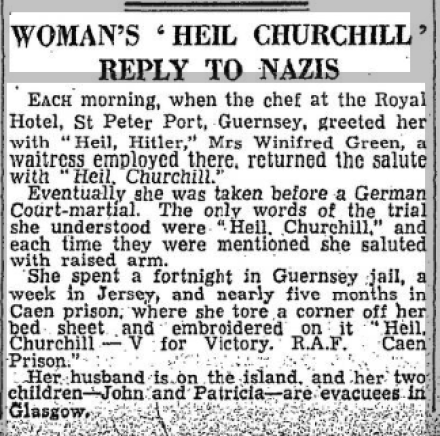
Probably one of the best known people for carrying out individual acts of defiance against the Germans during the occupation of the Channel Islands is Winifred Green. If you consult almost any book about the occupation Winifred gets a mention.
She became quite well known in the UK Newspapers in May 1945 when her story was widely reported. Some extracts below from a couple of newspapers.
Manchester Evening News 15 May 1945
The Scotsman 16 May 1945
Below is a photo of the display at the German Occupation Museum in Guernsey.
Display at German Occupation Museum
You can read more about Winifred at the Frank Falla archive here
I hope that you have enjoyed reading the blog post.
I also co-host a podcast with Keith Pengelley in which we talk about the occupation of the Channel Islands month by month using first hand accounts, diaries and our research in the archives. You can find us on all the major podcast services. Just search “Islands at War” or visit our podcast page here.
You can also follow the blog on Twitter at @Fortress_Island where I share other information and photographs. If you prefer Facebook I also have a page there.
If you would like to receive email notifications of future blogs, you can sign up to the right of this blog post or here. Feel free to look around the website, where I have categorised posts to make them easier to find and other resources such as tours, places to visit and films that may be of interest.
You can also find articles, podcasts, TV appearances and other social media etc here.
I will be adding more as time permits. Thank you for taking the time to read this, and I hope you enjoyed it. Please share it on social media or add a comment if you did. Feedback is always appreciated.
Also happy to be contacted with questions about the war in the Channel Islands, media appearances, podcasts etc.
Paul Woodage of WW2TV is running a ‘Channel Islands Week’ starting this Monday (26 September). Links are below to the various shows as they stand at the moment. Promising to be a cracking week of excellent content.
Really pleased to have been invited to talk about ‘Commando Raids on the Channel Islands’ on Wednesday. I will be dealing with all the raids except Operation Basalt as Paul has the wonderful Eric Lee doing that on the anniversary on 3rd October 2022 live from Sark. I am also planning on being in Sark that day for the re-enactment on the anniversary.
Don’t worry plenty of other raids for me to talk about! Come along and ask questions.
Ever so slightly in awe that I am in such esteemed company as Duncan Barrett , Eric Lee , Phil Marett talking about various aspects of the occupation.
If you haven’t seen WW2TV it is a free to view history resource with lots of fantastic content covering all aspects of the Second World War. Either click the links below or go give the channel a follow on the various social media below. If you enjoy what you watch Woody would appreciate a sign up on Patreon.
Monday 26 September 2022 – live at 7:00pm (BST) – or catch up anytime after that.
Tuesday 27th September 2022 – live at 7:00pm (BST) or catch up anytime after that.
Wednesday 28th September live 7:00pm (BST) – or catch up anytime after that.
Monday 3rd October 2022 – live at 7:00pm (BST) – or catch up anytime after that.
If you would like to receive email notifications of future blogs, you can sign up to the right of this blog post. Feel free to look around the website, where I have categorised posts to make them easier to find and other resources such as tours, places to visit and films that may be of interest.
You can also follow on Twitter at @Fortress_Island where I share other information and photographs.
I will be adding more as time permits. Thank you for taking the time to read this, and I hope you enjoyed it. Please share it on social media or add a comment if you did. Feedback is always appreciated.
Also happy to be contacted with questions about the war in the Channel Islands.
In this modern age, as I sit here writing this blog post on my iPad with my iPhone next to me, it occurred that we take instant communication for granted. During the occupation of the Channel Islands it was a lengthy process to send and receive messages from the islands. Typically it would take four or five months for a message to be received and then a similar time frame for the reply to be received. An urgent message may take 5-6 weeks.
In the instance of my mother my grand parents found out four months later of her birth.
The first actions to set up communications began as early as the end of July 1940. It is included in a speech given by the Duke of Devonshire in the House of Lords in August 1940.
As announced in the other House yesterday, the question of whether communication with the islands could be established through the Red Cross has been taken up with that body, and I can assure my noble friend that whatever can be done in this connection, and generally, for the relief of the islanders is being done.
It was announced on the wireless last night that the Post Office is prepared to accept letters for the Channel Islands by arrangement with Messrs. Cook and Son, who, I believe, dispatch the letters to the Channel Islands, but I can, of course, give no guarantee that the letters will arrive.
My noble friend can rest assured that the Government are conscious of the very hard position of the islanders, and that they are most anxious to do anything they can to alleviate it.
Duke of Devonshire in the House of Lords in August 1940. – Hansard
Unlike prisoners of war held on mainland Europe, who were able to write letters on a regular basis, islanders and their friends and family overseas found it very difficult to communicate. An International Red Cross office was set up at Elizabeth College in Guernsey as well as an office in Jersey.
In the early days islanders could only write to those outside of the Channel Islands if they had first received a Red Cross message to reply to. This changed in April 1941 when they were able to originate Red Cross messages.
As you can see below it also became possible to communicate with German and German occupied countries and these letters were not limited to 25 Words.
The only other information that found its way from the Channel Islands to England was either provided by the few that managed to escape, those that were repatriated from camps having been deported or information gathered during Commando raids.
Evening Press, Saturday April 19 1941
Messages were limited to ten words initially then twenty words and this was later increased to twenty five words. The messages were checked by the German and English censors. Often if you see a Red Cross message it will have a blue stripe across it or a blue cross. This is residue left by the German censor using a chemical to check for invisible ink.
The reason that it took so long for a message to reach the intended recipient was that the messages went via Portugal, Spain, France, Switzerland and then on to Germany before being sent on to Guernsey.
After D-Day on 6 June 1944 it became impossible to send messages so there was no further news from the islands or from the UK.
The quote below from the International Red Cross gives a good feel for how it worked.
All messages were routed via the International Red Cross headquarters in Geneva, Switzerland. The islands exchanged about 1 million messages.
The organization provided message forms on which islanders could communicate with family and friends who were outside the island. To ensure that the service was maintained for humanitarian reasons, both sides agreed that all messages would be read by both German and English censors. This was to ensure that no secret military or coded information was being sent via the forms. They were intended for non-military, civilian messages only. In May 1941, the first 7,000 arrived in England
Messages took anywhere from a few weeks to several months to get from the island to England and back again. At one point, islanders were not permitted to write to relatives but could write to friends. The number of messages that one could send was limited, and replies had to be on the back of the original message. To islanders, this link was invaluable. Messages ceased shortly after June 6, 1944, when the islands were cut off and isolated.
One thing that is of interest in the quote above is that it refers to the first 7,000 messages being received in England in May 1941. This seems to be at odds with reports in the Guernsey Evening Press of 2 April 1941 which indicates that messages were being received in England in January 1941.
Evening Press 2 April 1941
Likewise in the Evening Press of 16 January 1941 news of Red Cross Messages are recorded.
Evening Press 16 January 1941
There is also a report in the Aberdeen Evening Express of 10 October 1940 that there was a scheme being arranged. This is followed by an article of 4 November that such a scheme had been arranged.
Aberdeen Evening Express – Thursday 10 October 1940Dundee Evening Telegraph – Monday 04 November 1940
In an effort to share news of loved ones that had been evacuated from the Island or were away serving in the forces recipients of a message could consent to the message being published in the Evening Press in Guernsey. An example of this is below.
Dundee Evening Telegraph – Saturday 22 February 1941Evening Press 30 April 1941
The end of these articles usually finished with a replies wanted to remind people that they needed to send a response.
Evening Press April 15, 1941
The reason for the “replies wanted” was that the messages were received in numbered batches and a batch of replies could not be sent until it was complete.
Evening Press 30 April 1941
The articles below from the Channel Islands Monthly Review October 1941 explain how the system worked and some of the frustrations.
Channel Islands Monthly Review October 1941Channel Islands Monthly Review October 1941
The short video below tells the story of one family and their messages.
The Scotsman – Saturday 15 November 1941
I hope that you have enjoyed reading the blog post.
I also co-host a podcast with Keith Pengelley in which we talk about the occupation of the Channel Islands month by month using first hand accounts, diaries and our research in the archives. You can find us on all the major podcast services. Just search “Islands at War” or visit our podcast page here.
You can also follow the blog on Twitter at @Fortress_Island where I share other information and photographs. If you prefer Facebook I also have a page there.
If you would like to receive email notifications of future blogs, you can sign up to the right of this blog post or here. Feel free to look around the website, where I have categorised posts to make them easier to find and other resources such as tours, places to visit and films that may be of interest.
You can also find articles, podcasts, TV appearances and other social media etc here.
I will be adding more as time permits. Thank you for taking the time to read this, and I hope you enjoyed it. Please share it on social media or add a comment if you did. Feedback is always appreciated.
Also happy to be contacted with questions about the war in the Channel Islands, media appearances, podcasts etc.