Unfortunately Keith is currently unwell having succumbed to the latest bout of the flu that is doing the rounds. So instead of the scheduled July 1943 episode we have some interviews for you. Thank you to Katie Roger for voicing one of the stories which was received as an email.
In this episode of Islands at War, host Nick Le Huray shares personal stories from individuals who experienced evacuation during World War II, focusing on the unique narratives of Mary Jay, Johnny Thomas Boalch, and Val Le Feurve. The episode highlights the chaos and emotional turmoil of wartime decisions, the kindness shown by individuals during the occupation, and the varying experiences of evacuees. Additionally, the episode discusses upcoming community events related to the history of the Channel Islands, encouraging listener engagement and participation.
The episode features personal stories from evacuees during World War II.
Mary Jay’s unique evacuation experience highlights the chaos of wartime decisions.
John Thomas Boalch shares his memories of kindness from a German soldier during the occupation.
Val Le Feuvre recounts her husband’s challenging experiences as an evacuee in Glasgow.
The podcast emphasizes the importance of community and shared history in understanding wartime experiences.
The stories reflect a mix of adventure and hardship faced by evacuees.
The impact of the war on families and communities is a central theme.
Future episodes will continue to explore the history of the Channel Islands during the war so don’t worry July 1943 is coming soon!
Also details of some upcoming events.
You can find the episode here or by clicking our rss feed here.
A massive thank you to Matt Gaudion for this excellent article that he provided for the blog. Matt lives in Jersey but is originally from Guernsey. An operation that is often overlooked in the whole scheme of things.
Monday 17th June 1940
During the chaos and confusion that befell France in the first half of June 1940, a number of major events occurred on a single, critical day. One of these, the sinking of the HMT Lancastria, is so sensitive that the official report remains embargoed under the ‘100 year rule’ part of the Official Secrets Act until 2040.
This blog post will tell the story of Monday 17th June 1940, which placed the Channel Islands on the very frontline of world events.
Events leading up to Monday 17th June
Reinforced by the 2017 Christopher Nolan film, the evacuation of Dunkirk is lodged in the collective memory of anyone with an awareness of this period. However, there’s a seldom told evacuation that occurred weeks later, all along Western France, including via the Brittany port of St Malo which is the nearest major French port to the Channel Island of Jersey.
At 11:30pm on Sunday 2nd June, Major-General Harold Alexnder took a motor launch and sailed along the beaches towards Bray Dunes at Dunkirk, at the top of the length of beach next to the harbour. Calling out to any men who may be remaining, but hearing no reply, the signal went out “BEF [British Expeditionary Force] evacuated, Returning now” and sailed away from a beach silhouetted by discarded trucks and equipment (much was destined to be repurposed by the Nazis), turning towards home.
There’s a common misconception that the Dunkirk evacuation ended the involvement of British troops on French soil in 1940, but in fact there was a second BEF.
Such was the pressure at the very top of the British Government to keep the French fighting, that agreement was given to dispatch multiple divisions (each approx. 16k personnel) of British troops and the 1st Canadian Division to France. This second BEF was led by Lieutenant-General Alan Brooke, who was vocal towards senior military and political leaders of the futility of the effort, but it went ahead nonetheless. Only a fraction of these forces made it across the English Channel. Some would be captured, but most would require evacuation.
As Allied troops embarked at south coast English ports, the German war machine was surging as part of its Blitzkrieg aiming to destroy the French as a viable fighting force. Meanwhile, Winston Churchill was making multiple and hazardous trips to visit the French Government, including with their Prime Minister Paul Reynaud.
Gradually, as the Nazi Panzers partly led by Erwin Rommel made their way towards Paris, the French Government ‘fell back’. Burning documents and taking only essentials, they established a temporary capital in the Loire valley, at Tours, and then moved West to further safety in Bordeaux.
It was Sunday June 16th that in London a last ditch attempt to stiffen French resistance was made. It was proposed that a full political union would exist between Britain and France. This proposal would have merged the two great powers, and created a single country. It briefly seemed as though it might gain some traction, and was chiefly motivated by the British attempting to avoid the French fleet falling into German hands.
However, by the time it was received, defeatism had fully taken hold of the French leadership, and as Paul Reynaud presented it to the Government, it was firmly rejected as a British plot to pickup French colonies overseas. If this offer had been made a week prior, the counter-factual history is fascinating as this could indeed have given resolve to French efforts to continue fighting from beyond their borders, and may have stymied the effect of any ‘Vichy’ type regime.
Serious consideration was also given to forming a ‘Breton Redoubt’ as last bastion against Nazi dominance, from which to continue the struggle. [map] It was into Brittany where thousands of refugees and Allied troops flooded overnight on Sunday 16th June, and towards what would be one of the most notable days of the war, Monday 17th June 1940.
The Evacuation of Saint Malo
In the British Channel Island of Jersey at this time, much speculation was taking place over if the Nazis would invade. There was a significant focus on ‘business as usual’ to the extent that sailings of passenger vessels from the UK were continuing to occur, and there were even holiday makers and business day trippers still on the island when the Germans did invade. They would not see or hear from any English countrymen for 5 long years of Nazi occupation.
There was some nervousness about what would happen next. Jersey is within sight of the Cotentin peninsula, and at this point Jersey was not ‘demilitarised’ as it would shortly be by the British government.
On Sunday 16th June, the Jersey Bailiff (Civil Head of Government) Sir Alexander Coutache, was summoned to see the Lieutenant-Governor who is the Kings appointed representative, and he was shown a telegram. It was from the Admiralty (HQ of the Royal Navy), and it was requesting ‘all available craft to be sent immediately’ to the nearby French port of St Malo to assist in the evacuation of British troops.
Without delay, the Bailiff asked the Commodore of the St Helier Yacht club, William Le Masurier to organise the small ships needed. A meeting of the St Helier Yacht club that afternoon lead to multiple volunteers putting themselves forward for this dangerous mission. It wasn’t straightforward, as several members had already left the island, including many men of fighting age. Some had not made ready their vessels for sea since the previous winter, in the impending uncertainty over the invasion. The majority of the vessels were between 26-40 ft, and constituted pleasure craft or fishing boats.
The first little boats crewed by mostly older Jerseymen (including teenage helpers, some of whom had never been to sea before) left St Helier before midnight that evening. They were headed towards what was then an active war zone and frontline, with the Nazi blitzkrieg approaching.
Twenty small boats from Jersey were involved, including the ex lifeboat, and the States of Jersey Government motor launch, the Duchess of Normandy. Under significant pressure and in what must have been a stressful time, over 20,000 personnel were evacuated via St Malo port, using a combination of the Jersey boats and locally based vessels, which went onwards to England.
The degree of confusion meant that even British diplomatic staff were caught up as the drama unfolded. One of the St Helier Yacht club vessels, Teazer brought back the British consul Vyvyan Macleod Ferrers. He was to go on to reside in Jersey with his wife, and ultimately was sent to a German prison camp, but he did survive the war.
Aftermath
In 1952, the St Helier Yacht club was awarded a rare honour of a special Battle Honour in the form of a defaced Red Ensign. This includes the gold crossed axes to represent St Helier along with the Admiralty pattern anchor. There’s a fascinating article on the Jersey War Tunnels website about this whole episode, which I recommend to anyone interested.
When we look back at history with our certain view of events that did occur, it is hard to imagine the sheer uncertainty of what those living through these times went through. The local population were not sure whether there would be fighting or significant area bombing of the island by the invading forces, or whether British troops would fight street to street to ward off the invaders.
There was a bombing raid towards the end of June 1940 which in Guernsey killed 33 islanders, and in Jersey 10, but fortunately for the local population there was no further engagement, and the islands were surrendered peacefully not long after.
It was crucially important to the British that useful infrastructure in northern France did not fall into German hands. There was a genuine belief that the next target would be the south coast of England, and that port facilities would be directed towards that effort. A combined operation called ‘XD’ was put into action, of which St Malo was code named XD (M).
At 2pm on Sunday 16th June, HMS Wild Swan set sail from Plymouth with a party of 32 men of combined Royal Navy/Engineers led by Commander C D Howard-Johnston DSC, and 8 tonnes of explosives.
Their orders were to call in at St Helier on the way, make contact with the island government, and proceed onwards to St Malo and destroy the port equipment. Upon arriving in St Helier early in the evening, and a brief conversation with Jersey Government officials, HMS Wild Swan sailed onwards at 11:30pm, towards St Malo.
Arriving in St Malo shortly before 1:00am, HMS Wild Swan disembarked the demolition party and explosives, and immediately got out of danger, returning to Plymouth without waiting for them to complete their mission. This was likely part of the planning, as a Royal Navy destroyer at anchor outside a key allied held port as daylight approached, would have presented too tempting target for Luftwaffe crews overhead.
During the course of Monday 17th June, charges were set by the demolition party and at 1:20pm, the petrol tank depots along the harbour were destroyed. It was at this point around 2pm that a message arrived saying that the Germans were no more than 9 miles away from the harbour.
The lock gates were then blown up, rendering the harbour useless and the demolition party embarked on the Jersey small craft. This was to be the last time anyone was to see freedom in St Malo until 15th August 1944, when it was finally liberated by US forces under General Patton, after fierce fighting.
Thanks to Matt for submitting this contribution to the blog.
I hope that you have enjoyed reading the blog post.
I also co-host a podcast with Keith Pengelley in which we talk about the occupation of the Channel Islands month by month using first hand accounts, diaries and our research in the archives. You can find us on all the major podcast services. Just search “Islands at War” or visit our podcast page here.
You can also follow the blog on Twitter at @Fortress_Island where I share other information and photographs. If you prefer Facebook I also have a page there.
If you would like to receive email notifications of future blogs, you can sign up to the right of this blog post or here. Feel free to look around the website, where I have categorised posts to make them easier to find and other resources such as tours, places to visit and films that may be of interest.
You can also find articles, podcasts, TV appearances and other social media etc here.
I will be adding more as time permits. Thank you for taking the time to read this, and I hope you enjoyed it. Please share it on social media or add a comment if you did. Feedback is always appreciated.
Also happy to be contacted with questions about the war in the Channel Islands, media appearances, podcasts etc.
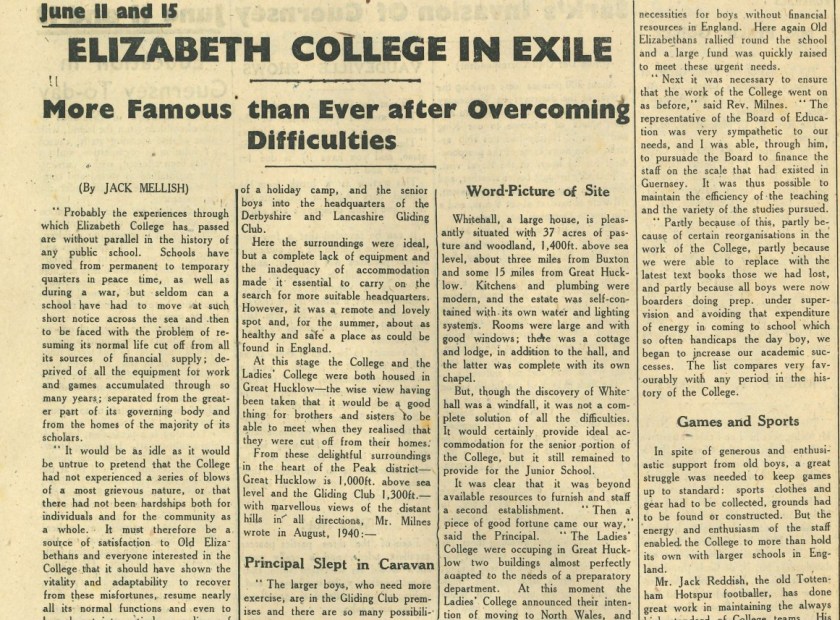
Whilst going through the numerous copies of the Guernsey Press from the Occupation years I found this in the Guernsey Weekly Press of 20 June 1945.
It is an article about my old school Elizabeth College during the years that the pupils and staff spent in exile in England. Link to a longer account of their time at the end of this post.
I was given a box of Channel Islands Monthly Reviews and in the May 1943 edition spotted this letter:
If you want to read a more detailed account of the evacuation and exile of Elizabeth there is a more detailed account written by Vernon Collenette who was a pupil at the time and teacher at Elizabeth College. Mr Collenette was a teacher at the time that I was at Elizabeth College in the 1980s.
You can read his account here as Elizabeth College have digitised it.
I hope that you have enjoyed reading the blog post.
I also co-host a podcast with Keith Pengelley in which we talk about the occupation of the Channel Islands month by month using first hand accounts, diaries and our research in the archives. You can find us on all the major podcast services. Just search “Islands at War” or visit our podcast page here.
You can also follow the blog on Twitter at @Fortress_Island where I share other information and photographs. If you prefer Facebook I also have a page there.
If you would like to receive email notifications of future blogs, you can sign up to the right of this blog post or here. Feel free to look around the website, where I have categorised posts to make them easier to find and other resources such as tours, places to visit and films that may be of interest.
You can also find articles, podcasts, TV appearances and other social media etc here.
I will be adding more as time permits. Thank you for taking the time to read this, and I hope you enjoyed it. Please share it on social media or add a comment if you did. Feedback is always appreciated.
Also happy to be contacted with questions about the war in the Channel Islands, media appearances, podcasts etc.
Just a short blog post today to flag an article that may be of interest. Regular readers of the blog will be aware that the demilitarisation of the Channel Islands in June 1940 was not without controversy in UK Government circles.
The article below from the Birmingham Daily Post – Wednesday 10 July 1940 details various concerns raised in the House of Lords. Lord Portsea, who was born in Jersey, was to remain vocal throughout the war in raising his concerns in respect of the Channel Islands. I mention him in my blog about False Hope And Fear as a result of D-Day when he called for a force of Channel Islanders to be raised to liberate the Channel Islands. You can find that here
I hope that you have enjoyed reading the blog post.
I also co-host a podcast with Keith Pengelley in which we talk about the occupation of the Channel Islands month by month using first hand accounts, diaries and our research in the archives. You can find us on all the major podcast services. Just search “Islands at War” or visit our podcast page here.
You can also follow the blog on Twitter at @Fortress_Island where I share other information and photographs. If you prefer Facebook I also have a page there.
If you would like to receive email notifications of future blogs, you can sign up to the right of this blog post or here. Feel free to look around the website, where I have categorised posts to make them easier to find and other resources such as tours, places to visit and films that may be of interest.
You can also find articles, podcasts, TV appearances and other social media etc here.
I will be adding more as time permits. Thank you for taking the time to read this, and I hope you enjoyed it. Please share it on social media or add a comment if you did. Feedback is always appreciated.
Also happy to be contacted with questions about the war in the Channel Islands, media appearances, podcasts etc.