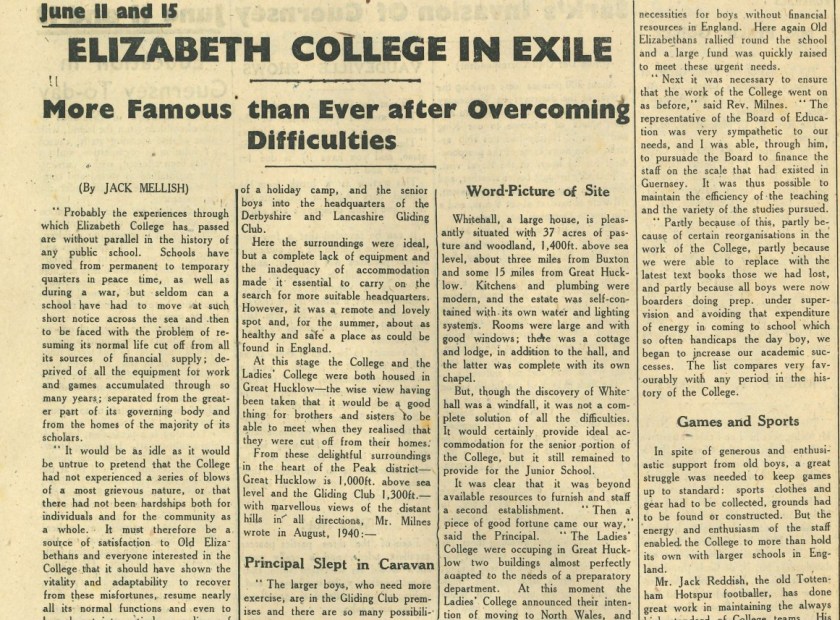
Following on from my recent post about Elizabeth College in exile the Guernsey Weekly Press of 20 June 1945 also featured an article about Ladies’ College in exile. The paper is quite fragile and difficult to scan so apologies for it being somewhat askew in some of the images below.
I hope that you have enjoyed reading the blog post.
I also co-host a podcast with Keith Pengelley in which we talk about the occupation of the Channel Islands month by month using first hand accounts, diaries and our research in the archives. You can find us on all the major podcast services. Just search “Islands at War” or visit our podcast page here.
You can also follow the blog on Twitter at @Fortress_Island where I share other information and photographs. If you prefer Facebook I also have a page there.
If you would like to receive email notifications of future blogs, you can sign up to the right of this blog post or here. Feel free to look around the website, where I have categorised posts to make them easier to find and other resources such as tours, places to visit and films that may be of interest.
You can also find articles, podcasts, TV appearances and other social media etc here.
I will be adding more as time permits. Thank you for taking the time to read this, and I hope you enjoyed it. Please share it on social media or add a comment if you did. Feedback is always appreciated.
Also happy to be contacted with questions about the war in the Channel Islands, media appearances, podcasts etc.
Whilst going through the numerous copies of the Guernsey Press from the Occupation years I found this in the Guernsey Weekly Press of 20 June 1945.
It is an article about my old school Elizabeth College during the years that the pupils and staff spent in exile in England. Link to a longer account of their time at the end of this post.
I was given a box of Channel Islands Monthly Reviews and in the May 1943 edition spotted this letter:
If you want to read a more detailed account of the evacuation and exile of Elizabeth there is a more detailed account written by Vernon Collenette who was a pupil at the time and teacher at Elizabeth College. Mr Collenette was a teacher at the time that I was at Elizabeth College in the 1980s.
You can read his account here as Elizabeth College have digitised it.
I hope that you have enjoyed reading the blog post.
I also co-host a podcast with Keith Pengelley in which we talk about the occupation of the Channel Islands month by month using first hand accounts, diaries and our research in the archives. You can find us on all the major podcast services. Just search “Islands at War” or visit our podcast page here.
You can also follow the blog on Twitter at @Fortress_Island where I share other information and photographs. If you prefer Facebook I also have a page there.
If you would like to receive email notifications of future blogs, you can sign up to the right of this blog post or here. Feel free to look around the website, where I have categorised posts to make them easier to find and other resources such as tours, places to visit and films that may be of interest.
You can also find articles, podcasts, TV appearances and other social media etc here.
I will be adding more as time permits. Thank you for taking the time to read this, and I hope you enjoyed it. Please share it on social media or add a comment if you did. Feedback is always appreciated.
Also happy to be contacted with questions about the war in the Channel Islands, media appearances, podcasts etc.
Sgt. Stanley Ferbrache – You can see this and more information at the German Occupation Museum
This one is just a short blog to tie up the end of the Operation Ambassador story.
If you read my earlier blog about Operation Anger and Operation Ambassador you might be wondering why there was an attempt to rescue them on the 3rd of August when they became POWs on 28 July 1940. The earlier blog is here.
The answer to that question is that there was no way of getting a message out of the Guernsey other than if someone escaped or by the covert landings. Rumours abound on some forums that someone had a radio transmitter but this is simply untrue. All of the military equipment had been destroyed or removed prior to the arrival of the Germans.
Another Guernseyman Stanley Ferbrache volunteered to attempt to meet up with Mulholland and Martel and get them off of the island.
As with the previous raids he was landed at La Jaonnet Bay, this time having learnt of the issues with using other boats they used an MTB, on the 3rd of August.
Having met some of his family members he discovered that Mulholland and Martel had been left with no choice but to surrender the previous week. In order to avoid the mission being a waste of time he spent the next few days gathering intelligence on the German forces in the island.
He succeeded on leaving the island on 6th August. He was awarded the Distinguished Conduct Medal for this mission.
Churchill is reputed to have said ‘Let there be no more silly fiascos like those perpetrated at Guernsey.’ As it turned out there were plenty more missions to the Channel Islands to come and they were much better organised. More of those to come in future blogs.
I hope that you have enjoyed reading the blog post.
I also co-host a podcast with Keith Pengelley in which we talk about the occupation of the Channel Islands month by month using first hand accounts, diaries and our research in the archives. You can find us on all the major podcast services. Just search “Islands at War” or visit our podcast page here.
You can also follow the blog on Twitter at @Fortress_Island where I share other information and photographs. If you prefer Facebook I also have a page there.
If you would like to receive email notifications of future blogs, you can sign up to the right of this blog post or here. Feel free to look around the website, where I have categorised posts to make them easier to find and other resources such as tours, places to visit and films that may be of interest.
You can also find articles, podcasts, TV appearances and other social media etc here.
I will be adding more as time permits. Thank you for taking the time to read this, and I hope you enjoyed it. Please share it on social media or add a comment if you did. Feedback is always appreciated.
Also happy to be contacted with questions about the war in the Channel Islands, media appearances, podcasts etc.
On my blog post about stage one of Operation Anger we left the story at the point where Hubert Nicolle had been picked up by submarine H43 after two other Guernseymen 2nd Lieutenants Martel and Mulholland had been landed and briefed by Nicolle before he left. If you haven’t read that you might want to start there and come back to this after. You can find it here
Update October 2024 – When you get to the end of this post I have updated for a conversation I had with Al Murray over a glass of wine in September 2024. We discussed his take on the merits of the raid!
2nd Lieutenant MulhollandMartel taken post war.
This is probably as near to plan a things went! The rest most definitely didn’t go to plan.
The second phase of Anger was to prepare for the arrival of the raiding force of Operation Ambassador. Ambassador was originally planned for a landing in the early hours of 13 July 1940. The idea being that Martel and Mulholland would meet them on the beach and act as guides. The plan being that they would take the first of the raiding party to the airport where they could destroy aircraft and fuel supplies. They would then leave on the boats that had brought the raiding party to the island. The raiding party was to consist of No. 3 Commando and No. 11 Independent Company. Some 140 men were to take part in all.
The commander of the raid was Lieutenant Colonel Durnford-Slater. Upon arriving at Combined Operations Headquarters in Whitehall he was briefed by the actor David Niven, who was one of the staff officers. Niven having been an officer in the army in the 1930s before resigning his commission to embark on his Hollywood career. He returned from Hollywood and re-enlisted following the outbreak of war. Incidentally he recounts in his autobiography “The Moon’s a Balloon” a raid on Sark which he took part in. His other connection was starring in “Appointment with Venus”in 1951 which was filmed in Sark.
The first landing was to take place at Pointe de la Moye immediately south of the airport. The intention being this would be a distraction to the Germans. This aspect of the raid was to be carried out by H troop of 3 Commando.
Map showing Pointe de la Moye at the bottom, the airport at the top left and Le Jaonnet Bay on the right.
There were to be two other landings other than the party landing at Point de la Moye to attack the airport. The second landing was to be further east at Petit Port to attack a German machine gun post and a billet that had been identified at Telegraph Bay.
The third landing was to take place at Le Jaonnet Bay where the others had been previously been dropped. The idea being that they would be able to deal with any reinforcements sent from St Peter Port as a result of the landings. They were also tasked with taking prisoners in order to bring them back to England.
Map showing Le Jaonnet Bay on the left and Petit Port on the Jerbourg peninsula
At this point the wheels really started to come off the operation.
Mulholland and Martel made for the rendezvous at the appointed time on the night of 12th/13th July but unknown to them bad weather had delayed the mission. It wasn’t possible to contact them to tell them of the delay. They hid during the following two days coming out at night to return to the beach to give the signals again.
The Commander of the submarine that had dropped the three men in Guernsey had been quite robust in his report. He felt that the operation had been put together far too quickly and without time to practice. He felt that it was only because of the experience that the three Guernseymen had with boats that they had succeeded in getting ashore at all.
The submarine was commissioned in 1919 and was not ideal for an operation such as this. They had to stay submerged for most of the trip and this placed a strain on the batteries. Navigation to the Guernsey coast was also problematic for the submarine crew.
The landings for Ambassador were to take place from two destroyers HMS Scimitar and HMS Saladin with six RAF Launches to accompany them. Two RAF Ansons were to circle at low level over the Island to drown out the noise of the engines and provide a distraction.
Having arrived off of the coast of Guernsey they set about landing the men who would have just an hour and a half ashore before being picked up. Well that was the plan anyway!
One launch set off and for some reason immediately headed off in the wrong direction. There are a couple of theories as we know it was because the compass was incorrectly indicating direction. The first is that equipment on the destroyer interfered with the compass or that equipment for the raid stowed on the launch had interfered with it.
Here there are varying accounts as to what happened to the launch. It found its way to one of the islands off of the east coast of Guernsey. Some accounts indicate that they landed on Little Sark, other accounts say they went there but didn’t land. Further accounts appear to indicate it may have been Herm or Jethou. In any event they returned to HMS Saladin.
The second party set off in launches heading for Pointe de la Moye. Here the waited for the signal from Martel & Mulholland who were in fact at Le Jaonnet bay as originally planned. As a result the launches at Pointe de la Moye didn’t receive a signal and failed to identify a beach to land on. Two launches returned to HMS Saladin the third was unable to find the ship so returned to Dartmouth.
If they had managed to make it to the airport they would likely have found rich pickings as the Germans based a variety of aircraft there including fighters. A report of activity at the airport around that time indicated that there were approximately 30 to 50 aircraft. Approximately two thirds were Bf109s the rest being Bf110s and JU52s.
Bf109 at Guernsey Airport
The third landing force successfully landed at Petit Port after a struggle to get ashore involving having to save ashore with all their kit in four feet of water. The delay in the operation had meant that the launches couldn’t get as close in due to the rocks and tides.
They created a road block out of rocks and they sent out patrols to try and find some Germans as well as to destroy the machine gun post at Telegraph Bay along with the telegraph hut.
They searched the barracks and a nearby house and they quickly discovered that there no Germans in the area and the machine gun post was deserted. The barracks had been in use until 1918 after which they were used to house civilians until the Germans took them over in 1940.
Local guide Tim has some photos of the barracks here
Durnford-Slater gives an account of not finding any Germans in his memoir.
Johnny Giles and I crawled up on either side of the little mound in which the machine-gun nest was dug. I carried grenades and a 45 Webley; Giles, a giant of well over six feet, had a tommy gun.
We jumped to our feet and into the nest, a sandbagged circle. We were both ready to shoot, but I found myself face to face with Johnny’s tommy gun; and he with my Webley. “Hell!” Johnny said bitterly, “there’s no one here!” We went down to where the others were cutting the cables leading from the hut. Knight asked me rather plaintively: “Please can I blow the place up, sir?” He had a pack of demolition stores on his back and was aching to use it.
“No. Apparently the Germans don’t know yet that we’ve come. There’s no point in announcing it. Just cut the cables.”
We went back to see if we could help de Crespigny’s party. It was pitch dark, and as I approached, Corporal “Curly” Gimbert burst through a hedge at me. The next thing I felt was a bayonet pushing insistently through my tunic. “Password!” Gimbert hissed.
He was a big, powerful man. It seemed a long time before I could say anything when I’ve been less scared. At last I remembered the word and let it out with a sigh. “Desmond!” I said. Gimbert, recognising my voice, removed the bayonet quickly. “All right, Colonel.” I thought he sounded disappointed.
Telegraph Bay a Photograph taken later in the war in February 1945. Higher resolution images are available from NCAP here
They resigned themselves to returning empty handed although they were not happy about it as Durnford-Slater recounts.
We formed up on the road between the barracks and the Doyle Column, a monument we had used as a landmark. It was easy to guess from the muttered curses that the others shared my disgust at our negative performance and at the fact that we had met no Germans.
George Herbert was particularly upset and begged me to give them a few minutes more to visit some houses nearby which he thought might contain Germans. In this atmosphere of complete anticlimax, it was clear that none of us wanted to leave. But I called the officers together. “We’ve got to be back on the beach in ten minutes,” I said urgently.
The only shot fired by the raiders was accidental when Durnford-Slater slipped and discharged his pistol. A searchlight briefly came on followed by a brief burst of machine gun fire. The Germans had only been in the island for two weeks so had not yet built the bunkers that you see on Jerbourg peninsula today.
Their troubles were not over. Due to the tide and the rocks the launches couldn’t get close in. They began ferrying the party out in a dinghy but on one of the trips it was caught in the waves and overturned. One of the commandos, Gunner J. McGoldrick, was lost overboard and feared drowned. He was later found alive and captured remaining a POW until 1945.
They were now left with no choice but to swim to the launches. This presented another problem as three of them couldn’t swim. The three men were Private F.T. Drain, Private A Ross and Corporal D. Dumper. They were left on the beach with instructions to hide and return the next night to be picked up. Unfortunately for them this was deemed too risky and the Navy refused to come and pick them up.
When I mentioned on Twitter that I was writing about Operation Ambassador@GuernseyLiz14 Liz Walton was kind enough to share the information that she had collated about her relatives who helped to hide the non swimmers. Her Aunt & Uncle stayed in contact with Fred Drain after the war with him visiting them. Thanks Liz for your kind permission to share these.
They were later apprehended walking down the road near the airport some days later. At least unlike Mulholland and Martel they were wearing uniform.
There is an account of the raid in an interview held by the Imperial War Museum given in 1988 by Sir Ronald Swayne MC who held the rank of Lieutenant at the time of the raid. In his interview he recalls that some of the boats were towed by the destroyers and that they had gone too fast for these boats which left them damaged and leaking.
But we weren’t remotely ready. We didn’t know what kind of boats we wanted, we didn’t know how to do it, there wasn’t a proper planning body to prepare for these raids. In any case there was a fearful shortage of weapons and everything… we had no Tommy guns and we didn’t have the Remington Colt which we were issued with later… we were armed with .38 revolvers which was, I always thought, a poor weapon. There was a shortage of ammunition for teaching the soldiers to shoot. Some of them had hardly done any practice on the range, it was all frightfully amateurish.
Sir Ronald Swayne MC, interview with the IWM which you can find it here.
Interestingly his account regarding the weapons situation seems to different from other accounts as they all refer to them being armed with Tommy guns and Bren guns. The pistol situation sounds about right given that Durnford-Slater’s pistol was cocked when he lost his footing and it discharged. This difference in accounts may be due to the passage of time between the events and the interview some forty eight years later. Many other accounts given more closely to the raid indicate that Tommy guns and Brens were used.
As the party due to meet Martel and Mulholland never made it to the bay instead heading on a trip to another island they weren’t picked up. As a result the two men, fearing for the impact that their capture may have on their relatives still in Guernsey decided they needed to hide then escape.
They left the beach and decided to hide in a barn and spent some time hiding with family. Martel with his sister and Mulholland with his mother then spending some time at a house in Vazon on the west coast of the island. Realising this was putting their family at great risk and after several attempts to escape from Guernsey, including one by stealing a boat from Perelle Bay which left them stranded on rocks, they decided they had no choice but to surrender themselves to the German authorities.
They contacted the Bailiff Ambrose Sherwill and he arranged for them to be supplied with some uniforms as they had come to the island in civilian clothes which would have resulted in them being treated as spies with the prospect of being shot. Luckily for both men the Germans treated them as prisoners of war rather than spies when they surrendered on 28th July.
They were taken to France and interrogated separately. Mulholland was sent to Oflag VIIb Eichstätt, Bavaria and Martel to a camp at Tittmoning, Warburg and then Eichstätt.
As with many operations relatively early in the war these two were put together in a rush and a relatively amateur fashion.
The RAF Launches proved to be far from suitable for the job. They were designed for operating over much shorter distances and nearer the coast than traveling over 90 miles to the south west coast of Guernsey. Two of them became unserviceable before the raid even started. They had been supposed to carry twenty men each to the beach. As a results other boats from the destroyers had to be towed behind the launches.
Subsequent raids used larger MTBs, as shown above, which were much more suited to this type of operating environment. Durnford-Slater went on to requisition his own boats that his men were trained to operate and maintain for future raids on mainland Europe.
Ambassador may appear a bit of a disaster with four men captured, Mulholland and Martel subsequently captured and no military objective achieved other than cutting some telephone wires. It did however provide some valuable lessons which were to be implemented for future raids.
Whilst being able to swim was a requirement when signing up for the commandos nobody had actually checked that they could. The unit had only been formed in mid June 1940.
The Navy came in for some criticism from the Army for not being as professional and as experienced as expected. This would seem to me to be a little harsh given the efforts they made to recover the commandos. They stayed beyond the allotted time putting the ships at risk of air attack as dawn came. They had also been promised a pilot with local knowledge but he was not taken onboard before they left England.
The main thing that they learned what was those involved required adequate training and that proper planning was key to the success of future operations.
CAB 65/56/157 National Archives – Confidential Annexes and Notes to WM (40) 205
Churchill’s initial reaction is recorded in the image above. He was later reported to be furious at the amateurish nature of the operation but surely must be partly culpable in the lack of planning because of his wish for it to take place so quickly. After all Anger took place six days after Churchill had ordered the raid and Ambassador twelve days after his initial order.
CAB 65/56/156 – National Archives
Dunford-Slater recalls in his memoirs that those involved had all become caught up in the rush to stage the raid that the first proper briefing was on the eve of the operation after they had set sail.
In his interview Swayne puts the blame squarely on the Royal Navy.
It was beautifully planned from an army point of view but the naval preparation was very inefficient, partly due to inadequate equipment of course…. it was a wonderful idea and it could have been a very, very clever raid.
Sir Ronald Swayne MC, interview with the IWM which you can find it here.
One aspect of Ambassador that was a success was that it made the Germans nervous. They conducted a thorough investigation into the landing at Petit Port and the activity around Jerbourg. Having been unable to extract any information from the four commandos and with Martel and Mulholland still at large they were unaware of the other two attempts at landing.
They even staged a re-enactment to try and better understand what had happened. Their assessment was rather more generous in the capabilities of the landing party than if they had been aware of the other landing parties and issues.
As a result of this they spent time searching the island for any raiders that had been left behind and became nervous about the defence of the coastal areas. They also instructed the Guernsey Police force to assist with the search, although they didn’t look very hard.
They placed more restrictions on areas around the coast that civilians could visit and deployed more men to those areas. In addition they began laying minefields.
Evening Press 18 July 1940
The President of the Controlling Committee, the civillian government, Ambrose Sherwill (Later Sir Ambrose Sherwill) was troubled by the raid as the Germans had threatened to bomb the island if there was any trouble, presumably after withdrawing themselves. With the deaths of civilians in the raid before the Germans arrived only a few weeks earlier he was moved to write a letter to the British Government. In it he warned of the consequences of such raids. He asked the Germans to ensure this was passed on through diplomatic channels but they declined. You can read my blog about the air raid here
Durnford-Slater certainly learned from the lessons of Ambassador and took this forward to lead No.3 Commando to many notable successes in future operations.
UPDATE – In September 2024 when Al Murray visited Guernsey and we had a discussion over a glass of wine as to why Al thought maybe it wasn’t such a disaster! I wasn’t convinced at first but as the discussion went on I started to think he might have had a point! No men were killed and a few men ended up in the bag but it led to unease amongst the Germans. Following our chat I spoke to a friend of mine who had spoken to one of the Germans who had visited the Island in the 1990s. He had been 17 when he was here and when asked how the commando raids made him feel when he was on a remote guard duty on the coast. Apparently it made him very uneasy that he could be captured or killed by commandos. Apparently this German said ‘How you say, I was sh**ting myself!’ So there we go maybe it wasn’t such a disaster after all!
Photo of the We Have Ways of Making You Talk team in Guernsey.
If you want to hear more listen to our podcast on the player below.
If you want to learn more about the raids and some of the individuals I recommend these books:
If you are in Guernsey then you may wish to contact Keith from Guernsey Walking Tours as he does a tour that includes Mulholland. You can follow them on Twitter here @gsywtours.
I hope that you have enjoyed reading the blog post.
I also co-host a podcast with Keith Pengelley in which we talk about the occupation of the Channel Islands month by month using first hand accounts, diaries and our research in the archives. You can find us on all the major podcast services. Just search “Islands at War” or visit our podcast page here.
You can also follow the blog on Twitter at @Fortress_Island where I share other information and photographs. If you prefer Facebook I also have a page there.
If you would like to receive email notifications of future blogs, you can sign up to the right of this blog post or here. Feel free to look around the website, where I have categorised posts to make them easier to find and other resources such as tours, places to visit and films that may be of interest.
You can also find articles, podcasts, TV appearances and other social media etc here.
I will be adding more as time permits. Thank you for taking the time to read this, and I hope you enjoyed it. Please share it on social media or add a comment if you did. Feedback is always appreciated.
Also happy to be contacted with questions about the war in the Channel Islands, media appearances, podcasts etc.
Just a short blog post today to flag an article that may be of interest. Regular readers of the blog will be aware that the demilitarisation of the Channel Islands in June 1940 was not without controversy in UK Government circles.
The article below from the Birmingham Daily Post – Wednesday 10 July 1940 details various concerns raised in the House of Lords. Lord Portsea, who was born in Jersey, was to remain vocal throughout the war in raising his concerns in respect of the Channel Islands. I mention him in my blog about False Hope And Fear as a result of D-Day when he called for a force of Channel Islanders to be raised to liberate the Channel Islands. You can find that here
I hope that you have enjoyed reading the blog post.
I also co-host a podcast with Keith Pengelley in which we talk about the occupation of the Channel Islands month by month using first hand accounts, diaries and our research in the archives. You can find us on all the major podcast services. Just search “Islands at War” or visit our podcast page here.
You can also follow the blog on Twitter at @Fortress_Island where I share other information and photographs. If you prefer Facebook I also have a page there.
If you would like to receive email notifications of future blogs, you can sign up to the right of this blog post or here. Feel free to look around the website, where I have categorised posts to make them easier to find and other resources such as tours, places to visit and films that may be of interest.
You can also find articles, podcasts, TV appearances and other social media etc here.
I will be adding more as time permits. Thank you for taking the time to read this, and I hope you enjoyed it. Please share it on social media or add a comment if you did. Feedback is always appreciated.
Also happy to be contacted with questions about the war in the Channel Islands, media appearances, podcasts etc.
Photograph of Hubert Nicolle on display at the German Occupation Museum which I took a photograph of recently.
Just over a week after after the Germans had occupied the Channel Islands twenty year old Hubert Nicolle landed in Guernsey to undertake “Operation Anger”. Hubert was a Guernseyman that had originally served in the Royal Guernsey Militia and then joined the Hampshire Regiment.
Guernsey had been occupied by the Germans on 30 June 1940 and on 4 July Nicolle was ordered to report to Room 74 at the Admiralty. Arriving, still having no idea why, he learned that Combined Operations had been instructed by Winston Churchill to send someone “to find out what is going on in the Channel Islands”. He was told, “If you do this and are caught we don’t want to know you; you are out on your own. You will be shot and that will be the end of it.” Nicolle immediately agreed to go.
He was brought to the Island on the submarine H43 and landed at Le Jaonnet Bay on the south coast of Guernsey in the early hours of 8 July.
In an interview with the Imperial War Museum Ian McGeoch who was a first lieutenant on H43 recalls how things didn’t go smoothly.
We found our way to the southwest side of Guernsey and surfaced near the coastline so we could hear the dogs barking. Fortunately, it was fairly calm. Well not calm but fairly calm. I recall an incident, it was a very still night.
I recall probably the second Coxswain, the leading seaman whose job it was to open up the casing and help to get the canoe out and so forth when he lifted the big steel plate which was part of the door of the top of the casing, he inadvertently let it drop. And you can imagine the noise made by about 100 square inches of steel being dropped. And of course, we thought oh well everybody is bound to hear the dogs bark and everything I said there was a panic, but we got away with it.
He was taken ashore in a canoe that had been purchased from Gamages a London department store a few days before. The flat pack canoe was originally assembled inside the submarine but they then discovered it wouldn’t fit out of the hatch. It had to be taken apart and reassembled on the hull.
Once assembled a naval officer, Sub-Lt J.L.E. Leitch took him the two miles to shore before returning to the submarine.
This bay is at the bottom of a large cliff. The initial ascent is via a ladder from the beach, sorry no photo, and 218 steps to the cliff path at the top. As you can imagine this beach doesn’t attract the casual visitor given how difficult it is to access. So on a dark night it must have been a challenge to get up from the beach.
The picture below and the map will give you an idea of where he landed.
Nicolle was able to make contact with friends and family. He borrowed a bicycle and was able to move around the island and obtain information about the German garrison and their positions. Now you might wonder how he was able to move about so freely. He was of course in civilian clothes and the island had been occupied for little more than a week.
He had determined that the German Garrison stood at only 469 soldiers based mainly around St Peter Port, this information was provided to him by a friend who was a baker and forced to supply the Germans. His uncle was the assistant harbour master and provided him with information about German shipping activity.
The reason for the small numbers was that they had only been here for a week. At the peak in numbers Charles Cruickshank estimates in in his book there were approximately 12,000. Whilst there were machine gun posts located around the coast he estimated that it would take about twenty minutes for reinforcements to arrive if the alarm was raised.
As a result the Germans were still present in relatively small numbers and identification cards had not yet been introduced. He was of course a local so able to pass without suspicion as well as using his local knowledge to move about through the lanes. He was therefore able to also visit the roads around the airport and assess the position there.
Having gathered this intelligence he was picked up by the same submarine on 10 July 1940 and two other Guernseymen were dropped off, this time using a Berthon boat rather than a canoe. They were 2nd Lieuts Philip Martel and Desmond Mulholland who were to conduct the second phase of Operation Anger.
They were taken to shore by the same navy officer that had dropped Nicolle off. This nearly ended in disaster as the boat became swamped in the waves near the shore. Fortunately they made it with the help of Nicolle. He briefed his two fellow Guernseymen on the curfew, where the Germans were and other useful information.
They didn’t have to wait long to repay the favour of being rescued as the boat began to sink as it was on the way back to the submarine and they had to help bring it back to shore.
Eventually the boat made it back to the submarine and Nicolle was able to report back to London with his findings.
A memorial stone stands at the top of the cliffs in commemoration of Nicolle’s landing.
I was privileged to have known Hubert or Mr Nicolle as we called him. He was a past pupil of the school that I attended, Elizabeth College, and was actively involved in college activities when I was a pupil in the 1980s. Little did I know that the gentleman that often started swimming races with a starting pistol was used to more deadly weapons!
He was to return to Guernsey again on 3 September 1940 with another Guernseyman and fellow pupil of Elizabeth College James Symes. That is a story for a future blog and a far more eventful visit it was! I have an interview with Symes that provides some interesting insight into this raid as well as some archive material and an interview with one of the submarine crew who recalled the landing. Sign up for email notifications of you don’t want to miss out.
I have only been able to touch on a fraction of the story here so if you would like to read more about the operation I recommend you track down a copy of William Bell’s “The Commando Who Came Home To Spy” which is out of print but you can pick up for a few pounds second hand on Amazon, eBay or from a second hand book shop.
At this point you are probably wondering what happened to Martel and Mulholland. Well they stayed in the island to gather intelligence and take part in the next phase Operation Anger and the follow up Operation Ambassador later in the month. This was a raid consisting of some 140 men. A blog post about this will be out later in July.
You can listen to me talk about this on the Islands at War Podcast on the player below.
I hope that you have enjoyed reading the blog post.
I also co-host a podcast with Keith Pengelley in which we talk about the occupation of the Channel Islands month by month using first hand accounts, diaries and our research in the archives. You can find us on all the major podcast services. Just search “Islands at War” or visit our podcast page here.
You can also follow the blog on Twitter at @Fortress_Island where I share other information and photographs. If you prefer Facebook I also have a page there.
If you would like to receive email notifications of future blogs, you can sign up to the right of this blog post or here. Feel free to look around the website, where I have categorised posts to make them easier to find and other resources such as tours, places to visit and films that may be of interest.
You can also find articles, podcasts, TV appearances and other social media etc here.
I will be adding more as time permits. Thank you for taking the time to read this, and I hope you enjoyed it. Please share it on social media or add a comment if you did. Feedback is always appreciated.
Also happy to be contacted with questions about the war in the Channel Islands, media appearances, podcasts etc.
The blog has been going for just over six months now and I have endeavoured to cover a variety of topics so far. It takes time to research and write each post and I appreciate the time that everyone takes to read them. At the time of writing this almost 10,000 views of the blog have happened from around the world.
It probably won’t surprise you that when I open my web browser the most visited sites are the various archives across the world! Sometimes documents aren’t digitised so I have to request them or go and photograph them. I also have a vast collection of documents and newspapers from that time.
I have many things that I am researching at the moment but that doesn’t mean I can’t turn my attentions to a topic that may be of interest to you. If you have a question please either comment here or drop me an email to Nick@Le-Huray.com .
Also happy to receive information or stories that you may wish to share. The personal stories are so interesting and often missed from so many books.
I have helped a few people resolve questions about events that impacted their families and not all of these have made it onto the blog because they were of a personal nature to those families. Should you wish to get assistance with this happy to help.
So over to you. I am taking a few days out to recharge my batteries but there are already a couple of blogs written and already scheduled to post during that time. I will be sat on a beach with some books and no doubt dipping into the odd archive or two…..
A couple of blog posts are scheduled to appear later this week.
In the meantime if you could share the site on social media or just tell people about it that would be greatly appreciated.
This blog post will look at why people were still coming on holiday right up until the days immediately before invasion and what happened to a couple on their honeymoon and a family who chose Guernsey instead of Cornwall.
It may surprise you that even up until mid June 1940 adverts for holidays to the Channel Islands were still being published in British newspapers. What could possibly go wrong?
“Lovely Guernsey for a Restful Holiday” proclaimed the advert in the 13th June 1940 edition of the London paper the Daily News. Just nine days short of the French capitulation the adverts were extolling the benefits of “Golf, Tennis, Bathing, Boating and Fishing.”
The adverts advised that sea services were available from Southampton and air services were “available three times daily from Shoreham. Apply Guernsey Airways, Hudson Place, Victoria Station, S.W.1.”
Adverts like the one below featured in Newspapers across the whole of Britain.
Daily Mirror 1 June 1940
They were of course placed well in advance so it is no surprise that they were still appearing at this point in the war. They had come about because of lobbying by hoteliers across the Channel Islands who in the spring of 1940 were keen not to miss out on their usual stream of visitors. After all in early 1940 it looked like the war would be fought far away from these islands.
Fast forward to June 1940 and you may be wondering did people still travel for holidays given that the Germans were advancing across France at a rapid pace? Especially with the Channel Islands being so close to the French coast.
Given that the British Government kept changing their assessment of whether the Islands would be invaded, sometimes twice in a day, you can’t really blame people for taking a holiday. The deliberations by the Government would not have been public knowledge in any case. Well not until the announcement that they were demilitarised and declared an open town on 15 June 1940.
In a few cases these holiday makers were to have an unexpected longer “holiday” than planned. Mr & Mrs Dunkley of Ramsgate had considered going to Cornwall but had previously enjoyed a holiday in Guernsey so decided to visit again with their son Leonard.
Thanet Advertiser & Echo 12th April 1945
Unfortunately for them not long after they arrived the Germans bombed St Peter Port harbour on 28 June 1940. They were down at the harbour at the time of the raid and Mrs Dunkley described it as a terrifying experience. Two days later the occupying forces arrived and they were trapped for almost the next five years.
The problem that they will have faced is that once evacuation started it was clear that not everyone would be able to be evacuated.
Mr Dunkley and his son found work and they were able to find somewhere to live. In September 1942 they were deported to France and then onward to an internment camp in Biberach in Southern Germany. This was part of the deportation of all English born residents between the ages of 16-70, together with their families. Also deported were those who had at any time in their lives been enrolled in the armed forces of the Crown. The notice published by the Germans used the term “evacuated” rather than deported.
They were liberated in April 1945 and returned to Ramsgate where they were delighted to find their home intact. The whole article from the newspaper is at the end of this blog post.
Another couple who came to the island on Honeymoon were to suffer a similar fate. Ronald Harris married Eileen Brewer in London on 14 June 1940 and travelled to Guernsey for their honeymoon.
Ronald & Eileen from the Daily Herald June 1945
They had intended to return to England on the day that the Germans bombed St Peter Port.
Finding themselves stuck in Guernsey with only £3 Ronald volunteered to be an an ARP warden as he had experience. After the invasion on the 30th June he found himself as second officer in the Guernsey Fire Brigade. Whenever they were called out after an RAF raid they had to get permission to attend the fire and the telephonist at the German HQ didn’t speak English. They worked as slowly as possible when the Germans wanted them to put out a fire.
In early 1942 the Germans stood down the Guernsey Fire Brigade and insisted that they train Germans. So Ronald found himself in charge of 25 Germans for some weeks with them obeying his orders and his whistle. He clearly enjoyed ordering them about and training them to his whistle!
As with the Dunkley family they were also deported in September 1942. Eventually they were repatriated to England in April 1945.
The article from the Below is an article published in the Thanet Advertiser & Echo on 17 April 1945.
I hope you have enjoyed the blog. If you would like to receive email notifications of future blogs, you can sign up to the right of this blog post. Feel free to look around the website, where I have categorised posts to make them easier to find and other resources such as tours, films and other resources that may be of interest.
I will be adding more as time permits. Thank you for taking the time to read this, and I hope you enjoyed it. Please share it on social media or add a comment if you did. Feedback is always appreciated.
I thought this might be useful to share for those readers of the blog that are either on Island but for whatever reason unable to go out to watch events live or those overseas.
You can take part in the Church Service, watch the Cavalcade and even the Fireworks. Just follow the link for details. All times are British Summer Time.
The small-scale raids that took place around Alderney and the other Channel Islands are well recorded; however, this planned raid was something completely different. This would have been a full-scale invasion of the island with the intention of holding it for a week during 1942.
The attack would have involved a force of 6,000-7,000 personnel from all services—a vastly different proposition from anything planned before. An estimated 4,800 men to land on the island.
It raises many questions; why hold it for a week and then leave? Why do it at all? What would it achieve, especially in the first half of 1942? This blog post will look at all these questions and more.
Whilst researching something else, I listened to an interview on the IWM website with General Michael Stephen Hancock, part of which he talked about his role in this proposed raid and the training that was undertaken in early 1942.
Before I start with an explanation, there are a couple of things that would be useful to set the scene, particularly for those not familiar with Alderney or its location. This will help understand the reasons for the proposed raid and the challenges they may have faced if it had been executed. If you are already familiar with Alderney, then feel free to skip past this bit.
Alderney is the most northerly Channel Island and approximately ten miles from La Hague on the Cotentin Peninsula. You can see it on the map below with the red pin.
Map from Google Maps.
The island is shown on the map below, and it is 3 miles (5 km) long by 1.5 miles (2.4 km) wide. The size of the island is essential for understanding some of the challenges the proposed raid may face.
Map from Visit Alderney
I remembered that I had come across a few references to this planned raid some time ago when reading the diaries of General Sir Alan Brooke, later 1st Viscount Alan Brooke. The references to the planned raid did not provide much information but are of interest because it involved those at the highest level of the armed forces and the prime minister Winston Churchill.
Frankly, the diaries do not give you a lot to go on. It is also important to note that his diary entries are obviously from his perspective and need to be tempered by reviewing other documents from the time. I decided to search the National Archives and various other sources to see what I could find.
Brooke notes on 28 March 1942 that “Mountbatten was still hankering after a landing near Cherbourg where proper air support is not possible.”
It is fair to say that Brooke found Mountbatten quite irritating at times, not least because of his status and his relationship with Churchill. Brooke found it frustrating because he frequently stayed with Churchill at Ditchley Park and Chequers from late 1942. This gave him the opportunity to discuss his ideas and try to get Churchill onside.
Now Lord Mountbatten was known for his love of a hair-brained scheme, and this certainly would seem to be one. However, he was not alone in these ideas of actions in the Channel Islands. Vice-Admiral John Hughes-Hallett also advocated operations to retake the Channel Islands by force at various times during the war.
These were discounted for many reasons. Primarily because of the massive loss of life, this would have caused the civilian population let alone the inevitable casualties of any invading force. One must remember that an estimated 8% of all the concrete used on the Atlantic Wall was poured into the fortifications of the Channel Islands by the end of the war. The fortifications in the Islands contained more armaments than the 350 miles of the nearby Normandy coastline.
The other Channel Islands were also of less significance for the Allies from a strategic point of view aside from the other challenges mentioned above. The fortification and sinking of men and resources into the Islands are often referred to as “Hitler’s Island Madness.”
Alderney would have been a different prospect as only approximately seven civilians were left on the island. However, many forced workers on the island would have also become casualties. During the war, Alderney was heavily fortified and became one of the most heavily armed sections of the Atlantic Wall. Alderney was designated a Festung (Fortress).
Alderney had gun batteries that could prove troublesome to any attack on Cherbourg at a later stage in the war but not in the summer of 1942. Later in the war, in June 1944, the 150 mm guns in Battery Blücher on Alderney fired upon the American troops on the Cotentin Peninsula. Subsequently, the British warship HMS Rodney attacked the gun battery, which cost the lives of two German soldiers.
Article from the Northampton Mercury & Herald 18 August 1944
What purpose could risking so many lives to occupy the island for a week serve war effort? There appears to be some speculation that such a raid could have been used to appease Stalin that the Allies were serious about mounting operations to open a second front, but surely this would have been too small scale.
Another reason that they considered the raid to be of value was that the Germans were using Alderney as a control centre for U Boats in the area returning to or leaving the French ports.
In his book “The German Occupation of The Channel Islands” Cruickshank states that Mountbatten first raised the idea of a an operation to take Alderney at a meeting of his staff on 6 March 1942.
Brooke notes in his diary on 8 April 1942, “Very difficult COS attended by Paget, Sholto Douglas, and Mountbatten. Subject-attempt to assist Russia through action in France. Plan they had put up was a thoroughly bad one!!” This would indicate some substance to the assertion that the raid may have been partly for this purpose.
Mountbatten briefed the Chiefs of Staff Committee on 16 April 1942. His initial plan was to take and hold Alderney permanently. His reasons for doing so were:
A) The island would provide a base for small craft to be used to attack the German’s convoy route from the Channel ports down to Bay of Biscay.
B) It could be used to site a radar installation to extend Fighter Command’s radar coverage.
C) It could be used as an emergency landing strip.
D) To open a second front in a small way.
The plan changed many times during the course of April and early May. Not least changing from a plan to hold the island permanently to a plan to hold it for a week.
The interview with General Michael Hancock sheds more light on the plan and just how far preparations went.
“The object of the operation was only to hold the island for about a week, and the stated objects in the Chiefs of Staffs um appro… approval of it were, (I cannot remember in what order they were), but they included three things, and I don’t know that I can remember them all, but one of them, (which surprised me having had nothing to do with the political side of things) was in order to satisfy the clamour for a second front. Seems a little surprising, I suppose for a small-scale thing like this, but still, it was not all that small scale. We are talking about 7,000 men that sort of size.”
“A lot of men to put on such a small island. It is the island is what three miles by one something about that, but the Germans were holding it with four or five thousand.”
“Secondly, to put out of action, er, their control of their submarines, which they did from there with radio control etcetera and thirdly, to hold it long enough, so the Germans might think we intended springboards for the invasion of France and might withdraw something from the Russian front.”
“Wishful thinking, I suspect. We had allocated not only for this not only for this, but we had also been allocated a Parachute Battalion.”
“One of the snags was that the island is about a mile wide from the northwest side, north, east side and southwest side. The prevailing wind, of course, is across that, and in those days, you jumped out of an aircraft with 20 men, one after the other, and the mathematics of it are that if you do this and everything goes perfectly, you drop two or three men in the sea, either before you start or at the end of the run.“
“This was one of the difficulties at any rate, in the end, after I suppose three or four weeks of planning and rehearsal and so on. It was called off because it was recommended the RAF, who would have to give us a great deal of support beforehand, would lose several hundred aircraft, and they could not afford it at the time.”
So how far did they get with the plan?
“We got as far as having a particular beach and the Isle of Wight, which had the right characteristics tarted up a bit with certain little floating jetties, but to make it similar to where we would be landing in at Alderney. We did rehearsal landings on it.”
When asked why they expected such significant losses, he explained “It was heavily defended, very heavily defended. I don’t know, but that is what we were told.”
Brooke notes in his diary on 6 May 1942, “Arrived just in time to go to COS meeting to turn down proposed attack on Alderney Island [Channel Islands] as a large raid by Guards Brigade.”
So why did they turn it down, given the immense effort put into planning and training? These extracts from that meeting explain the discussion and the reasons. They even considered scaling back the operation to a single day.
A significant problem was the gap they would have between the bombing of the island and the landing. Given the small size of the island and the lack of accurate bombing in 1942, it was doubtful how effective it would have been in softening up the defences.
In 1942 it would only have been possible for fighters to provide cover for fifteen minutes at a time. The Luftwaffe would have been able to operate from airfields only twenty miles from Alderney where as the RAF would have had to operate from airfields more than seventy miles away. This partly explains the massive commitment of aircraft that would have been required.
Overall, they felt that the casualties would not be worth the dividend from such an operation. You can read the complete deliberations in the extracts of the War Cabinet Chiefs of Staff Committee minutes below.
Churchill was still keen for a raid, perhaps spurred on by Mountbatten. Brooke notes in his diary of 11 May 1942, “At 12 noon we had meeting with PM to discuss the giving up of the attack on Alderney, and raids planned as alternatives.”
The minute of this meeting is not very clearly scanned in the national archives, but you can get its gist. (Blue text added to clarify the feint wording)
Even at this stage, they didn’t discount resurrecting the operation later in the year. It did make an appearance later in they year as Operation “Aimwell” with the intention of a smaller force and only holding the island for twenty four hours. This was also cancelled.
Going back to the interview with Hancock, he talks about what happened next. “So as we were there and all geared up for such an operation, an alternative operation was planned as a raid on the French coast. Somewhere in the … between Boulogne and Dieppe, I forget where but in that sort of area, and so we then started planning for that instead. And they got us in, I suppose it must have been the end of May, early June, and we are about then getting into the ships ready to go, and we were all in our ships with these funny little radios off Spithead, and the weather was foul.”
“That is why I remember the ship was flat bottomed pitching and, and so all these six-seven thousand men but in the ship sitting there we sat down for three days. The weather showed no sign of abating. And they decided then that it was too long or risks to security over us being there for three days. Without anything happening were too great. So, the whole operation was called off. We were sent back to Scotland.”
Ultimately some of what they planned was used in the planning and execution of Operation “Jubilee”, the raid on Dieppe.
I wonder what the impact would have been on the civilian population of the Channel Islands if the raid had gone ahead, given the deportations following other raids later in the war.
If you find this of interest, I can highly recommend visiting Alderney, where you can visit some of the fortifications. You can find details at Visit Alderney.
Worth a watch if you want to get a feel for the fortifications on Alderney.
If you would like to receive email notifications of future blogs, you can sign up to the right of this blog post. Feel free to look around the website, where I have categorised posts to make them easier to find and other resources such as tours, films and other resources that may be of interest.
I will be adding more as time permits. Thank you for taking the time to read this, and I hope you enjoyed it. Please share it on social media or add a comment if you did. Feedback is always appreciated.
Thanks to my brother Matt Le Huray for his patience in proofreading these longer blog posts. Any typos in the shorter ones that I put out are nothing to do with him 😊