A quick post to highlight the excellent news that not one, but two films are in the process of being made. They are about two ladies that committed acts of resistance in Jersey during the German Occupation.
At least one of the films has received funding from the Jersey Government. Claude Cahun and Marcel Moore put notes in German soldiers pockets or left them in German cars inciting them to revolt. They created many of these messages under the German pseudonym Der Soldat Ohne Namen, or The Soldier With No Name, to deceive German soldiers that there was a conspiracy amongst the occupation troops
They were arrested in July 1944 for listening to the BBC and inciting the German Garrison to revolt. Imprisoned until May 1945 it is amazing that they survived the war as they were sentenced to death.
Bailiwick Express have written an article about this which is well worth a few minutes of your time to read. Follow the link here to read it.
You can read more about Claude Cahun and Marcel Moore here as there is an ten page article here from Jersey Heritage with photographs.
It is great to see that these films are going to be be made to tell their story.
I have a number of long blog posts in the works which will be out in the coming weeks.
I hope that you have enjoyed reading the blog post.
I also co-host a podcast with Keith Pengelley in which we talk about the occupation of the Channel Islands month by month using first hand accounts, diaries and our research in the archives. You can find us on all the major podcast services. Just search “Islands at War” or visit our podcast page here.
You can also follow the blog on Twitter at @Fortress_Island where I share other information and photographs. If you prefer Facebook I also have a page there.
If you would like to receive email notifications of future blogs, you can sign up to the right of this blog post or here. Feel free to look around the website, where I have categorised posts to make them easier to find and other resources such as tours, places to visit and films that may be of interest.
You can also find articles, podcasts, TV appearances and other social media etc here.
I will be adding more as time permits. Thank you for taking the time to read this, and I hope you enjoyed it. Please share it on social media or add a comment if you did. Feedback is always appreciated.
Also happy to be contacted with questions about the war in the Channel Islands, media appearances, podcasts etc.
On the 3rd October 2022 I was lucky enough to attend the unveiling of the new plaques on the monument and walk some of the route that they took as well as listen to various speeches at a lunch held afterwards. The purpose of this blog post is to share some videos of events at the commemoration, some photos and discussion around some aspects of the raid that came up during the day. Also included are some other things that I have found over the years in respect of the raid.
The order of the day – just to give you some idea of what to expect in this blog.
I had the great pleasure of talking at some length to Eric Lee, who wrote the definitive book on the operation Operation Basalt: The British Raid on Sark and Hitler’s Commando Order. It also proved a good chance to catch up with an old school friend Simon Elmont who lives in Sark and spoke at the point where we reached the “Cassino Tree” and explained the significance to us of the tree. There is a video later down the blog post of the story of the tree and it’s importance. Russ Guille whom I have been in contact with on twitter also provided insight into the raid and it was great to meet him and his dad Reg.
THE STORY OF THE RAID
Operation Basalt was a commando raid on the Channel Island of Sark originally planned for 18/19th of September 1942 that attempt had to be abandoned. The raid then took place on 3rd/4th October 1942. The raid would have a much wider impact on operations in the European theatre of operations as it led to Hitler issuing the “Kommandobefehl (Commando Order)”. You can view a translation of the Commando Order here.
Operation Basalt (Op Basalt) was a raid by Commandos of the Small-Scale Raiding Force (SSRF) on the Island of Sark.
The object of the raid was to gather information on conditions in Sark and to capture one or more German soldiers to take back to England for interrogation. The objectives were achieved.
The raid was led by Major John Geoffrey Appleyard and he, with his Commandos, including the Danish Second Lieutenant Anders Lassen, made their way across the English Channel, to make landfall on the end of this headland known as the Hog’s Back which they scaled.
The raiders were transported on MTB 344 (Nicknamed “The Little Pisser”), which had the ability to run very fast (33 Knots / 40MPH / 64KPH) but with quiet auxiliary engines for close to shore work. The MTB Skipper was directed to wait until 3 am, then leave. This gave the shore party some two hours to conduct the mission.
Having scaled the cliff of the Hog’s Back, the party made their way inland, coming across the house Le Petit Dixcart which was unoccupied. The next building they came to also seemed deserted, but on breaking into La Jaspellerie, they discovered a Mrs. Pittard, who was most helpful in providing them with information on where some German soldiers could be found, a few hundred yards away in Dixcart Hotel. She also provided information on the deportations that had happened in September.
The Commandos made their way silently to Dixcart Hotel; discovering a sentry, Lassen was sent to deal with him, which he did quietly by knife. Entering the Annex of the Hotel, the Commandos captured five German soldiers and restrained them, by tying up their hands and then moving them outside to take back to the MTB. However, the German soldiers realising how few men had them captured, started to resist and cry out. In the ensuing melee two of the prisoners were shot dead, two escaped and the Commandos beat a hasty retreat with their one remaining prisoner to the Hog’s Back.
Fortunately for the Commandos, the MTB skipper had waited beyond his ordered time to leave and was still waiting for them when they arrived alongside, in their canoes at about 3.30am. Mission accomplished, the MTB went to full speed and headed north to arrive in Portland at about 6.30am.
Text from the memorial.
An initial German report notes that Oblt Herdt, the former Company Commander of the 6./IR 583 was relieved of his command and was to face a court martial. Senior Gefreiter (Orderly Corporal) Schubert was also to be court-martialled.
The Germans put their own spin on the raid on 9 October 1942 in an article on the front page of the Guernsey Evening Press.
The English & Irish newspapers also contained articles very shortly after the raid. A selection of them are below.
The Sphere 24 October 1942The Sphere 24 October 1942Irish Independent 8 October 1943 Irish Independent 8 October 1943 Yorkshire Post 8 October 1942
Interestingly the newspapers also reported some months later that copies of both of the local newspapers were being received in England. Some of these would have come from the raid. Others from those that escaped.
For a quick overview of the raid there is a copy of Eric Lee’s speech from the 75th Anniversary here.
If you want a comprehensive read on the raid I recommend the book by Eric Lee. You can also watch Eric speak from Sark on WW2 TV at the link below.
THE COMMEMORATION
The commemoration took place on the 3rd October 2022, the 80th Anniversary.
The photograph below gives you an idea of the scale of the cliffs on the coastline of Sark. This one is taken looking out from the path on the Hog’s Back where they landed across Derrible Bay.
Whilst waiting for the proceedings to start two members of the British Legion from Sark stood ceremonial guard at the monument. As you can see it is on an exposed point near the top of the cliff.
Lt Col Reg Guille MBE briefed the crowd at what was about to happen. Proceedings were to commence with a recreation of the cliff climb by The Guernsey Military History Company. They were wearing the correct period kit, which it had taken a long period of time to assemble, and were all former or serving members of the forces. Russell Doherty who heads up the Guernsey Military History Company told me that it had taken eighteen months to assemble the kit and out of all of the re-enactments he had been involved in this one had made him the most nervous. The commandos were instructed to ignore those assembled and move as they would have at the time.
Lt Col Reg Guille said: “We have added two new names to the 10 that we listed five years ago, a corporal Jimmy Flint and Bombardier Eric Forster.”
“Additionally we have corrected a spelling error in the rank of one of the German soldiers on their plaque.” The reasons for the new names are explained later on in the blog.
The plaques were unveiled by Simon Wood – a nephew of the commando leader Major Geoffrey Appleyard – and Captain Karsten Adrian of the Bundeswehr, a German Officer serving in the Allied Rapid Reaction Corps (ARRC).
As we moved off to follow the route they took we passed the memorial further along the Hog’s Back to Hardtack 7. Operation Basalt meant that the Germans laid 13,000 mines in Sark some on this route which proved disastrous for this later mission. I wrote about Operation Hardtack 7 here.
We then reached the point where they turned down the track to the Petit Dixcart house. They heard a German patrol so had to take cover and wait for them to pass before moving off down the track.
Once we reached the Petit Dixcart the current resident explained what had happened there. He was standing roughly where the commandos left the Bren gunner to cover them in case the patrol they saw earlier returned. The Bren gunner was facing back up the track in the above photo.
They broke into the house by breaking the glass on the door to turn the handle only to find that the door was unlocked. Finding the house empty they found some newspapers which gave details of deportations which they took with them. Although the Germans did not refer to these as deportations instead they used the term “evacuation”. This was obviously an attempt to justify the deportations.
It didn’t take long for news of the deportations from these papers and the additional papers they were given later in the raid to make it into the the Channel Islands Monthly Review just one month later. The Channel Islands Monthly Review was produced monthly in England to keep all of those that had been evacuated before the occupation up to date with news of their friends and relatives and conditions in the Channel Islands.
Extract from the Channel Islands Monthly Review November 1942 which was published in Stockport. Picture is of one of the original reviews in my collection.Extract from the Channel Islands Monthly Review November 1942 which was published in Stockport. Picture is of one of the original reviews in my collection.
Next we moved on to the site of “The Cassino Oak” which was planted on their route to the next property that they went to.
At this site we paused again where my friend, and Sark resident, Simon Elmont gave an explanation of the significance of the Oak and how it came about.
Due to time constraints on the day we didn’t go all the way to La Jaspellerie. On the night of the raid they did where they encountered Mrs Pittard who is described as an elderly lady when in fact she was only in her early 40s. I guess if you were as young as the Commandos then you would have thought that she was elderly in comparison!
Mrs Pittard was rightly recalled at Eric Lee’s lunchtime talk as being the heroine of the raid. Once she realised that they were British Commandos she invited them in to her house and gave them information about the troops on the island and more copies of the local papers.
She offered to accompany them to show them to where the Germans were nearby. They declined this offer and instead offered her a trip on their MTB to return to England because of the danger she would be in from assisting them. She declined this offer and was to pay the price later when the Germans discovered her broken window and then shipped her to prison in Guernsey for three months. Fortunately she was not deported.
They left the house with the newspapers and proceeded towards Dixcart Hotel where Mrs Pittard had indicated the nearest Germans were to be found.
Lt Col Reg Guille MBE said a few words of introduction and Captain Karsten Adrian of the Bundeswehr, a German Officer serving in the Allied Rapid Reaction Corps (ARRC) said a few words.
Eric Lee explained at his lunchtime talk why it had been difficult to identify exactly who had taken part in the raids. Whilst it was easy to identify the officers through official records it was often difficult to find the lists of other ranks. This was doubly difficult because of the raiding party not knowing each other and being made up of different nationalities.
Lt Col Reg Guille MBE then showed everyone a Fairbairn Sykes fighting knife often called a “Commando Knife” and invited Patricia Falle to tell the story of this particular knife.
Mrs Falle then explained that she had lived at Petit Dixcart in the 1960s when the house was in disrepair and had renovated it with her husband. During the course of this they found this knife. It is possible that it could have been dropped by one of the commandos on the raid.
The knife had been used as a poker for a fire by Pat Falle until someone told her what it was.
You can watch the news report from ITV Channel Islands and some drone footage here.
It was a pleasure to take part in the day and the opportunities to talk to so many different people during the course of the day as well as pay my respects.
If you enjoyed reading about this raid you can read about other raids on the Channel Islands here. Other planned Allied Operations can also be found here.
I hope that you have enjoyed reading the blog post.
I also co-host a podcast with Keith Pengelley in which we talk about the occupation of the Channel Islands month by month using first hand accounts, diaries and our research in the archives. You can find us on all the major podcast services. Just search “Islands at War” or visit our podcast page here.
You can also follow the blog on Twitter at @Fortress_Island where I share other information and photographs. If you prefer Facebook I also have a page there.
If you would like to receive email notifications of future blogs, you can sign up to the right of this blog post or here. Feel free to look around the website, where I have categorised posts to make them easier to find and other resources such as tours, places to visit and films that may be of interest.
You can also find articles, podcasts, TV appearances and other social media etc here.
I will be adding more as time permits. Thank you for taking the time to read this, and I hope you enjoyed it. Please share it on social media or add a comment if you did. Feedback is always appreciated.
Also happy to be contacted with questions about the war in the Channel Islands, media appearances, podcasts etc.
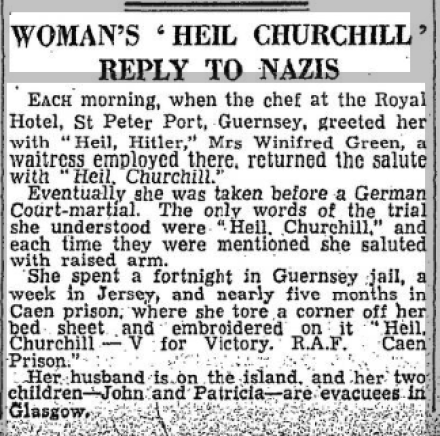
Probably one of the best known people for carrying out individual acts of defiance against the Germans during the occupation of the Channel Islands is Winifred Green. If you consult almost any book about the occupation Winifred gets a mention.
She became quite well known in the UK Newspapers in May 1945 when her story was widely reported. Some extracts below from a couple of newspapers.
Manchester Evening News 15 May 1945
The Scotsman 16 May 1945
Below is a photo of the display at the German Occupation Museum in Guernsey.
Display at German Occupation Museum
You can read more about Winifred at the Frank Falla archive here
I hope that you have enjoyed reading the blog post.
I also co-host a podcast with Keith Pengelley in which we talk about the occupation of the Channel Islands month by month using first hand accounts, diaries and our research in the archives. You can find us on all the major podcast services. Just search “Islands at War” or visit our podcast page here.
You can also follow the blog on Twitter at @Fortress_Island where I share other information and photographs. If you prefer Facebook I also have a page there.
If you would like to receive email notifications of future blogs, you can sign up to the right of this blog post or here. Feel free to look around the website, where I have categorised posts to make them easier to find and other resources such as tours, places to visit and films that may be of interest.
You can also find articles, podcasts, TV appearances and other social media etc here.
I will be adding more as time permits. Thank you for taking the time to read this, and I hope you enjoyed it. Please share it on social media or add a comment if you did. Feedback is always appreciated.
Also happy to be contacted with questions about the war in the Channel Islands, media appearances, podcasts etc.
Paul Woodage of WW2TV is running a ‘Channel Islands Week’ starting this Monday (26 September). Links are below to the various shows as they stand at the moment. Promising to be a cracking week of excellent content.
Really pleased to have been invited to talk about ‘Commando Raids on the Channel Islands’ on Wednesday. I will be dealing with all the raids except Operation Basalt as Paul has the wonderful Eric Lee doing that on the anniversary on 3rd October 2022 live from Sark. I am also planning on being in Sark that day for the re-enactment on the anniversary.
Don’t worry plenty of other raids for me to talk about! Come along and ask questions.
Ever so slightly in awe that I am in such esteemed company as Duncan Barrett , Eric Lee , Phil Marett talking about various aspects of the occupation.
If you haven’t seen WW2TV it is a free to view history resource with lots of fantastic content covering all aspects of the Second World War. Either click the links below or go give the channel a follow on the various social media below. If you enjoy what you watch Woody would appreciate a sign up on Patreon.
Monday 26 September 2022 – live at 7:00pm (BST) – or catch up anytime after that.
Tuesday 27th September 2022 – live at 7:00pm (BST) or catch up anytime after that.
Wednesday 28th September live 7:00pm (BST) – or catch up anytime after that.
Monday 3rd October 2022 – live at 7:00pm (BST) – or catch up anytime after that.
If you would like to receive email notifications of future blogs, you can sign up to the right of this blog post. Feel free to look around the website, where I have categorised posts to make them easier to find and other resources such as tours, places to visit and films that may be of interest.
You can also follow on Twitter at @Fortress_Island where I share other information and photographs.
I will be adding more as time permits. Thank you for taking the time to read this, and I hope you enjoyed it. Please share it on social media or add a comment if you did. Feedback is always appreciated.
Also happy to be contacted with questions about the war in the Channel Islands.
I will be writing a couple of blogs around life in Sark during the Second World War but I thought this account of life in Sark may be of interest.
It features in the December 1944 Channel Islands Monthly Review and is possibly the first news from Sark other than the Commando raids and a brief letter that found its way to England in 1941 (see below).
Written by Miss Jehanne Beaumont, Daughter of La Dame de Serk. It covers the period up to Jehanne’s deportation in 1943. The photo at the top of the blog is Jehanne Beaumont from an article in the Tatler in 1929.
Belfast News-Letter – Wednesday 21 May 1941
I hope that you have enjoyed reading the blog post.
I also co-host a podcast with Keith Pengelley in which we talk about the occupation of the Channel Islands month by month using first hand accounts, diaries and our research in the archives. You can find us on all the major podcast services. Just search “Islands at War” or visit our podcast page here.
You can also follow the blog on Twitter at @Fortress_Island where I share other information and photographs. If you prefer Facebook I also have a page there.
If you would like to receive email notifications of future blogs, you can sign up to the right of this blog post or here. Feel free to look around the website, where I have categorised posts to make them easier to find and other resources such as tours, places to visit and films that may be of interest.
You can also find articles, podcasts, TV appearances and other social media etc here.
I will be adding more as time permits. Thank you for taking the time to read this, and I hope you enjoyed it. Please share it on social media or add a comment if you did. Feedback is always appreciated.
Also happy to be contacted with questions about the war in the Channel Islands, media appearances, podcasts etc.
Despite Churchill being reputed to have said ‘Let there be no more silly fiascos like those perpetrated at Guernsey’ after the Ambassador operation it was only a matter of a few weeks before another raid was under way.
Following Nicolle’s earlier mission and the subsequent disastrous Operation Ambassador it was decided to send him again. This time it was planned that he and fellow Guernseyman and school friend James Symes would stay for three days and gather intelligence. They had known each other since they both attended Elizabeth College and played in the football team together.
James Symes – Photograph of a photograph on display at the German Occupation MuseumPhotograph of Hubert Nicolle on display at the German Occupation Museum which I took a photograph of recently.
Much has been written about this operation mostly from the perspective of Hubert Nicolle, however, I recently came across an interview in the IWM archives with James Symes where he recounts his memories. I thought that it would be interesting to use this and some other resources to recount his side of the operation. I will also pick out some of the key aspects of the operation.
We pick up the story where Symes recalls how he came to be involved.
I think if I remember rightly, anyway, Hubert Nicolle had already been to and come out from Guernsey. He was summoned to the Admiralty again, because he went in by submarine and came out by submarine and he was asked if he would go again.
He said he would go on condition that I went with him. I used to play inside left in the football team and he played inside right between us we had enough. There was something between us like that on the football pitch, which made us friends for life really.
So this was what all that was about and I said yes I would go. So I went up to London, Nicolle at that time was in Parkhurst, in this other holding unit.
Both men knew that they were taking a massive risk as they were landing wearing civilian clothing. They also had family in the island so they were putting them at risk as well. More of that later.
They were landed at 3am on the 4th September 1940 at Petit Port from an MTB.
I went to see him and he had a lot of photographs of German planes which we had to look at and memorise and then we set off London, where we were both asked if we would go and said yes. Did we realise that If we were caught, nobody could help us? Like idiots we both said yes, we were only 20 at the time, both of us and we went.
We went over by MTB, Motor Torpedo Boat. I took five and fourpence ha’penny and a flask of brandy. I was dressed in civvies, I was dressed in a Guernsey so was he and that was all we had because we were going to be there for three days and then they would come and pick us up. We could do what we’d like to on the island as long as we got information on the civilian aspects of the island. Not the German military side so much but they wanted to know in London how people were being treated those were our tasks.
Symes recalls that it was either MTB 69 or MTB 70 that dropped them ashore in Guernsey. Photographs of these two vessels are below. Sadly he never solved the mystery of which of these vessels it was as their records were lost.
It was decided to use an MTB because of the issues that had previously been encountered using a submarine on the first visit and the difficulties encountered using other types of launch during Operation Ambassador.
Surprisingly they were landed at one of the beaches, Petit Port, that was used during Operation Ambassador in July 1940. Although they were cautioned not to use the same route up the steps and instead used a path that they were familiar with. Given that there are approximately 350 steps this was no mean feat! Instead of the steps they used a steep track to the left of the beach if you stand facing the cliffs.
After a few days they successfully gathered the information required by London and were ready to return.
At the end of the period, we went back to where we had landed earlier. We did take one thing we took a torch quite a large torch, which had been had a metal funnel put on it so when it shone out to sea the beam was restricted by this funnel. All we had to do was once every half hour we had to signal the letter, dot dash dot, dot, dot dash dot, dot and a long one and a little shorter one went straight out to sea.
We were on a bay where they would pick us up at approximately 3am They never came. So we went back to our respective homes and the following night we went back to this beach they never came so we went along the third night was a hell of a storm.
Anyway we instead of concentrating on one beam down the middle every hour or whatever the timing was we’ve decided to do one left one centre one right like that in case the ship, the torpedo boat was out there somewhere and one couldn’t see the beam or a direct line. It never came so we both went back to our respective homes.
They had been told that if nobody came they were to wait until the next period with no moon and somebody would come and look for them. This did happen but didn’t go to plan.
A chap came and he got caught. Fortunately for him, he was in uniform and he couldn’t be treated like we could have been if we’d been caught because we were in civilian clothes. He, John Parker, Captain John Parker, he told the Germans he was on a recce. I don’t know whether they believed it or not, anyway, he became a prisoner of war. So we have to sit at home and wait for the next new moon.
Apologies for the quality but this is a photograph of photograph on display at the German Occupation Museum
Parker was later repatriated in 1944 as detailed below.
Guernsey Evening Press 28 April 1944
Now at various times during the time from the landing up until their surrender they stayed with family or friends and even hid in the cricket pavilion at their former school. The problem they had was that they could not move about easily as the Germans were convinced that there were British troops on the island. They could only move around under cover of darkness and after the curfew.
Between the time of the September new moon and the late September and October the Germans issued an order that anybody, after Parker, issued an order in Guernsey that if there were any British soldiers in hiding in the island, they’d already done this once before when they first got there, and they got a few who were on leave. If these people gave themselves up they would be treated as prisoners of war and those who helped them would not be punished.
Below is the notice issued by the Germans. As you will see later on the offer of no punishment was an empty promise as Nicolle and Symes were initially treated as spies.
Notice issued by the German Authorities October 1940
In the interview Symes recalls how Ambrose Sherwill, later Sir Ambrose Sherwill and Baliff of the island post war assisted them greatly. At the time Sherwill was President of the Controlling Committee for the island. Effectively the most senior person in the government during the war. He negotiated with the German Commandant, Major Fritz Bandelow, for any members of the British armed forces still in the island who gave themselves up to be treated as POWs.
A clever man he saved our lives he persuaded the Germans he put up a draft for the letter that sort of go out into the press the notice he knowing full well that we were there. He got the thing worded in such a way that we could go and give ourselves up as if we were as if we’ve stayed behind when the Germans arrived as if we were on leave when the Germans arrived.
Under the terms of that letter, which became a German proclamation, we eventually gave ourselves up with five minutes to go to the time when we should have done it. On October the 21st Trafalgar day 1940 we ourselves up to the local police, who then told the Germans and we were then spies captured spies. Terrible now thinking of it, anyway we were court martialled by the Germans. We were sentenced to death.
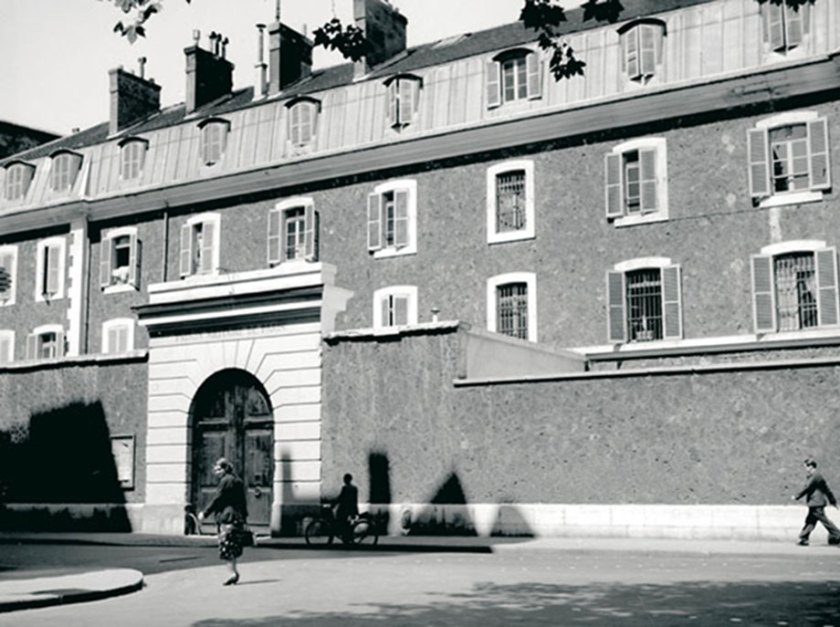
We were then relieved because of this letter. We were taken to France we went to the prison Cherche-Midi in Paris, Dreyfus was one time so we were in good company.
We spent two and a half months in solitary confinement there and then just before Christmas my father died in the prison. My mother was in the prison, a lot of our friends were in this prison. Terrible place. It no longer exists. We were told on the 21st of December or there about that the Germans had decided we should be treated as prisoners of war.
You can read about the prison on the Frank Falla Archive website here including the experiences of those that assisted Symes and Nicolle.
If you click on the links in the quote below you can access the individual stories.
Uniforms were found for Symes and Nicolle and they handed themselves in. However, the Germans reneged on the agreement and the friends and family of the two men were picked up and put in prison. When Sherwill went to complain, he realised that he, too, was a suspect. With days, all involved were deported to France.
Those deported were Ambrose Sherwill; Jimmy Symes’ parents Louis Symes and Rachel Symes; Albert Marriette and Linda Marriette and their daughter Jessie Marriette (Hubert Nicolle’s girlfriend); Wilfred Bird and his adult children Mary Bird (Jimmy’s Symes’ girlfriend) and Walter ‘Dick’ Bird; Emile Nicolle and Elsie Nicolle (the parents of Hubert Nicolle); Hilda Nicolle and Frank Nicolle (Hubert Nicolle’s aunt and uncle); Henry E. Marquand (a family friend); Bill Allen (the groundsman at the Elizabeth College sports field, who helped shelter the commandos when they were hiding in the pavilion), and farmer Tom Mansell (who was covering for his married brother, Dick Mansell, at whose farm Hubert Nicolle arrived as part of his gathering of intelligence as the Mansell’s farm bordered the airport). 16 people in total were deported.
The uniforms were obtained by the Deputy Harbour Master from stocks left behind by the Germans.
It transpired that the reason that they were treated as spies was that It was later established that Bandelow, who had been on leave at the time of their surrender, moved heaven and earth in his endeavour to keep his word. He called for a Court of Honour and General Feldmarschall Von Reichenau was consulted. He declared, “When one gives one’s word, one gives one’s word.” Sherwill later said that he regarded Bandelow’s action in time of war as in the very highest traditions of chivalry.
Below is the notice that was published in the Guernsey Evening Press of 24th December 1940 announcing the change in the decision and the exemption from punishment. Sadly this was too late for Louis Symes, James’s father, as he had died a few days before.
From the 24 December 1940 Guernsey Press
As you will see from the above the it ultimately cost Sherwill his position although this was reversed during the winter of 1942/43 when he was to return as Attorney General.
Both Symes and Nicolle remained prisoners of war until their camp was liberated. Both men were awarded the Military Cross for their trip to Guernsey for “displayed the highest qualities of fortitude and bravery throughout”.
Symes went on to win a second MC in Malaya in 1955 for anti terrorist work. He finally retired from the army in 1971. You can read his obituary here
Hubert Nicolle returned to Guernsey and was very active in the community as well as being an insurance salesman. I was privileged to have known Hubert or Mr Nicolle as we called him. He was a past pupil of the school that I attended, Elizabeth College, and was actively involved in college activities when I was a pupil in the 1980s. Little did I know that the gentleman that often started swimming races with a starting pistol was used to more deadly weapons!
A plaque was erected at the College Field Pavilion commemorating the actions of Nicolle and Symes.
Plaque in the Cricket Pavilion at the College Field where they hid
I have only been able to touch on a fraction of the story here so if you would like to read more about the operation I recommend you track down a copy of William Bell’s “The Commando Who Came Home To Spy” which is out of print but you can pick up for a few pounds second hand on Amazon, eBay or from a second hand book shop.
If you want to hear more about this and the repercussions listen to the Islands at War Podcast where Keith and I talk about events as they develop.
If you would like to listen to the whole interview with James Symes you can find it here .
Keith and I also talked about the September, October, November and December episodes of our “Islands at War” podcast. You can find these episodes on the links below.
I hope that you have enjoyed reading the blog post.
I also co-host a podcast with Keith Pengelley in which we talk about the occupation of the Channel Islands month by month using first hand accounts, diaries and our research in the archives. You can find us on all the major podcast services. Just search “Islands at War” or visit our podcast page here.
You can also follow the blog on Twitter at @Fortress_Island where I share other information and photographs. If you prefer Facebook I also have a page there.
If you would like to receive email notifications of future blogs, you can sign up to the right of this blog post or here. Feel free to look around the website, where I have categorised posts to make them easier to find and other resources such as tours, places to visit and films that may be of interest.
You can also find articles, podcasts, TV appearances and other social media etc here.
I will be adding more as time permits. Thank you for taking the time to read this, and I hope you enjoyed it. Please share it on social media or add a comment if you did. Feedback is always appreciated.
Also happy to be contacted with questions about the war in the Channel Islands, media appearances, podcasts etc.
A while ago I wrote about Operation Blazing which was a planned operation for a large scale attack on Alderney in 1942. You can read it here .
A forerunner to Blazing was Operation Attaboy in 1941. Despite Attaboy ultimately being cancelled they still went on to plan Blazing and Constellation at later stages in the war. This was partly due to Lord Mountbatten and the fact that he had the ear of Churchill and an apparent obsession with retaking one or all of the islands at various stages of the war. Some of the reasons are in earlier blog posts and some are for future blog posts.
Given this first assessment for Attaboy concluded that “The strategic value of the Channel Islands either to ourselves or the enemy is negligible.” it is somewhat surprising that they persisted.
If Attaboy had gone ahead it would have been Alderney that was the most likely target.
The paper below sets out the original proposal.
The National Archives’ reference CAB-79-9-43_8.jpgThe National Archives’ reference CAB-79-9-43_8.jpgThe National Archives’ reference CAB-79-9-43_8.jpgThe National Archives’ reference CAB-79-9-43_8.jpg
The minutes and papers below show the consideration of this proposal and subsequent meetings.
The National Archives’ reference CAB-79-9-37_The National Archives’ reference CAB-79-9-37_02.jpgThe National Archives’ reference CAB-79-9-43_1.jpgThe National Archives’ reference CAB-79-9-43_5.jpgThe National Archives’ reference CAB-79-9-43_6.jpgThe National Archives’ reference CAB-79-9-44_1.jpgThe National Archives’ reference CAB-79-9-44_3.jpgThe National Archives’ reference CAB-79-9-48_1.jpgThe National Archives’ reference CAB-79-9-48_1.jpgThe National Archives’ reference CAB 80/57The National Archives’ reference CAB 80/57The National Archives’ reference CAB 80/57The National Archives’ reference CAB-79-9-55_1.jpgThe National Archives’ reference CAB-79-9-55_1.jpgThe National Archives’ reference CAB 80/57The National Archives’ reference CAB 80/57The National Archives’ reference CAB-79-9-54_1.jpgThe National Archives’ reference CAB-79-9-54_4.jpg
As you can see from the minute above they decided not to proceed and instead to proceed with Operation Barbaric.
‘Barbaric’ was a British unrealised intelligence-gathering operation involving the landing of special forces parties of No. 12 Commando, totalling some 220 men, along the north coast of France between Dunkirk and Calais, and between Boulogne and the Somme Bay for the purposes of capturing German troops for interrogation (20/21 March 1941).
The operation was cancelled just before its commitment.
If you want to read about other raids that happened or were planned take a look at my other posts that are listed here.
Worth a watch if you want to get a feel for the fortifications on Alderney.
I hope that you have enjoyed reading the blog post.
I also co-host a podcast with Keith Pengelley in which we talk about the occupation of the Channel Islands month by month using first hand accounts, diaries and our research in the archives. You can find us on all the major podcast services. Just search “Islands at War” or visit our podcast page here.
You can also follow the blog on Twitter at @Fortress_Island where I share other information and photographs. If you prefer Facebook I also have a page there.
If you would like to receive email notifications of future blogs, you can sign up to the right of this blog post or here. Feel free to look around the website, where I have categorised posts to make them easier to find and other resources such as tours, places to visit and films that may be of interest.
You can also find articles, podcasts, TV appearances and other social media etc here.
I will be adding more as time permits. Thank you for taking the time to read this, and I hope you enjoyed it. Please share it on social media or add a comment if you did. Feedback is always appreciated.
Also happy to be contacted with questions about the war in the Channel Islands, media appearances, podcasts etc.
Following on from my recent post about Elizabeth College in exile the Guernsey Weekly Press of 20 June 1945 also featured an article about Ladies’ College in exile. The paper is quite fragile and difficult to scan so apologies for it being somewhat askew in some of the images below.
I hope that you have enjoyed reading the blog post.
I also co-host a podcast with Keith Pengelley in which we talk about the occupation of the Channel Islands month by month using first hand accounts, diaries and our research in the archives. You can find us on all the major podcast services. Just search “Islands at War” or visit our podcast page here.
You can also follow the blog on Twitter at @Fortress_Island where I share other information and photographs. If you prefer Facebook I also have a page there.
If you would like to receive email notifications of future blogs, you can sign up to the right of this blog post or here. Feel free to look around the website, where I have categorised posts to make them easier to find and other resources such as tours, places to visit and films that may be of interest.
You can also find articles, podcasts, TV appearances and other social media etc here.
I will be adding more as time permits. Thank you for taking the time to read this, and I hope you enjoyed it. Please share it on social media or add a comment if you did. Feedback is always appreciated.
Also happy to be contacted with questions about the war in the Channel Islands, media appearances, podcasts etc.
Whilst going through the numerous copies of the Guernsey Press from the Occupation years I found this in the Guernsey Weekly Press of 20 June 1945.
It is an article about my old school Elizabeth College during the years that the pupils and staff spent in exile in England. Link to a longer account of their time at the end of this post.
I was given a box of Channel Islands Monthly Reviews and in the May 1943 edition spotted this letter:
If you want to read a more detailed account of the evacuation and exile of Elizabeth there is a more detailed account written by Vernon Collenette who was a pupil at the time and teacher at Elizabeth College. Mr Collenette was a teacher at the time that I was at Elizabeth College in the 1980s.
You can read his account here as Elizabeth College have digitised it.
I hope that you have enjoyed reading the blog post.
I also co-host a podcast with Keith Pengelley in which we talk about the occupation of the Channel Islands month by month using first hand accounts, diaries and our research in the archives. You can find us on all the major podcast services. Just search “Islands at War” or visit our podcast page here.
You can also follow the blog on Twitter at @Fortress_Island where I share other information and photographs. If you prefer Facebook I also have a page there.
If you would like to receive email notifications of future blogs, you can sign up to the right of this blog post or here. Feel free to look around the website, where I have categorised posts to make them easier to find and other resources such as tours, places to visit and films that may be of interest.
You can also find articles, podcasts, TV appearances and other social media etc here.
I will be adding more as time permits. Thank you for taking the time to read this, and I hope you enjoyed it. Please share it on social media or add a comment if you did. Feedback is always appreciated.
Also happy to be contacted with questions about the war in the Channel Islands, media appearances, podcasts etc.
Sgt. Stanley Ferbrache – You can see this and more information at the German Occupation Museum
This one is just a short blog to tie up the end of the Operation Ambassador story.
If you read my earlier blog about Operation Anger and Operation Ambassador you might be wondering why there was an attempt to rescue them on the 3rd of August when they became POWs on 28 July 1940. The earlier blog is here.
The answer to that question is that there was no way of getting a message out of the Guernsey other than if someone escaped or by the covert landings. Rumours abound on some forums that someone had a radio transmitter but this is simply untrue. All of the military equipment had been destroyed or removed prior to the arrival of the Germans.
Another Guernseyman Stanley Ferbrache volunteered to attempt to meet up with Mulholland and Martel and get them off of the island.
As with the previous raids he was landed at La Jaonnet Bay, this time having learnt of the issues with using other boats they used an MTB, on the 3rd of August.
Having met some of his family members he discovered that Mulholland and Martel had been left with no choice but to surrender the previous week. In order to avoid the mission being a waste of time he spent the next few days gathering intelligence on the German forces in the island.
He succeeded on leaving the island on 6th August. He was awarded the Distinguished Conduct Medal for this mission.
Churchill is reputed to have said ‘Let there be no more silly fiascos like those perpetrated at Guernsey.’ As it turned out there were plenty more missions to the Channel Islands to come and they were much better organised. More of those to come in future blogs.
I hope that you have enjoyed reading the blog post.
I also co-host a podcast with Keith Pengelley in which we talk about the occupation of the Channel Islands month by month using first hand accounts, diaries and our research in the archives. You can find us on all the major podcast services. Just search “Islands at War” or visit our podcast page here.
You can also follow the blog on Twitter at @Fortress_Island where I share other information and photographs. If you prefer Facebook I also have a page there.
If you would like to receive email notifications of future blogs, you can sign up to the right of this blog post or here. Feel free to look around the website, where I have categorised posts to make them easier to find and other resources such as tours, places to visit and films that may be of interest.
You can also find articles, podcasts, TV appearances and other social media etc here.
I will be adding more as time permits. Thank you for taking the time to read this, and I hope you enjoyed it. Please share it on social media or add a comment if you did. Feedback is always appreciated.
Also happy to be contacted with questions about the war in the Channel Islands, media appearances, podcasts etc.