28 June is the anniversary of the bombing of the Channel Islands by the Germans. I thought I would take a slightly different approach to the usual articles on the subject and look at it from the point of view of the reporting in the Newspapers across the UK.
Whilst some aspects of these reports are the same the regional newspapers record the views of those that were there but left the island before the occupation forces arrived or escaped shortly after. As they turned up in different parts of the UK you get some different views based on this.
As a brief overview Frank Falla wrote of the event:
Six enemy aircraft came, it seemed, from nowhere… three swooped down over the harbour dropping incendiaries and high explosive bombs, and machine-gunning ruthlessly along the line of waiting lorries…
The air-raid warning sirens were not set going until at least ten minutes after the first bomb had been dropped, and even then it was not the ARP officials who set them in motion but three cool-headed telephone operators… as a result of this raid on defenceless Guernsey, thirty-four people died on the spot or in hospital soon afterwards, and another thirty-three were injured.
Frank Falla – Silent War
Don’t worry if you aren’t familiar with events as you can find links at the bottom of this page which take you to the usual sources that explain the raid. If you want to skip to these first before reading the rest of the blog click here.
The newspaper articles focus on the attack on the area around St Peter Port Harbour but there were other areas of Guernsey that were attacked. This is an example of a bomb which was dropped on the Capelles area.
The Aberdeen Press and Journal of 8 July 1940 tells the story from the perspective of a bandmaster who was there and had subsequently arrived in Aberdeen.
The Evening Sentinel of 29 June 1940 reported on the Murderous German Raids including the death of a Guernsey Lifeboatman. You can read more about this here Death of a Guernsey Lifeboat Man.
In Warwickshire the Evening dispatch reported on 29 June 1940 about Channel Islanders abandoning their homes.
Strangely the number of casualties had become vastly inflated above the actual number when this article appeared in the Nottingham Evening Post – Thursday 12 December 1940.
I hope that you have enjoyed reading the blog post.
I also co-host a podcast with Keith Pengelley in which we talk about the occupation of the Channel Islands month by month using first hand accounts, diaries and our research in the archives. You can find us on all the major podcast services. Just search “Islands at War” or visit our podcast page here.
You can also follow the blog on Twitter at @Fortress_Island where I share other information and photographs. If you prefer Facebook I also have a page there.
If you would like to receive email notifications of future blogs, you can sign up to the right of this blog post or here. Feel free to look around the website, where I have categorised posts to make them easier to find and other resources such as tours, places to visit and films that may be of interest.
You can also find articles, podcasts, TV appearances and other social media etc here.
I will be adding more as time permits. Thank you for taking the time to read this, and I hope you enjoyed it. Please share it on social media or add a comment if you did. Feedback is always appreciated.
Also happy to be contacted with questions about the war in the Channel Islands, media appearances, podcasts etc.
John Nettles, those of a certain age will know him as Bergerac or if you are slightly younger as DCI Tom Barnaby in ITV’s Midsomer Murders, is also a man with a passion for the history of the Channel Islands during the Second World War.
His latest endeavour, no he wasn’t in that TV detective show, was to finally get the Occupation Diaries of the Reverend Douglas Ord published. The diaries were held at the Priaulx Library in Guernsey and often referred to by historians in their publications but were not available to the public unless they were aware of them and also able to visit the library.
The diaries are a great primary source of information about life during the Occupation of Guernsey. Written at the time so not subject to the passage of time on memories. It is also an excellent read, rather than just a reference book, it tells of the challenges of daily life.
This short film explains a little more and will only take a five minutes of your time to watch. It comes with the caveat that you may end up buying a book!
If you want to find out more about the Reverend Ord or might be interested in purchasing the book take a look at The Ord Diaries
This blog is about the impact that the D-Day landings on the morale of islanders in Guernsey, the hopes and fears surrounding the news, and the impact on them and the German garrison over the following weeks.
Islanders suffered a poor night’s sleep on the evening of 5th and 6th of June 1944 as streams of Allied aircraft flew overhead the Islands from 11pm.
Some feared it was German aircraft that were forming up to attack the English south coast as they had done on many occasions. Others awakened by the aircraft thought “This is it, the invasion of France has started!”
The Rev. Douglas Ord recorded in his diary that sleep was impossible even if one had wanted to sleep. He was standing in his balcony watching the streams of aircraft flying overhead which finally slowed in intensity at 3pm on the 6th.
In addition to the noise of the aircraft there was the sound of the bombing and shelling of the Cherbourg peninsula and the German’s returning fire.
As the Germans had been on a heightened state of alert for some weeks it is somewhat surprising that they didn’t seem to react until approximately 2am when Ord records that they started firing the anti aircraft guns, of which there were many on the islands. Allied aircraft also attacked positions on the islands.
The only civilian casualty in Guernsey on D-Day was a Mr Malbon of the Vale who was killed at 7:30am when an anti aircraft shell fell on his house.
By the morning of 6 June news had begun to circulate that the Allies had landed in Normandy. This news was obtained by islanders from illicit crystal radio sets but also from German troops who were, unlike their commanders, on the whole keen for the whole thing to be over so that they could return home.
In the first few days after D-Day islanders moods were lifted and islanders would great each other with a smile and a thumbs up. Various rumours abounded including that the German High Command had fled that morning. In fact they had left on 4 June to attend a conference in Renne and had been taken by surprise by the invasion. They had to rush back to Guernsey.
Many thought that it would be only a couple of weeks before the islands were liberated. This hope was tempered by the fear that the German commanders were determined to fight on and any attempt to liberate the islands would result in massive loss of civilian lives.
Even in England there were many who thought that the war would end soon. The psychic “Jagana” was at the more extreme of speculation as can be seen below.
The psychic “Jagana” in the New Milton Advertiser – 10 June 1944
In the House of Lords long time champion of the Channel Islands Lord Portsea, who was a Jersey man, called for a force of Channel Islands troops to liberate the islands.
Western Morning News, 21 June 1944
This of course was a completely impractical suggestion given that the Channel Islanders serving in the forces were spread far and wide across the world. If you take my own grandfathers as an example one was serving in Ceylon (now Sri Lanka) and my other was more close at hand as a gunnery petty officer on HMS Ramillies supporting the D-Day landings.
Now Lord Portsea wasn’t the only one that advocated retaking the Channel Islands at various points during the war both Mountbatten and Vice-Admiral John Hughes-Hallett also advocated operations to retake them. One such example is covered in my blog post about Operation Blazing that can be found here.
Fortunately the implications of trying to retake the islands had not been overlooked by the Allied commanders and in addition to this they were of little strategic value so they decided to pass them by. Attempts were made to secure a surrender but these came to nothing until 9 May 1945. You can read about these attempts in an earlier blog post of mine about the liberation.
As a result of the landings the German forces were placed on the highest state of alert. Islanders were confined to their houses from 9pm until 6am as the curfew was brought forward from 11pm. All places of entertainment were closed as were schools because of the danger of air raids.
Rules were introduced forbidding islanders from going about their business but few seemed to obey them. Ord notes in his diary that he went into town and there was hardly anyone around and little business to be going about in any case as the difficulties in obtaining supplies meant many shops were closed.
The German police were fining those that hung around in groups which is just another example of how petty they could be at times. Other than the police the Germans were notable by their absence from the streets as they were either required to man the defences or remain in their billets.
There was also the fear that the remaining civilian population would be taken from the islands to Germany in order to allow the Germans to hold out longer. There had of course been deportations earlier in the occupation to internment camps in Germany such as Biberach internment camp Ilag V-B for allied civilians.
The fear was exasperated when islanders witnessed forced workers being marched through the streets to boats to be taken away to the mainland Europe. Indeed the removal of the population was suggested numerous times to Hitler but his procrastination over making a decision effectively took it out of his hands as the Allies seized all of the French ports that could have been used.
One of the strange bits of propaganda that the Germans broadcast on the radio for consumption in Germany was that there had been a landing in Guernsey and Jersey by Allied parachutists. They reported that there had been great loss of life of both the parachutists and the local civilian population as well as severe damage. Now the German garrison heard this broadcast and of course knew it wasn’t true. This made many of them question what to believe and was certainly an own goal from that perspective.
It was even reported in the UK Newspapers on 6 June 1944.
Belfast Telegraph 6 June 1944
During the weeks preceding D-Day there had been an increased level of air attacks on German positions in the Channel Islands. In particular the area around the harbour and Fort George. The main aim being to destroy the radar installation at the Fort as it was feared that this would detect the invasion fleet heading for France in D-Day.
These attacks increased in intensity post D-Day which led to islanders to leave their front doors unlocked to enable passersby to shelter in the event of an air raid. It is worth mentioning that these weren’t large scale air raids but more targeted attacks on specific targets. They usually consisted of fewer than ten aircraft aircraft and quite often just two or three aircraft.
They were of course seeking to cause maximum damage on German forces with minimal civilian casualties. The raids were often timed for when the minimal number of civilians would be in the harbour area. One such raid to attack shipping that had taken shelter including a U-Boat was carried out before the shops and offices opened. Which was just as well as they dropped a 1,000lb bomb in the harbour which blew all the windows out of the shops in the high street as well as some of the stained glass windows of the Town Church.
This raid was carried out by Typhoons protected by Spitfires. Whilst on local suffered slight shrapnel wounds but twenty eight Germans were killed or badly wounded.
This was likely to be U-275 which was attacked no less than five times in St Peter Port Harbour. On the 14th of June it was attacked leaving the harbour by Typhoons. It escaped but two support vessels were severely damaged. I found an account of this attack from an NCO Pilot Tom Handley who was a Typhoon pilot. It is only a brief mention on reel 7 of the tapes here on the IWM if you want to listen to it. He recalls them attacking the submarine with rockets when he was hit by flak and had to head for home.
Now whilst there was minimal airborne opposition to these raids they did run the risk of considerable anti aircraft fire. This can be seen in a selection of photographs below.
German anti aircraft defences around the harbour images courtesy of Das Bundesarchiv
The area around Havelet Bay in St Peter Port had been largely abandoned by the civilian population as the risk of being injured was too high. Rather unfortunately for a Mr Jehan who owned a house on the Strand overlooking the bay it was hit by a stray bomb and completely demolished. Fortunately it was unoccupied as it had been badly damaged in 1940 when the Germans bombed the harbour. In the book ‘The Battle of Newlands: the Wartime Diaries of Winifred Harvey’ Mr Jehan is recorded as having agreed it had rather solved a problem for him as to what to do about the property.
As a result of these air raids the Germans started to move away from the harbour area and the fort and seek billets in civilian house. The occupiers being turfed out to find alternative accommodation.
As the weeks went on islanders found that the other implications of the Normandy landings began to become apparent. The islands had effectively become cut off and supplies were not able to get through. The Royal Navy was active in the area as were Allied aircraft. This led to an announcement on the BBC that the area from a line drawn east of Cherbourg to Guernsey and a line across from St Malo in the south was a free bombing area and that fishermen should avoid putting to sea in this area.
This presented a problem for Channel Islands fishermen as once they were allowed to return to sea they could not refuse to do so as this would have alerted the Germans to the fact they had been listening to the BBC on an illicit radio.
Map from the Illustrated London News February 1945
This announcement didn’t deter islanders from attempting to escape the islands using small boats. Now this wasn’t an easy task as any fishing trips were guarded by the Germans but this didn’t stop attempts at night or in bad weather such as fog. The Allies now being much closer on the French coast led to an increase in these attempts as any journey would be no more than thirty miles rather than a minimum of eighty miles across the Channel to England.
The initial hope given by the D-Day landings soon changed to a realisation that it wasn’t going too end soon. This lead to severe hardship for the islanders for the next eleven months but that is a topic for another blog post. If you want an initial insight into the problems encountered in the winter of 1944/45 I discuss it in my blog about a German soldiers experience which you can find here.
Report from the March 1945 Channel Islands Monthly Review of a speech about why the Islands had not been liberated after D-Day.
I hope that you have enjoyed reading the blog post.
I also co-host a podcast with Keith Pengelley in which we talk about the occupation of the Channel Islands month by month using first hand accounts, diaries and our research in the archives. You can find us on all the major podcast services. Just search “Islands at War” or visit our podcast page here.
You can also follow the blog on Twitter at @Fortress_Island where I share other information and photographs. If you prefer Facebook I also have a page there.
If you would like to receive email notifications of future blogs, you can sign up to the right of this blog post or here. Feel free to look around the website, where I have categorised posts to make them easier to find and other resources such as tours, places to visit and films that may be of interest.
You can also find articles, podcasts, TV appearances and other social media etc here.
I will be adding more as time permits. Thank you for taking the time to read this, and I hope you enjoyed it. Please share it on social media or add a comment if you did. Feedback is always appreciated.
Also happy to be contacted with questions about the war in the Channel Islands, media appearances, podcasts etc.
I was pleased to see that the locally produced film “Occupied” can now be watched online for free. This follows it finishing its run of screenings on the film festival circuit It is refreshing to see a film on the subject actually filmed locally and with Guernsey actors!
The short film made by White Rock Productions explores various aspects of the occupation of Guernsey starting with the bombing of the St Peter Port harbour and following the impact on some of the characters. It also uses Guernésiais, our local language, in a short segment. Don’t worry there are subtitles for that bit!
Those of you who are Guernsey based may even have seen some of it being filmed at various places around the Island.
It is well worth twenty one minutes of your time to watch it. The titles at the end are accompanied by Guernsey’s unofficial anthem “Sarnia Cherie”.
If you enjoy this film go give them a follow on Twitter or Facebook as they have other projects.
If you would like to receive email notifications of future blogs, you can sign up to the right of this blog post. Feel free to look around the website, where I have categorised posts to make them easier to find and other resources such as tours, films and other resources that may be of interest.
I thought this might be useful to share for those readers of the blog that are either on Island but for whatever reason unable to go out to watch events live or those overseas.
You can take part in the Church Service, watch the Cavalcade and even the Fireworks. Just follow the link for details. All times are British Summer Time.
The small-scale raids that took place around Alderney and the other Channel Islands are well recorded; however, this planned raid was something completely different. This would have been a full-scale invasion of the island with the intention of holding it for a week during 1942.
The attack would have involved a force of 6,000-7,000 personnel from all services—a vastly different proposition from anything planned before. An estimated 4,800 men to land on the island.
It raises many questions; why hold it for a week and then leave? Why do it at all? What would it achieve, especially in the first half of 1942? This blog post will look at all these questions and more.
Whilst researching something else, I listened to an interview on the IWM website with General Michael Stephen Hancock, part of which he talked about his role in this proposed raid and the training that was undertaken in early 1942.
Before I start with an explanation, there are a couple of things that would be useful to set the scene, particularly for those not familiar with Alderney or its location. This will help understand the reasons for the proposed raid and the challenges they may have faced if it had been executed. If you are already familiar with Alderney, then feel free to skip past this bit.
Alderney is the most northerly Channel Island and approximately ten miles from La Hague on the Cotentin Peninsula. You can see it on the map below with the red pin.
Map from Google Maps.
The island is shown on the map below, and it is 3 miles (5 km) long by 1.5 miles (2.4 km) wide. The size of the island is essential for understanding some of the challenges the proposed raid may face.
Map from Visit Alderney
I remembered that I had come across a few references to this planned raid some time ago when reading the diaries of General Sir Alan Brooke, later 1st Viscount Alan Brooke. The references to the planned raid did not provide much information but are of interest because it involved those at the highest level of the armed forces and the prime minister Winston Churchill.
Frankly, the diaries do not give you a lot to go on. It is also important to note that his diary entries are obviously from his perspective and need to be tempered by reviewing other documents from the time. I decided to search the National Archives and various other sources to see what I could find.
Brooke notes on 28 March 1942 that “Mountbatten was still hankering after a landing near Cherbourg where proper air support is not possible.”
It is fair to say that Brooke found Mountbatten quite irritating at times, not least because of his status and his relationship with Churchill. Brooke found it frustrating because he frequently stayed with Churchill at Ditchley Park and Chequers from late 1942. This gave him the opportunity to discuss his ideas and try to get Churchill onside.
Now Lord Mountbatten was known for his love of a hair-brained scheme, and this certainly would seem to be one. However, he was not alone in these ideas of actions in the Channel Islands. Vice-Admiral John Hughes-Hallett also advocated operations to retake the Channel Islands by force at various times during the war.
These were discounted for many reasons. Primarily because of the massive loss of life, this would have caused the civilian population let alone the inevitable casualties of any invading force. One must remember that an estimated 8% of all the concrete used on the Atlantic Wall was poured into the fortifications of the Channel Islands by the end of the war. The fortifications in the Islands contained more armaments than the 350 miles of the nearby Normandy coastline.
The other Channel Islands were also of less significance for the Allies from a strategic point of view aside from the other challenges mentioned above. The fortification and sinking of men and resources into the Islands are often referred to as “Hitler’s Island Madness.”
Alderney would have been a different prospect as only approximately seven civilians were left on the island. However, many forced workers on the island would have also become casualties. During the war, Alderney was heavily fortified and became one of the most heavily armed sections of the Atlantic Wall. Alderney was designated a Festung (Fortress).
Alderney had gun batteries that could prove troublesome to any attack on Cherbourg at a later stage in the war but not in the summer of 1942. Later in the war, in June 1944, the 150 mm guns in Battery Blücher on Alderney fired upon the American troops on the Cotentin Peninsula. Subsequently, the British warship HMS Rodney attacked the gun battery, which cost the lives of two German soldiers.
Article from the Northampton Mercury & Herald 18 August 1944
What purpose could risking so many lives to occupy the island for a week serve war effort? There appears to be some speculation that such a raid could have been used to appease Stalin that the Allies were serious about mounting operations to open a second front, but surely this would have been too small scale.
Another reason that they considered the raid to be of value was that the Germans were using Alderney as a control centre for U Boats in the area returning to or leaving the French ports.
In his book “The German Occupation of The Channel Islands” Cruickshank states that Mountbatten first raised the idea of a an operation to take Alderney at a meeting of his staff on 6 March 1942.
Brooke notes in his diary on 8 April 1942, “Very difficult COS attended by Paget, Sholto Douglas, and Mountbatten. Subject-attempt to assist Russia through action in France. Plan they had put up was a thoroughly bad one!!” This would indicate some substance to the assertion that the raid may have been partly for this purpose.
Mountbatten briefed the Chiefs of Staff Committee on 16 April 1942. His initial plan was to take and hold Alderney permanently. His reasons for doing so were:
A) The island would provide a base for small craft to be used to attack the German’s convoy route from the Channel ports down to Bay of Biscay.
B) It could be used to site a radar installation to extend Fighter Command’s radar coverage.
C) It could be used as an emergency landing strip.
D) To open a second front in a small way.
The plan changed many times during the course of April and early May. Not least changing from a plan to hold the island permanently to a plan to hold it for a week.
The interview with General Michael Hancock sheds more light on the plan and just how far preparations went.
“The object of the operation was only to hold the island for about a week, and the stated objects in the Chiefs of Staffs um appro… approval of it were, (I cannot remember in what order they were), but they included three things, and I don’t know that I can remember them all, but one of them, (which surprised me having had nothing to do with the political side of things) was in order to satisfy the clamour for a second front. Seems a little surprising, I suppose for a small-scale thing like this, but still, it was not all that small scale. We are talking about 7,000 men that sort of size.”
“A lot of men to put on such a small island. It is the island is what three miles by one something about that, but the Germans were holding it with four or five thousand.”
“Secondly, to put out of action, er, their control of their submarines, which they did from there with radio control etcetera and thirdly, to hold it long enough, so the Germans might think we intended springboards for the invasion of France and might withdraw something from the Russian front.”
“Wishful thinking, I suspect. We had allocated not only for this not only for this, but we had also been allocated a Parachute Battalion.”
“One of the snags was that the island is about a mile wide from the northwest side, north, east side and southwest side. The prevailing wind, of course, is across that, and in those days, you jumped out of an aircraft with 20 men, one after the other, and the mathematics of it are that if you do this and everything goes perfectly, you drop two or three men in the sea, either before you start or at the end of the run.“
“This was one of the difficulties at any rate, in the end, after I suppose three or four weeks of planning and rehearsal and so on. It was called off because it was recommended the RAF, who would have to give us a great deal of support beforehand, would lose several hundred aircraft, and they could not afford it at the time.”
So how far did they get with the plan?
“We got as far as having a particular beach and the Isle of Wight, which had the right characteristics tarted up a bit with certain little floating jetties, but to make it similar to where we would be landing in at Alderney. We did rehearsal landings on it.”
When asked why they expected such significant losses, he explained “It was heavily defended, very heavily defended. I don’t know, but that is what we were told.”
Brooke notes in his diary on 6 May 1942, “Arrived just in time to go to COS meeting to turn down proposed attack on Alderney Island [Channel Islands] as a large raid by Guards Brigade.”
So why did they turn it down, given the immense effort put into planning and training? These extracts from that meeting explain the discussion and the reasons. They even considered scaling back the operation to a single day.
A significant problem was the gap they would have between the bombing of the island and the landing. Given the small size of the island and the lack of accurate bombing in 1942, it was doubtful how effective it would have been in softening up the defences.
In 1942 it would only have been possible for fighters to provide cover for fifteen minutes at a time. The Luftwaffe would have been able to operate from airfields only twenty miles from Alderney where as the RAF would have had to operate from airfields more than seventy miles away. This partly explains the massive commitment of aircraft that would have been required.
Overall, they felt that the casualties would not be worth the dividend from such an operation. You can read the complete deliberations in the extracts of the War Cabinet Chiefs of Staff Committee minutes below.
Churchill was still keen for a raid, perhaps spurred on by Mountbatten. Brooke notes in his diary of 11 May 1942, “At 12 noon we had meeting with PM to discuss the giving up of the attack on Alderney, and raids planned as alternatives.”
The minute of this meeting is not very clearly scanned in the national archives, but you can get its gist. (Blue text added to clarify the feint wording)
Even at this stage, they didn’t discount resurrecting the operation later in the year. It did make an appearance later in they year as Operation “Aimwell” with the intention of a smaller force and only holding the island for twenty four hours. This was also cancelled.
Going back to the interview with Hancock, he talks about what happened next. “So as we were there and all geared up for such an operation, an alternative operation was planned as a raid on the French coast. Somewhere in the … between Boulogne and Dieppe, I forget where but in that sort of area, and so we then started planning for that instead. And they got us in, I suppose it must have been the end of May, early June, and we are about then getting into the ships ready to go, and we were all in our ships with these funny little radios off Spithead, and the weather was foul.”
“That is why I remember the ship was flat bottomed pitching and, and so all these six-seven thousand men but in the ship sitting there we sat down for three days. The weather showed no sign of abating. And they decided then that it was too long or risks to security over us being there for three days. Without anything happening were too great. So, the whole operation was called off. We were sent back to Scotland.”
Ultimately some of what they planned was used in the planning and execution of Operation “Jubilee”, the raid on Dieppe.
I wonder what the impact would have been on the civilian population of the Channel Islands if the raid had gone ahead, given the deportations following other raids later in the war.
If you find this of interest, I can highly recommend visiting Alderney, where you can visit some of the fortifications. You can find details at Visit Alderney.
Worth a watch if you want to get a feel for the fortifications on Alderney.
If you would like to receive email notifications of future blogs, you can sign up to the right of this blog post. Feel free to look around the website, where I have categorised posts to make them easier to find and other resources such as tours, films and other resources that may be of interest.
I will be adding more as time permits. Thank you for taking the time to read this, and I hope you enjoyed it. Please share it on social media or add a comment if you did. Feedback is always appreciated.
Thanks to my brother Matt Le Huray for his patience in proofreading these longer blog posts. Any typos in the shorter ones that I put out are nothing to do with him 😊
Whilst busy writing another blog post I stumbled across a great film by Nicola White. I have followed her for some time on Twitter @tidelineart and had no idea that Nicola had a connection to the Island.
Nicola has featured on a number of programmes on the BBC on both radio and film. This film made in February 2022 is well worth a watch and features many people I know. Click the video below to watch it. Also do take a look at her website for some great mud larking finds in London.
Following my blog post recommending the film “Nazi Britain – Life in the Channel Islands 1940-1945” I was delighted to receive an email from Martin Morgan who was one of the producers. Martin also happens to be a subscriber to this blog.
Martin was pleased that I had highlighted the film that he produced with his sister Jane Morgan and Chris Denton. This film was part of a trilogy of films that they made which were originally shown on the History Channel.
Over a million people have watched these films. This helped them to achieve their promise to the interviewees that they would share their stories as far and wide as possible.
They produced these films as a response to what they felt were the overly sensationalised and unfair versions of the story in other films. They set out to tell the story of everyday life in Occupied Guernsey.
If you follow my personal Twitter account (@Nickleh) or the Twitter account for this blog (@fortress_island) you will know that the misleading films they made these to counter are also a pet hate of mine!
The format they chose is in my opinion an excellent format. They took the decision to only use first hand testimony, designing the production so it required no script , voice over or third party explanation – just the voices of Islanders who lived through the war.
“Fleeing the Reich – the story of the Evacuees” tells the first hand accounts of people that were evacuated as school children to England in June 1940. It turned out they got away just in time. Many of them had never left the Islands before and were sent to live with strangers who picked them from the groups of children that arrived. Siblings sometimes found themselves in different parts of the country.
“Stolen by Hitler – the story of the Deportees” tells the story of those that were forcibly deported to internment camps in Germany for allied civilians, mainly from the Channel Islands. A fascinating story of their experiences.
They have also produced another great documentary in a more conventional format. I will share that in another blog post.
Thanks once again to Martin for getting in touch and sharing these fantastic films.
At the time of writing in April 2022 this of course resonates with current world events.
Whilst I am busy researching and writing a couple of articles which are not quite complete I thought it might be worth sharing this video that I found yesterday.
It is an interesting selection of interviews with Islanders that lived through the Occupation. Some of whom I had the privilege to know.
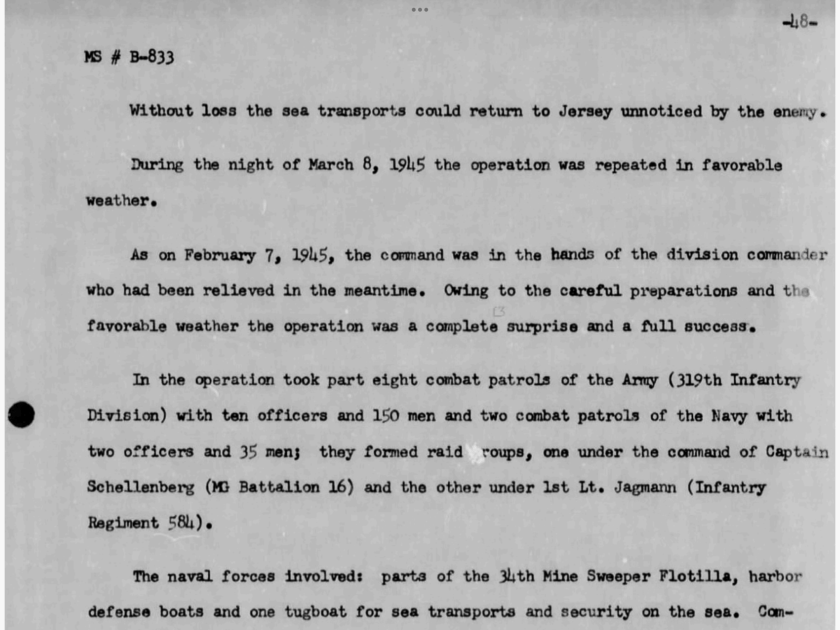
On the night of 8/9th of March 1945 the German occupying forces in the Channel Islands launched a raid on the French port at Granville. The port was in the hands of the Allies and is situated in the Manche department of Normandy.
There is an excellent article with maps and photographs which is linked further down this blog post which I recommend reading for a detailed understanding of the raid. Before you do I thought I would share a few bits of information that may be of interest.
Whilst the raid was initially planned by Rudolf Graf von Schmettow it was his successor as the islands Kommandant, Vice-Admiral Huffmeier who took the credit. Huffmeier is notable for having previously commanded the battle cruiser Scharnhorst.
The raid took place just two months before the end of the war. There are many reasons suggested for why they mounted the raid. A morale boost for the garrison in the Channel Islands and an attempt to steal much needed supplies are just two of the suggestions. They also succeeded in taking a large number of prisoners back to Jersey.
They liberated some German POWs although some decided that they would rather stay put and promptly did a runner to surrender again rather than end up on the Channel Islands.
Below is the report on the raid that the German forces made the Guernsey Evening Press publish.
Report on the raid – Guernsey Evening Press 12 March 1945 – Important to remember that the German forces controlled the output of the paper and used it for propaganda
In his report to the Historical Division, Group West, written in May 1948 Rudolf Graf von Schmettow outlined what happened. Extracts below.
The detailed article about the raid produced by Jersey War Tours is here and is well worth a read. It includes period photographs as well as modern photographs, maps, documents and in depth analysis.
Thanks for reading the blog. Feel free to sign up for notifications and if you want to read previous blog posts they are saved by category in the menu items. You can also find regular updates on Twitter @Fortress_Island