In this episode Nick chats to Tim Osborne about the Lancaster that landed in Sark, the RAF Typhoon raids on the radars at Fort George, what went at the camps in Alderney and the German railway in Guernsey.
Tim is a tour guide, historian and commercial pilot. You can find some of his videos here.
He tells the incredible story of the Lancaster that landed in a field in Sark.
Other topics we covered were the railway that the Germans built, Typhoon raids on Fort George, Alderney and two Germans that were prosecuted.
We also talked about Zac Osborne, who at 6 years old, is probably the youngest historian in the Channel Islands. You can find Zac’s short videos here.
Pictures below of the May 2024 visit to the Lancaster Field.
Standing in the 1,000 foot fieldCurrent Seigneur Christopher Beaumont telling the tour about the Dame of Sark and the Lancaster.
Tim’s video of some of the railway track is here:
I hope that you have enjoyed reading the blog post.
I also co-host a podcast with Keith Pengelley in which we talk about the occupation of the Channel Islands month by month using first hand accounts, diaries and our research in the archives. You can find us on all the major podcast services. Just search “Islands at War” or visit our podcast page here.
You can also follow the blog on Twitter at @Fortress_Island where I share other information and photographs. If you prefer Facebook I also have a page there.
If you would like to receive email notifications of future blogs, you can sign up to the right of this blog post or here. Feel free to look around the website, where I have categorised posts to make them easier to find and other resources such as tours, places to visit and films that may be of interest.
You can also find articles, podcasts, TV appearances and other social media etc here.
I will be adding more as time permits. Thank you for taking the time to read this, and I hope you enjoyed it. Please share it on social media or add a comment if you did. Feedback is always appreciated.
Also happy to be contacted with questions about the war in the Channel Islands, media appearances, podcasts etc.
December 1940. Search Islands At War in your favourite podcast app or listen here.
In this episode we deal with the fate of Symes & Nicolle the two commandos and the civilians that helped them. Find out how they were treated and conditions in the prison.
We also talk about the repercussions of the raid and how the local population feels about the raid.
Also in the show we look at RAF activity around the islands, a German aircraft crash, fortifications and address listeners questions. If you want to email in a question send it to occupied@gnetradio.com.
We talked about a guided walk in Sark by Tim’s Guided Walks on 25th May. Details here on how to book.
The Festung Guernsey books are available from online book shops.
Two weeks have passed already since the last podcast!
We are back for episode 3! We now have an appropriate theme tune thanks to our friend Jim Delbridge. He has kindly allowed us to use his song “5 to 7” from his album ‘The Navigator’. You can find details below about the song and the video.
You can find the podcast on all the usual podcast apps as well as here or listen below.
Keith and Nick talk you through the events of August 1940 the second full month of the islands being occupied by the German forces. We talk about matters both civilian and military.
Freedom of worship except for some. Major Marie Ozanne see more about her and a video here. Food & Essentials. The Bailiff’s controversial broadcast on German Radio. You can find full details of the broadcast here. A mission to rescue two commandos.
During the podcast we talk about some adverts from the Guernsey Press which are below.
We now have some intro and outro music thanks to our very talented friend Jim Delbridge.
If you listen to the podcast and like it please do like and share it with your friends. It would be great if you could also comment on the podcast on your favourite podcast app.
My co-host on the Islands at War podcast Keith Pengelley has written this blog post which is a slightly tongue in cheek look at fire precautions. Well worth a read.
Picture copyright Keith Pengelley
My grandmother kept a number of documents relating to the lead up of World War Two; mainly dealing with everyday life here on Guernsey.
One of the items she kept was Public Information No 5 which dealt with fire precautions resulting from an air raid.
You will see from the photograph that it was issued from the Lord Privy Seal’s Office in August 1939. So a pretty generic UK wide information leaflet that gives a rather casual though detailed set of instructions of how to panic….sorry….proceed should one’s house be hit by the Luftwaffe..or indeed by any other air force…presumably even the RAF.
The information within seems now a trifle tentative…as I say…casual though detailed. I particularly like the inclusiveness. See under Home Fire Fighters…all are urged to get involved. A bit like Christmas…EVERYBODY we are assured has a part to play…even presumably Bob the dog. All large fires start as small ones…an assertive promise if not confirmation of impending doom.
Picture copyright Keith Pengelley
Once we are at least kidding ourselves that we can snuff out a large fire by intimidating a small one, we now turn our attention to THE FIRE BOMB itself. An “ordinary” fire bomb is not in the least like a high explosive bomb…on no…this one, whilst it may not explode at all (so don’t just stand looking at it !) it could blaze up and scatter burning material in all directions. So no need for a compass.
The Fire bomb we are told will not simply bounce of our roof but will make its way, unassisted to the first boarded floor below the roof. After period of consideration…it will the set about turning the roof spaces, attic and upper storeys into a blazing inferno. So keep the wireless low, it’s not going to pop downstairs and introduce itself.
Working on the assumption that we are aware that the upper part of the house is ablaze we now have to DEAL WITH A FIRE which means that we need to ACT QUICKLY. We must realise that, and this I guess is small comfort, a fire started by a bomb is just like an ordinary fire thus we need not worry about panicking in any way than we would normally panic. Plus of course every minute we delay will make the job of putting out the fire more difficult. Not the time to be putting the kettle on.
Fortuitously, our leaflet informs us HOW TO DEAL WITH A BOMB. WE must not just throw water (or tea) as that will do more harm than good….a fine spray will be far more effective so the procurement of a stirrup pump with special nozzle is the best appliance. This is best done as soon as possible as the nation will require around 40 million stirrup pumps and it would be best to be at the front of the queue….again….not the time to making a pot of tea.
Should a pump be procured…best keep it down stairs….not in the roof spaces or attic…then all could be well; simply spray around the bomb and this will make it easier to approach it.
Say what !
Picture copyright Keith Pengelley
At this point our leaflet rather gives up on what happens once the bomb is approached but it seems too imply that there may be an opportunity to coax it into a bucket. Remember to keep the bomb coaxing bucket downstairs…not in the roof space or attic because…yup….they will be well ablaze.
But back to the bomb…
If the application for a stirrup pump is still at the post office it may be possible to introduce some sand…yes…sand…into the bomb coaxing bucket…four inches should be fine…possibly five…not a time to quibble. Then simply scoop up the bomb and place it therein.
Remove the bucket to a safe place. Not upstairs because…exactly.
All done…well apart from the roof spaces, attic etc. they will be well ablaze….you can’t have forgotten.
Picture copyright Keith Pengelley
However…WHAT SHOULD WE DO NOW ?
Well here the leaflet comes up trumps. Clear the attics of “junk” old or otherwise that may have been collected there.Especially the inflammable stuff.
Have ready a number of buckets, shovels, scoops, pumps and nozzles. Possibly even a garden syringe.
Then you’ll be fine.
An anti-aircraft gun would be good. Even an air force. But there’s a war on….
So….don’t forget to look at the reverse of the leaflet…now !…not when the house is on fire.
There is though time. We are advised that IF THERE SHOULD BE A THREAT OF WAR ACT AT ONCE AS FOLLOWS:
Purchase buckets and keep filled with water, as you can’t bank on the fire brigade giving you any, move the bath downstairs but place the buckets and other appliances upstairs in a place near but not too close to where the bomb is going to land.
Rest assured that if living in a small house you may hear the bomb striking the roof but if in a larger house a watcher may be deployed on or near the top floor. Tell him, or her, to take a whistle.
If the house does catch fire and you have approached the bomb and then successfully coaxed it into a bucket sand…go and find someone…anyone…..
A.R.P. St Martin’sNotice
Having taken a tongue in cheek look at the generic fire precautions we now can see that the Guernsey authorities issued localised A.R.P. Notices.
My grandmother retained her specific area details. These were for the parish of ST. Martin’s which is situated in the south west of the island. More specifically these would have been for the locality known as The Old Mill.
My grandmother was at that time resident with a number of other family members in an area known as Ville Aumphrey. The cottage still exists though passed out of family hands post-war.
We will though, in later episodes refer to that address.
The notice now informs us that sand dumps have been deposited in a field next to the tennis courts. Everyone in the area would have known where these were and indeed they still exist.
The notice further informs my grandmother that the nearest A.R.P. Post is Number 1 and who here wardens are. She may well have known them personally.
So….at the time of receipt, grandmother would have had time to collect her bucket of sand, settle down, make a pot of tea and await the incendiary bombs to fall.
Put that Bloney light out !
Picture copyright Keith Pengelley
Thanks to Keith for a very entertaining an informative article. You can catch Keith and myself on GNET Radio every other Monday evening or if you want to catch us on the podcast you can find details here and here. If you have any questions for us to address on the podcast email them to occupied@gnetradio.com.
I hope that you have enjoyed reading the blog post.
I also co-host a podcast with Keith Pengelley in which we talk about the occupation of the Channel Islands month by month using first hand accounts, diaries and our research in the archives. You can find us on all the major podcast services. Just search “Islands at War” or visit our podcast page here.
You can also follow the blog on Twitter at @Fortress_Island where I share other information and photographs. If you prefer Facebook I also have a page there.
If you would like to receive email notifications of future blogs, you can sign up to the right of this blog post or here. Feel free to look around the website, where I have categorised posts to make them easier to find and other resources such as tours, places to visit and films that may be of interest.
You can also find articles, podcasts, TV appearances and other social media etc here.
I will be adding more as time permits. Thank you for taking the time to read this, and I hope you enjoyed it. Please share it on social media or add a comment if you did. Feedback is always appreciated.
Also happy to be contacted with questions about the war in the Channel Islands, media appearances, podcasts etc.
The pilot episode of the radio show ‘Islands At War’ is now available to listen to on demand. You can listen in your browser by clicking on the link below. Keith and I talk about the phoney war, refugees from France escaping through the islands, confusion about whether to stay or go, the German bombing raid and much more! If you have a spare 46 minutes go take a listen.
We will be releasing a discussion about each month of the occupation every two weeks. Any feedback gratefully received.
I hope that you have enjoyed reading the blog post.
I also co-host a podcast with Keith Pengelley in which we talk about the occupation of the Channel Islands month by month using first hand accounts, diaries and our research in the archives. You can find us on all the major podcast services. Just search “Islands at War” or visit our podcast page here.
You can also follow the blog on Twitter at @Fortress_Island where I share other information and photographs. If you prefer Facebook I also have a page there.
If you would like to receive email notifications of future blogs, you can sign up to the right of this blog post or here. Feel free to look around the website, where I have categorised posts to make them easier to find and other resources such as tours, places to visit and films that may be of interest.
You can also find articles, podcasts, TV appearances and other social media etc here.
I will be adding more as time permits. Thank you for taking the time to read this, and I hope you enjoyed it. Please share it on social media or add a comment if you did. Feedback is always appreciated.
Also happy to be contacted with questions about the war in the Channel Islands, media appearances, podcasts etc.
Today, 5 June 2023, I attended the memorial service for Flight Lieutenant John Saville who was killed during a Typhoon raid on Guernsey in the Channel Islands. This blog tells the story of the two raids that happened and also shares some footage of the memorial service.
Flight Lieutenant John Saville was a Canadian who flew two raids against St Peter Port in Guernsey, in the days preceding D-Day on 6th June 1944. He was a pilot in 439 Squadron Royal Canadian Air Force, ‘Tiger Squadron’, flying Typhoon 1b aircraft. Often when these raids, and Saville himself, are written about there is only a passing mention of the first raid.
I thought it would be useful to provide some detail on both raids, as well as some photographs to provide the reader with an insight into what they were attacking. Hopefully this will bring to life the events recounted in this blog.
There was concern that the radar, with a range of 100 miles, would pick up aircraft and ships approaching Normandy for D-Day on 6 June 1944. The map below shows the proximity of the Channel Islands to the Normandy beaches used for D-Day.
Google maps showing the proximity of the Channel Islands to Normandy.
Below shows the target area, Fort George in the centre of the picture. Top centre is Castle Cornet along with the emplacement that forms the south side of the harbour.
Squadron 439 RCAF Operations Record Book entry for the first raid on 3rd June 1944. Listing the aircraft and pilots involved. National Archives AIR 27/1879/8.
Eight aircraft carrying 500 lb MC bombs with instantaneous nose fusing attacked the radar installation at Saint Peter Port on the eastern coast of the heavily defended Channel Island of Guernsey. The attack was made without a hitch from a south westerly direction at an altitude of 12,500 feet led by Flight Lieutenant Dadson. The squadron half rolled into a dive on the target and succeeded In scoring a large number of hits in the target area.
No bombs were seen to burst outside of the target area. As the aircraft individually half rolled into position, then heavy flak opened up and lateral errors only were all that kept a number of our aircraft from severe damage. The dive was carried out from 12,000 feet to 3000 feet, with the aircraft being followed all the way by both light and heavy flak and finally crossing out at over 500 mph amid a barraged of incendiary bullets.
Miraculously only two of our aircraft suffered minor damage, one flown by Flying Officer Burgess was struck in the radiator and the other flown by Flying Officer Porritt was nicked in the tailplane. All aircraft returned safely operations successful.
Squadron 439 RCAF Operations Record Book entry for the first raid on 3rd June 1944. National Archives AIR 27/1879/8.
The second raid 5th June 1944
Although the record book recorded the raid on 3rd June as a success photo reconnaissance photographs revealed that the Germans were making repairs to the radar installation. It was decided that a further raid was required to ensure that it was disabled permanently.
This time Saville was leading a flight of eight Typhoons from 439 Squadron Royal Canadian Air Force, “Tiger Squadron”.
Squadron 439 RCAF Operations Record Book entry for the first raid on 5th June 1944. Listing the aircraft and pilots involved. National Archives AIR 27/1879/8.
Having received confirmation of the fact that the last raid on the radar installation at saint peter port was 75% complete this squadron set out to finish the job by knocking over the one remaining Freya radar installation in the northeast corner of the target area.
Carrying two nose fused instantaneous 500lb M.C. bombs each the squadron led by Flight Lieutenant Saville attacked the highly defended target in a long dive from 12,000 feet to 4000 feet in an easterly direction. All the bombs appeared to burst on or very near the target itself.
A large disturbance was created in the sea about a mile offshore and at first it was believed to have been bombs. Flight Lieutenant Saville was not seen after the dive and it was later presumed that his aircraft had been hit by intense flag and failed to recover from the dive. The remaining seven aircraft and pilots returned unharmed.
Squadron 439 RCAF Operations Record Book entry for the first raid on 5th June 1944. National Archives AIR 27/1879/8.
A further report gives more insight into what was observed by another pilot.
On 5.6.44 at 08.20 hours, eight of the 439 Squadron aircraft took off to dive-bomb a Radar installation at Fort George on the Island of Guernsey.
The formation which was led by F/L Saville encountered very heavy flak over and near the target. As F/L Saville went into the target, six bursts of heavy flak were observed in front of him. This officer was seen making an aileron turn to port, which, on pull out, would have brought him out over the Island instead of the sea.
His No. 2 pulled out towards the sea and did not see him again. Shortly after F/L Saville’s No. 2 called him on the R/T twice, but received no reply.
The rest of the Squadron returned to base at 09.20 hours. Subsequently, an A.S.R. search was made in the face of very heavy flak which failed to find any trace of F/L Saville.
Circumstantial Report: Can J. 8146, F/L J. W. Saville, 439 Squadron, RCAF missing on Operations. w.e.f. 5.6.44. Typhoon MN210. – The Typhoon Project .Org
At the memorial service on 5th June 2023 an eyewitness account was read out, which had come to light in 1987. The eyewitness had seen the level of anti aircraft fire and was certain that the aircraft had been hit by fire from a flak ship in the harbour.
Swastika Over Guernsey – Victor Coysh – 1955
You will probably have noticed in the operations book extract above that twelve aircraft are noted as having flown that day. This is because four aircraft took off to search for Saville in the hope that he had been able to bail out of his aircraft and was in a dinghy at sea. If that had happened it would have been likely that he would have been captured by the Germans in any case. The aircraft searched in the face of heavy anti aircraft fire but to no avail.
The chance of being able to call in a seaplane or ship to rescue him would have been slim in any case due to the heavy fortifications on the island.
On the 16th June 1944 John Saville’s commanding officer wrote to his mother to report that he was missing in action.
Five weeks after the aircraft crashed the body of a Canadian airman was washed ashore, although it wasn’t able to be positively confirmed that it was the body of John Saville.
As can be seen from the letter below he was officially declared dead in 1952.
Unfortunately, despite the valiant efforts of those involved in both of the raids, all of the radar equipment remained in working order. As had been feared they detected the incoming invasions ships and aircraft on the evening of 5th/6th June and a message was radioed from the German Naval Signals Headquarters in St Peter Port to Berlin warning of the attack. You can read and see pictures of the Naval Signals Headquarters here.
Fort George. Original image here taken on 7 February 1945 by an aircraft of 541 Squadron RAFThe above is a zoomed in part of the previous photo which shows what appear to be bomb craters around the area where the radar was based. These are most likely from the June 1944 raids and just haven’t been filled in.
Discovery of the wreck of Typhoon MN210
In the 1960s what was believed to be aircraft wreckage was found in Havelet Bay. It wasn’t until 1982 that the site was investigated further by local diver Mick Peters and it was established that this was the wreck of Saville’s aircraft. It was subsequently designated as a war grave following identification of personal items which confirmed that Saville had gone down with his aircraft.
He is also commemorated on the Air Forces Memorial at Runnymede in Surrey, England.
Annual memorial service
Each year there is a memorial service held in Guernsey at the site of the memorial plaque on the Castle Emplacement in St Peter Port. Provided I am in Guernsey at the time I attend the service. Fortunately I was able to attend today, 5th June 2023.
Below you will find a couple of video clips from the service which I attended today. It was pleasing to see a good turn out for the memorial service despite the chilly easterly wind. Apologies for the wind noise but it was blowing a force 4!
Thanks to all involved in organising the memorial service and all that attended.
I hope that you have enjoyed reading the blog post.
I also co-host a podcast with Keith Pengelley in which we talk about the occupation of the Channel Islands month by month using first hand accounts, diaries and our research in the archives. You can find us on all the major podcast services. Just search “Islands at War” or visit our podcast page here.
You can also follow the blog on Twitter at @Fortress_Island where I share other information and photographs. If you prefer Facebook I also have a page there.
If you would like to receive email notifications of future blogs, you can sign up to the right of this blog post or here. Feel free to look around the website, where I have categorised posts to make them easier to find and other resources such as tours, places to visit and films that may be of interest.
You can also find articles, podcasts, TV appearances and other social media etc here.
I will be adding more as time permits. Thank you for taking the time to read this, and I hope you enjoyed it. Please share it on social media or add a comment if you did. Feedback is always appreciated.
Also happy to be contacted with questions about the war in the Channel Islands, media appearances, podcasts etc.
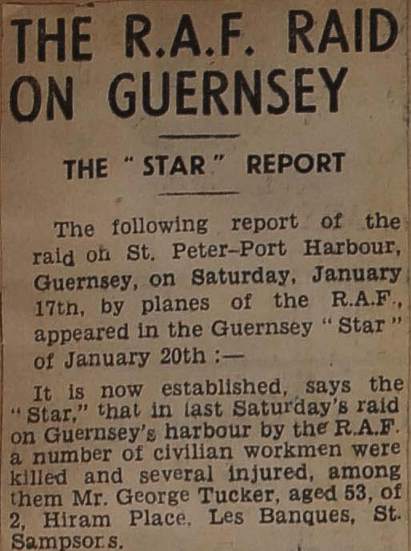
Last year I wrote a blog about this air raid. I recently came across this article, written at the time for the Star newspaper, and I thought it was worth sharing it.
It is important to remember that the content of the newspaper was controlled by the German forces, so presents their viewpoint.
My original blog post with tmore detail on the raid is here.
Report in the Jersey Evening Post reproducing the article from the Guernsey newspaper the Star. From a scrapbook kept by Helene Marie Sinnatt, née Jackson, during the Occupation. Book 3, Page 57. It is in the Jersey Heritage Archive ref L/C/306/A/3/57.
I hope that you have enjoyed reading the blog post.
I also co-host a podcast with Keith Pengelley in which we talk about the occupation of the Channel Islands month by month using first hand accounts, diaries and our research in the archives. You can find us on all the major podcast services. Just search “Islands at War” or visit our podcast page here.
You can also follow the blog on Twitter at @Fortress_Island where I share other information and photographs. If you prefer Facebook I also have a page there.
If you would like to receive email notifications of future blogs, you can sign up to the right of this blog post or here. Feel free to look around the website, where I have categorised posts to make them easier to find and other resources such as tours, places to visit and films that may be of interest.
You can also find articles, podcasts, TV appearances and other social media etc here.
I will be adding more as time permits. Thank you for taking the time to read this, and I hope you enjoyed it. Please share it on social media or add a comment if you did. Feedback is always appreciated.
Also happy to be contacted with questions about the war in the Channel Islands, media appearances, podcasts etc.
28 June is the anniversary of the bombing of the Channel Islands by the Germans. I thought I would take a slightly different approach to the usual articles on the subject and look at it from the point of view of the reporting in the Newspapers across the UK.
Whilst some aspects of these reports are the same the regional newspapers record the views of those that were there but left the island before the occupation forces arrived or escaped shortly after. As they turned up in different parts of the UK you get some different views based on this.
As a brief overview Frank Falla wrote of the event:
Six enemy aircraft came, it seemed, from nowhere… three swooped down over the harbour dropping incendiaries and high explosive bombs, and machine-gunning ruthlessly along the line of waiting lorries…
The air-raid warning sirens were not set going until at least ten minutes after the first bomb had been dropped, and even then it was not the ARP officials who set them in motion but three cool-headed telephone operators… as a result of this raid on defenceless Guernsey, thirty-four people died on the spot or in hospital soon afterwards, and another thirty-three were injured.
Frank Falla – Silent War
Don’t worry if you aren’t familiar with events as you can find links at the bottom of this page which take you to the usual sources that explain the raid. If you want to skip to these first before reading the rest of the blog click here.
The newspaper articles focus on the attack on the area around St Peter Port Harbour but there were other areas of Guernsey that were attacked. This is an example of a bomb which was dropped on the Capelles area.
The Aberdeen Press and Journal of 8 July 1940 tells the story from the perspective of a bandmaster who was there and had subsequently arrived in Aberdeen.
The Evening Sentinel of 29 June 1940 reported on the Murderous German Raids including the death of a Guernsey Lifeboatman. You can read more about this here Death of a Guernsey Lifeboat Man.
In Warwickshire the Evening dispatch reported on 29 June 1940 about Channel Islanders abandoning their homes.
Strangely the number of casualties had become vastly inflated above the actual number when this article appeared in the Nottingham Evening Post – Thursday 12 December 1940.
I hope that you have enjoyed reading the blog post.
I also co-host a podcast with Keith Pengelley in which we talk about the occupation of the Channel Islands month by month using first hand accounts, diaries and our research in the archives. You can find us on all the major podcast services. Just search “Islands at War” or visit our podcast page here.
You can also follow the blog on Twitter at @Fortress_Island where I share other information and photographs. If you prefer Facebook I also have a page there.
If you would like to receive email notifications of future blogs, you can sign up to the right of this blog post or here. Feel free to look around the website, where I have categorised posts to make them easier to find and other resources such as tours, places to visit and films that may be of interest.
You can also find articles, podcasts, TV appearances and other social media etc here.
I will be adding more as time permits. Thank you for taking the time to read this, and I hope you enjoyed it. Please share it on social media or add a comment if you did. Feedback is always appreciated.
Also happy to be contacted with questions about the war in the Channel Islands, media appearances, podcasts etc.
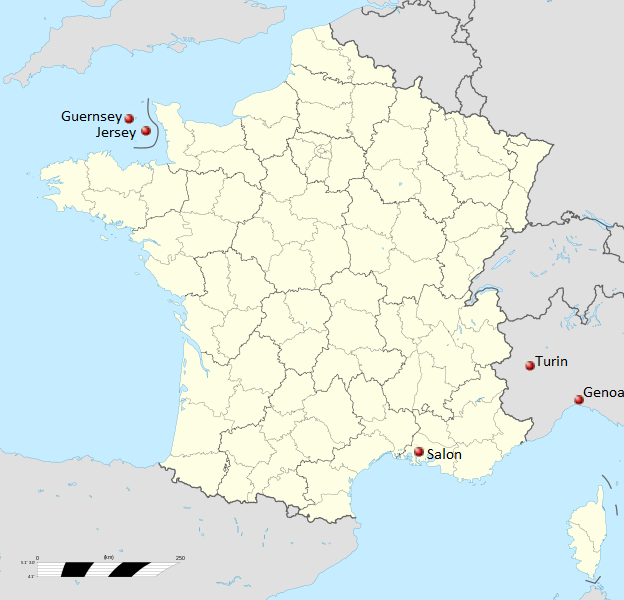
Whilst RAF aircraft operated from both Guernsey & Jersey prior to the Occupation of the Channel Islands by the Germans on 30 June 1940 their role was primarily reconnaissance and some fighter patrols. The night of 11/12 June 1940 saw the only air raid on mainland Europe that took place by the RAF from the Islands.
As part of Operation Haddock the raid was an attempt by the British to support France when Italy was about to enter the war. It was not well received by some of the French as they were concerned about retaliatory attacks on poorly defended areas due to a lack of fighter aircraft in the south of France, however, the British Air Ministry paid little heed to this and ordered that the raids go ahead.
In addition to the aircraft that operated from the Channel Islands for this raid there were also Vickers Wellington bombers which flew from England but refuelled at Salon-de-Provence outside of Marseille. These aircraft did not conduct their raid until the 15/16 June as the French blocked the runway.
No. 4 Group dispatched Armstrong Whitworth Whitley bombers to Guernsey and Jersey to launch a raid on Turin with a secondary target of Genoa. At the start of the war No.4 Group were the only trained night bomber force in the world.1
Aircraft from 10, 51, 58, 77 and 102 Squadrons carried out the raids from Guernsey and Jersey. In total 36 aircraft took part in the raid. 13 found the target and two failed to return. The fact that all but two came back is amazing given the weather conditions on the night, they encountered severe thunderstorms and suffered lightening strikes and severe icing. Both of which prevented them from flying above the storms.
One aircraft that was lost was from No 77 Squadron was lost on the homeward route,Sgt M N Songest and his crew were killed when N1362 crashed at Lignieres-Orgeres,Le Mans in the Mayenne Department.
Several of the bombers accidentally bombed neutral Switzerland hitting Geneva and Lausanne killing four people and injuring another eighty.2
they encountered severe thunderstorms and suffered lightening strikes and severe icing. Both of which prevented them from flying above the storms.
The accounts from the various Squadron records are below and well worth a read to see what the crews endured. One aircraft flew over the target for sixty-five minutes dropping flares to illuminate the target!
Whitley Bomber of 102 Squadron by Royal Air Force official photographer – This is photograph CH 2052 from the collections of the Imperial War Museum.Squadron Number: 10 Appendices: Y National Archives Air 27/147Squadron Number: 10 Appendices: Y National Archives Air 27/147Squadron Number: 10 Appendices: Y National Archives Air 27/147Squadron Number: 10 Appendices: Y National Archives Air 27/147Squadron Number: 10 Appendices: Y National Archives Air 27/141Squadron Number: 10 Appendices: Y National Archives Air 27/141Squadron Number: 10 Appendices: Y National Archives Air 27/141Squadron Number: 10 Appendices: Y National Archives Air 27/141Squadron Number: 51 Records of Events: Y National Archive AIR 27/491/18Squadron Number: 51 Records of Events: Y National Archive AIR 27/491/18Squadron Number: 58 Appendices: YSquadron Number: 77 Appendices: Y National Archives AIR 27/659B/1Squadron Number: 102 Appendices: Y National Archives AIR 27/812
Thanks to Nick Beale who advised that the Italian Commando Supremo war diary is online and records that 45 bombers raided Turin between 01.30 and 02.00. Flares were dropped and damage was done to the Fiat Mirafiori plant as well as to railways. The commercial district of Porta Palazzo was hit and a gasometer set on fire in the via Clemente Damiano Priocca. 15 people were killed and 30 injured.
I hope that you have enjoyed reading the blog post.
I also co-host a podcast with Keith Pengelley in which we talk about the occupation of the Channel Islands month by month using first hand accounts, diaries and our research in the archives. You can find us on all the major podcast services. Just search “Islands at War” or visit our podcast page here.
You can also follow the blog on Twitter at @Fortress_Island where I share other information and photographs. If you prefer Facebook I also have a page there.
If you would like to receive email notifications of future blogs, you can sign up to the right of this blog post or here. Feel free to look around the website, where I have categorised posts to make them easier to find and other resources such as tours, places to visit and films that may be of interest.
You can also find articles, podcasts, TV appearances and other social media etc here.
I will be adding more as time permits. Thank you for taking the time to read this, and I hope you enjoyed it. Please share it on social media or add a comment if you did. Feedback is always appreciated.
Also happy to be contacted with questions about the war in the Channel Islands, media appearances, podcasts etc.
Having seen the photograph it intrigued me and I thought I would find out a bit more about the raid. I had read some mentions of it before but hadn’t really looked at it in more detail.
When it comes to air raids on the Island it is mostly the German raid immediately prior to the taking of the Islands that is written about. This is entirely understandable given the large loss of life during that German raid. A subject I will cover in another post.
Below is a Royal Navy map of the harbour to provide some context for those not familiar with it as well as a map showing the location of the Islands. On the map of the harbour the RAF aircraft approached at low level from the top right of the map.
Map of St Peter Port harbour as it was during the Second World War
The aircraft took off from RAF St Eval in Cornwall, top left of the above map, having only moved there seven days earlier. Other aircraft types did fly to the Channel Islands from St Eval during the course of the war. One of which was an Avro Anson of No. 217 Squadron which had been on a photographic mission ditched during a storm west of Guernsey on 16 October 1940. The crew of 4 came ashore in Guernsey and taken as POW’s.
These are two extracts from the 86 Squadron operations record which I tracked down in the National Archive. These give an account of the raid from an official point of view.
Extract of No. 86 Squadron Operations Record page 1
The above extract refers to “excellent photographs” of the raid being taken but despite searching all of my usual sources the one at the top of the page is the only one that I am able to trace taken by the RAF.
Extract of No. 86 Squadron Operations Record page 2
It isn’t really surprising that they received a lot of incoming fire given that the German fortifications around the harbour and out towards the south of the Island, which was their flight path away from the raid, were fairly formidable.
The gallery below this gives a flavour of what the likely armaments were but as the photographs aren’t dated not all may have been in place in 1942 it is likely that many were given the previous raids. Click on the gallery to see larger pictures of the images.
In his book “Guernsey under German rule” written immediately after the war Ralph Durand provides quite a bit of detail on the impact the raid had. He also notes that this was the first raid that the Germans had reported in the newspapers having ignored the previous twenty five raids of varying kinds in the preceding years. This was almost certainly because of the evidence that Islanders could see could not be denied.
The casualties inflicted by the raiders were, as nearly as could be ascertained, one Guernseyman, eight Germans and twenty Frenchmen killed by the bombing and some fifty Germans killed or wounded by machine-gun fire in Castle Cornet and Fort George. Among other results of the raid that both accounts minimise were three cranes wrecked, a steamer of 8,000 tons sunk at the Southern Railway’s berth on the jetty, a large munitions steamer holed in the bows, the back of a barge broken, and the sides of several other barges perforated with bomb splinters.
The Germans always endeavoured to keep us in ignorance of any damage done to them by British planes, but they could not hide from us what had been done to these vessels for the broken-backed barge was towed into the inner harbour with her fore hold flooded, the steamer that still floated was brought to Albert Dock where any passer-by could see that the hole in her bows was at least eight feet in diameter, and as for the steamer that was sunk, because only her fore part was flooded, her stem rose with each tide and could be seen at high water high above the level of the jetty.
Ralph Durand
Durand also noted that the almost identical stories in the two local papers, which were controlled by the Germans, led to another impact on Islanders views on those publications.
But it is quite inconceivable that two such journalists, after neglecting to record any of the previous raids that the RAF had made on the island, should, three days after it had happened, be inspired by this particular raid to write, spontaneously and independently, accounts of it in which the same bare facts were chosen for record, the same misstatement made, the same important details as to the damage done to the shipping ignored, the same sneer indulged in, and the same attack made on the veracity of the British Broadcasting Corporation. Such coincidences do not occur in real life. Anyone who read both accounts must have realised that they had the same source and that that source was the mind of the German Press officer.
In causing them to be published the Press officer defeated his purpose. So far from sowing in our minds doubts as to the truth of the news given us by British broadcasts he confirmed what we already knew – that the anti-British propaganda published each day in our newspapers, though often amusing, was not to be credited as true. Incidentally he reminded us that among other cherished British institutions of which German rule had deprived us was the freedom of the Press.
Ralph Durand
Another account by Ruth Ozanne provides her experience as she was close to the harbour at the time of the raid.
Despite the damage that RAF raids caused to civilian properties they were pleased to see the RAF in action. This is noted in an interview with a German NCO Erwin Grubba which is in the IWM archive and can be found here . He wasn’t here in 1942 having arrived in late 1943 but recalls that locals used to “smile and give the thumbs up” if RAF aircraft appeared over the Island. Even if they were bombing the Island.
The images below show some of the damage caused by the raid to one of the ships. Unfortunately one is mostly reliant on German sources for pictures as cameras were confiscated in 1942 and anyone retaining one and using it did so at great personal risk.
This was not the first or last air raid on the Islands and I will be featuring others in later posts.
I hope that you have enjoyed reading the blog post.
I also co-host a podcast with Keith Pengelley in which we talk about the occupation of the Channel Islands month by month using first hand accounts, diaries and our research in the archives. You can find us on all the major podcast services. Just search “Islands at War” or visit our podcast page here.
You can also follow the blog on Twitter at @Fortress_Island where I share other information and photographs. If you prefer Facebook I also have a page there.
If you would like to receive email notifications of future blogs, you can sign up to the right of this blog post or here. Feel free to look around the website, where I have categorised posts to make them easier to find and other resources such as tours, places to visit and films that may be of interest.
You can also find articles, podcasts, TV appearances and other social media etc here.
I will be adding more as time permits. Thank you for taking the time to read this, and I hope you enjoyed it. Please share it on social media or add a comment if you did. Feedback is always appreciated.
Also happy to be contacted with questions about the war in the Channel Islands, media appearances, podcasts etc.