In the September 1941 edition of the Islands at War podcast we cover a number of aspects of events that month.
As requested by many people we have expanded the podcast to include regular Jersey content so each month going forward there will a more about Jersey.
We kick off this episode with the incredible escape of Denis Vibert from Jersey in a tiny boat. Moving on to some rumours of a tunnel being constructed from Jersey to France!
The Guernsey Press organised a charity swimming gala. Pictures and report below. See if you can spot any relatives! 2,000 people, a tenth of the population, attended.
One person didn’t do so well as he ended up in court!
The Germans hold a review where German artistes could perform. Wish I had thought of this before we recorded the episode but it is kind of “Germany’s Got Talent”.
We also talk about RAF activity in the area and shipping attacks.
You can find the podcast episode on all the major podcast apps or listen in the player below.
I hope that you have enjoyed reading the blog post.
I also co-host a podcast with Keith Pengelley in which we talk about the occupation of the Channel Islands month by month using first hand accounts, diaries and our research in the archives. You can find us on all the major podcast services. Just search “Islands at War” or visit our podcast page here.
You can also follow the blog on Twitter at @Fortress_Island where I share other information and photographs. If you prefer Facebook I also have a page there.
If you would like to receive email notifications of future blogs, you can sign up to the right of this blog post or here. Feel free to look around the website, where I have categorised posts to make them easier to find and other resources such as tours, places to visit and films that may be of interest.
You can also find articles, podcasts, TV appearances and other social media etc here.
I will be adding more as time permits. Thank you for taking the time to read this, and I hope you enjoyed it. Please share it on social media or add a comment if you did. Feedback is always appreciated.
Also happy to be contacted with questions about the war in the Channel Islands, media appearances, podcasts etc.
You can find it on all good podcast services or here.
In this episode we talk March 1941 of the Occupation of Guernsey in the Channel Islands. We cover off the end of joke that made the Germans look daft but got too teenage maids in trouble.
We look at the impact of sabotage when some phone lines get cut at the airport. Also the impact of sabotage that the RAF did before they left and subsequent bombing.attacks.
The aircraft that upset the Germans when it was discovered by the Germans.
The notice that appeared following the aircraft discovery is below.
We also talked about the Red Cross messages giving reassurance.
We also look at rationing of bread and much much more.
We mentioned the ‘Wee Mite’ aircraft that caused Kenny Bell a lot of trouble. You can find it here including photos.
Bread rationing details are included below.
If you want to email in a question send it to occupied@gnetradio.com.
Thanks to Gnet Radio for recording the podcast and thanks to Jim Delbridge for the use of his song ‘5 to 7’ as our theme.
If you have been reading my blog for a while you may have read my post about the two Hurricane pilots who spent some time operating from Guernsey. I am extremely grateful to Philip Mobbs who contacted me after reading my blog post. He has provided some more information which warrants a part two to the story of these men.
The original blog post is here if you haven’t read it or you want to refresh your memory!
Phillip is writing a book about another 17 Squadron Hurricane pilot Denis Wissler, who was a good friend of Harold Bird-Wilson, aka Bird’y.
Phillip was kind enough to agree to me including on the blog exerts from Denis’s diary which provides more information.
“Denis had been on 85 Sqn in France and been evacuated back to England at the time of the Dunkirk evacuations, much to his annoyance he was then sent back out as a replacement to 17. His diary entries of the period (with my text between) are below:
Monday 17 June
This was my day off but at lunch time we heard that the French had given up. We all went down to the ‘drome and after about an hour we took off and flew to Jersey Airport, a flight of about 25 mins. A grand party was thrown for us and we had a damn good time. I went to bed at midnight. We heard that the Russians had joined us and having drunk to it we heard it wasn’t true.
When the news of the impending armistice reached Dinard the French Base Commander gave the CO, Squadron Leader MacDougall, one hour to leave or all the squadron’s Hurricanes would be impounded and destroyed. Sergeant Desmond Fopp, a young Australian pilot, recalled:
‘The CO suddenly appeared and said that all serviceable aircraft were to be flown out immediately and climbed into his aircraft for take-off. We hastily followed as he had omitted to say where to! Due to a slow start (flat battery) I remember following the last dot in the sky and eventually landed in Jersey.’
Tuesday 18 June
What a day. We got up at 5am and were driven to the aerodrome. We sat about for a while and then I relieved 3 sergeants who were standing by in their aircraft. Just as we were to be relieved there was a flap and off we went. I did a patrol of 1.55 hrs over Cherbourg. Having landed I was sent to Guernsey where I remained with 5 others for the rest of the day, and night. We heard today that we are off to England tomorrow oh I hope it is true.
Wednesday 19 June
We were woken up at 4am and brought to readiness. We sat about and slept until 10 when we managed to rustle up something to eat. We were then told we were to go at 1.30. 1.30 came but we had to wait for a DH89 to arrive. We took off at about 3.15 and landed at Tangmere at about 4, and left for Debden at about 4.45 arriving about 25 mins later, whoppee, back in England again.“
Phillip also provided some more information about the state of their aircraft and that claim of a Guernsey lady having flown to England in a Hurricane.
“Many of the squadrons Hurricanes were by this time unserviceable, Sergeant Fopp flew his back with a burst tailwheel. Two pilots returned in a two seater Magister they had scrounged and another two found an abandoned Fairey Battle but managed to make it flyable enough to get them home. In a post-war interview Bird-Wilson said that some of the local women in Guernsey had asked to be flown to England and that later he had met one at a party who said that she had indeed flown back in a Hurricane, the pilot having removed the radio to make space for her. According to Edith Heap, a WAAF who served at Debden and had known Birdy, he had flown a girl back although he denied it.” – Phillip Mobbs.
Thanks very much to Phillip for taking the time to contact me and allowing me to share this. Do keep an eye out for his book when it comes out.
I hope that you have enjoyed reading the blog post.
I also co-host a podcast with Keith Pengelley in which we talk about the occupation of the Channel Islands month by month using first hand accounts, diaries and our research in the archives. You can find us on all the major podcast services. Just search “Islands at War” or visit our podcast page here.
You can also follow the blog on Twitter at @Fortress_Island where I share other information and photographs. If you prefer Facebook I also have a page there.
If you would like to receive email notifications of future blogs, you can sign up to the right of this blog post or here. Feel free to look around the website, where I have categorised posts to make them easier to find and other resources such as tours, places to visit and films that may be of interest.
You can also find articles, podcasts, TV appearances and other social media etc here.
I will be adding more as time permits. Thank you for taking the time to read this, and I hope you enjoyed it. Please share it on social media or add a comment if you did. Feedback is always appreciated.
Also happy to be contacted with questions about the war in the Channel Islands, media appearances, podcasts etc.
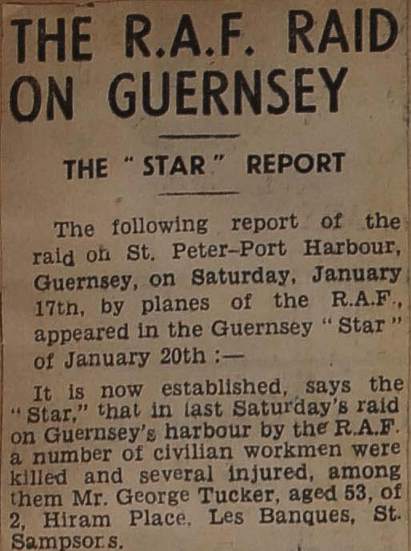
Last year I wrote a blog about this air raid. I recently came across this article, written at the time for the Star newspaper, and I thought it was worth sharing it.
It is important to remember that the content of the newspaper was controlled by the German forces, so presents their viewpoint.
My original blog post with tmore detail on the raid is here.
Report in the Jersey Evening Post reproducing the article from the Guernsey newspaper the Star. From a scrapbook kept by Helene Marie Sinnatt, née Jackson, during the Occupation. Book 3, Page 57. It is in the Jersey Heritage Archive ref L/C/306/A/3/57.
I hope that you have enjoyed reading the blog post.
I also co-host a podcast with Keith Pengelley in which we talk about the occupation of the Channel Islands month by month using first hand accounts, diaries and our research in the archives. You can find us on all the major podcast services. Just search “Islands at War” or visit our podcast page here.
You can also follow the blog on Twitter at @Fortress_Island where I share other information and photographs. If you prefer Facebook I also have a page there.
If you would like to receive email notifications of future blogs, you can sign up to the right of this blog post or here. Feel free to look around the website, where I have categorised posts to make them easier to find and other resources such as tours, places to visit and films that may be of interest.
You can also find articles, podcasts, TV appearances and other social media etc here.
I will be adding more as time permits. Thank you for taking the time to read this, and I hope you enjoyed it. Please share it on social media or add a comment if you did. Feedback is always appreciated.
Also happy to be contacted with questions about the war in the Channel Islands, media appearances, podcasts etc.
Having seen the photograph it intrigued me and I thought I would find out a bit more about the raid. I had read some mentions of it before but hadn’t really looked at it in more detail.
When it comes to air raids on the Island it is mostly the German raid immediately prior to the taking of the Islands that is written about. This is entirely understandable given the large loss of life during that German raid. A subject I will cover in another post.
Below is a Royal Navy map of the harbour to provide some context for those not familiar with it as well as a map showing the location of the Islands. On the map of the harbour the RAF aircraft approached at low level from the top right of the map.
Map of St Peter Port harbour as it was during the Second World War
The aircraft took off from RAF St Eval in Cornwall, top left of the above map, having only moved there seven days earlier. Other aircraft types did fly to the Channel Islands from St Eval during the course of the war. One of which was an Avro Anson of No. 217 Squadron which had been on a photographic mission ditched during a storm west of Guernsey on 16 October 1940. The crew of 4 came ashore in Guernsey and taken as POW’s.
These are two extracts from the 86 Squadron operations record which I tracked down in the National Archive. These give an account of the raid from an official point of view.
Extract of No. 86 Squadron Operations Record page 1
The above extract refers to “excellent photographs” of the raid being taken but despite searching all of my usual sources the one at the top of the page is the only one that I am able to trace taken by the RAF.
Extract of No. 86 Squadron Operations Record page 2
It isn’t really surprising that they received a lot of incoming fire given that the German fortifications around the harbour and out towards the south of the Island, which was their flight path away from the raid, were fairly formidable.
The gallery below this gives a flavour of what the likely armaments were but as the photographs aren’t dated not all may have been in place in 1942 it is likely that many were given the previous raids. Click on the gallery to see larger pictures of the images.
In his book “Guernsey under German rule” written immediately after the war Ralph Durand provides quite a bit of detail on the impact the raid had. He also notes that this was the first raid that the Germans had reported in the newspapers having ignored the previous twenty five raids of varying kinds in the preceding years. This was almost certainly because of the evidence that Islanders could see could not be denied.
The casualties inflicted by the raiders were, as nearly as could be ascertained, one Guernseyman, eight Germans and twenty Frenchmen killed by the bombing and some fifty Germans killed or wounded by machine-gun fire in Castle Cornet and Fort George. Among other results of the raid that both accounts minimise were three cranes wrecked, a steamer of 8,000 tons sunk at the Southern Railway’s berth on the jetty, a large munitions steamer holed in the bows, the back of a barge broken, and the sides of several other barges perforated with bomb splinters.
The Germans always endeavoured to keep us in ignorance of any damage done to them by British planes, but they could not hide from us what had been done to these vessels for the broken-backed barge was towed into the inner harbour with her fore hold flooded, the steamer that still floated was brought to Albert Dock where any passer-by could see that the hole in her bows was at least eight feet in diameter, and as for the steamer that was sunk, because only her fore part was flooded, her stem rose with each tide and could be seen at high water high above the level of the jetty.
Ralph Durand
Durand also noted that the almost identical stories in the two local papers, which were controlled by the Germans, led to another impact on Islanders views on those publications.
But it is quite inconceivable that two such journalists, after neglecting to record any of the previous raids that the RAF had made on the island, should, three days after it had happened, be inspired by this particular raid to write, spontaneously and independently, accounts of it in which the same bare facts were chosen for record, the same misstatement made, the same important details as to the damage done to the shipping ignored, the same sneer indulged in, and the same attack made on the veracity of the British Broadcasting Corporation. Such coincidences do not occur in real life. Anyone who read both accounts must have realised that they had the same source and that that source was the mind of the German Press officer.
In causing them to be published the Press officer defeated his purpose. So far from sowing in our minds doubts as to the truth of the news given us by British broadcasts he confirmed what we already knew – that the anti-British propaganda published each day in our newspapers, though often amusing, was not to be credited as true. Incidentally he reminded us that among other cherished British institutions of which German rule had deprived us was the freedom of the Press.
Ralph Durand
Another account by Ruth Ozanne provides her experience as she was close to the harbour at the time of the raid.
Despite the damage that RAF raids caused to civilian properties they were pleased to see the RAF in action. This is noted in an interview with a German NCO Erwin Grubba which is in the IWM archive and can be found here . He wasn’t here in 1942 having arrived in late 1943 but recalls that locals used to “smile and give the thumbs up” if RAF aircraft appeared over the Island. Even if they were bombing the Island.
The images below show some of the damage caused by the raid to one of the ships. Unfortunately one is mostly reliant on German sources for pictures as cameras were confiscated in 1942 and anyone retaining one and using it did so at great personal risk.
This was not the first or last air raid on the Islands and I will be featuring others in later posts.
I hope that you have enjoyed reading the blog post.
I also co-host a podcast with Keith Pengelley in which we talk about the occupation of the Channel Islands month by month using first hand accounts, diaries and our research in the archives. You can find us on all the major podcast services. Just search “Islands at War” or visit our podcast page here.
You can also follow the blog on Twitter at @Fortress_Island where I share other information and photographs. If you prefer Facebook I also have a page there.
If you would like to receive email notifications of future blogs, you can sign up to the right of this blog post or here. Feel free to look around the website, where I have categorised posts to make them easier to find and other resources such as tours, places to visit and films that may be of interest.
You can also find articles, podcasts, TV appearances and other social media etc here.
I will be adding more as time permits. Thank you for taking the time to read this, and I hope you enjoyed it. Please share it on social media or add a comment if you did. Feedback is always appreciated.
Also happy to be contacted with questions about the war in the Channel Islands, media appearances, podcasts etc.