In this episode, the hosts delve into the events of June 1942 in Jersey and Guernsey during the German occupation. They discuss various topics including the challenges of movement between the islands, a mysterious cobbler’s attempt to return to Jersey, a crime wave involving a young boy, the request for candles from Jersey, the second anniversary of the occupation, the significance of the Channel Island Monthly Review, and the restrictions on radios and photography.
The conversation highlights the local community’s resilience and the impact of the occupation on daily life. This conversation delves into the experiences and challenges faced during the German occupation of the Channel Islands in World War II. It highlights the medical concerns, resistance against German authority, the impact of deportation, military rumours, and personal anecdotes from the war. The discussion also touches on community engagement and reflections on historical events, emphasising the lasting effects of the occupation on local society.
A copy of the Channel Island Monthly Review from my collection.
Below is the Jersey Heritage post we mentioned about the diarist Le Sauteur.
I hope that you have enjoyed reading the blog post.
I also co-host a podcast with Keith Pengelley in which we talk about the occupation of the Channel Islands month by month using first hand accounts, diaries and our research in the archives. You can find us on all the major podcast services. Just search “Islands at War” or visit our podcast page here.
You can also follow the blog on Twitter at @Fortress_Island where I share other information and photographs. If you prefer Facebook I also have a page there.
If you would like to receive email notifications of future blogs, you can sign up to the right of this blog post or here. Feel free to look around the website, where I have categorised posts to make them easier to find and other resources such as tours, places to visit and films that may be of interest.
You can also find articles, podcasts, TV appearances and other social media etc here.
I will be adding more as time permits. Thank you for taking the time to read this, and I hope you enjoyed it. Please share it on social media or add a comment if you did. Feedback is always appreciated.
Also happy to be contacted with questions about the war in the Channel Islands, media appearances, podcasts etc.
This episode explores the challenges faced during the occupation of the Channel Islands in World War II, focusing on food supply issues, escape attempts, personal stories of individuals affected by the war, and the role of theatre as a form of escapism during difficult times.
Delving into various aspects of life during the occupation, including the use of subliminal messaging in theatre, bizarre orders from the German command, the underground scouting movement, community life around Forest Church, escape attempts, food shortages, the experiences of French workers, medical supply issues, concerns over invasion, and the humour that emerged amidst the tension. The discussion highlights the resilience and adaptability of the local population during challenging times.
Food Queue in Le Pollet. Image Courtesy of Island Archives Guernsey
We also mentioned a tour Nick is doing with Jo May. You can find details here
Listen at the link below or go to your favourite podcast app and search Islands at War!
I hope that you have enjoyed reading the blog post.
I also co-host a podcast with Keith Pengelley in which we talk about the occupation of the Channel Islands month by month using first hand accounts, diaries and our research in the archives. You can find us on all the major podcast services. Just search “Islands at War” or visit our podcast page here.
You can also follow the blog on Twitter at @Fortress_Island where I share other information and photographs. If you prefer Facebook I also have a page there.
If you would like to receive email notifications of future blogs, you can sign up to the right of this blog post or here. Feel free to look around the website, where I have categorised posts to make them easier to find and other resources such as tours, places to visit and films that may be of interest.
You can also find articles, podcasts, TV appearances and other social media etc here.
I will be adding more as time permits. Thank you for taking the time to read this, and I hope you enjoyed it. Please share it on social media or add a comment if you did. Feedback is always appreciated.
Also happy to be contacted with questions about the war in the Channel Islands, media appearances, podcasts etc.
This is the story of eight men who made a daring escape, by small boat, to England on 6th September 1940. The escapees were Frederick Hockey, a signalman at St Peter Port harbour, his three sons Frederick, George, and Harold. The remainder were William Dorey, William Mahy, Percy Du Port, and Herbert Le C. Bichard. Apart from Frederick they were all tomato growers.
It is incredible to think that they made this journey at night, in a 20ft boat, initially to Dartmouth and then on to Brixham. A journey of approximately eighty-seven miles through some challenging waters. They also didn’t have charts!
I had read a very brief report about this escape in the 1978 Channel Islands Occupation Review and decided to see if I could find more information1. This blog post is compiled using multiple sources which are detailed in the footnotes at the end.
I managed to find quite a bit of additional information as, unusually, it received quite a lot of newspaper coverage in England in the weeks following their escape. This included the names of all involved and a lot of other information about the occupation of Guernsey. This is partly because it was relatively early on in the occupation and thoughts about family members left behind being impacted hadn’t been considered.
The British government even sent three RAF bombing raids to Guernsey, as well as bombs they also dropped leaflets and copies of the the Daily Sketch and Daily Mirror newspapers reporting the escape. More of this later.
As with the all of the escapes in 1940 there doesn’t appear to be any MI 19 reports of interviews with them, unlike the later escapes where it is possible to obtain detailed reports. MI 19, a section of British Directorate of Military Intelligence, interviewed anyone arriving in England from the continent or the Channel Islands. This was to establish that they weren’t spies and to obtain valuable intelligence about the enemy. They also interrogated German prisoners as well as listening to their conversations covertly to obtain information. If you are interested in the activities of MI 19 I recommend the book by Helen Fry ‘The London Cage’.2
This escape, and the escape immediately preceding it, had serious ramifications for fisherman in Guernsey. Following these two escapes an order was issued on 26 September 1940 that all boats, including those stored on land, were to be moved to St Sampson and St Peter Port harbours by 1 October. The Germans were worried that escapees would provide valuable intelligence to the British authorities.
As a result of these restrictions this was to be the last escape from Guernsey until some two years later in September 1942.
Planning
In a newspaper interview Frederick said he felt that “All of this German business was getting a bit two thick.”3 The Germans were importing a large number of German women into the island and they were working in cafes and other places. Frederick’s son Harold went into a cafe and ordered a cup of tea but some Germans who came in after were served first. In typical British fashion Frederick said “This was the sort of thing that makes your blood boiling angry.” The other thing that irritated him was the “oily politeness” and attempts to ingratiate themselves with the local population.
All of the restrictions introduced by the Germans were in Frederick’s words making living in the island impossible.
Expecting air raids, there had been raids in August 1940 on the airport, the Germans had made all civilians dig air raid shelters at home and at their place of work. They also appeared worried that the British may try to take back the island and had, just before this escape, commandeered a number of large yachts and boats and had them fuelled and ready for them to make their getaway should this happen.
This made the prospect of escape by civilians more difficult. Despite this Herbert Bichard approached Frederick and discreetly enquired if he had ever thought of trying to escape. They went to Frederick’s house and sat in his kitchen where they discussed the possibility of an escape. Bichard had access to a 20ft boat, the ‘Tim’, and wanted to use it to escape along with three friends.
As they were all tomato growers they needed someone with boating experience. Frederick had considerable experience of boats sailing around the Channel Islands and this was why they had approached him. He agreed on the proviso that he could take his three sons with him.
They met several times after this, in his kitchen, to come up with a plan as to how to get away. Eventually they agreed on a plan and the night they would attempt it providing conditions were suitable. They needed a pitch dark night and the right tide.
Escape
At ten thirty, half an hour after the curfew started, on the evening of 6th September the men left their homes and set off on foot. They carried a few recent copies of local newspapers, some heavy spanners and some petrol for the boat engine. The petrol was difficult to obtain despite this being only two months after the Germans occupied the island.
Frederick said that they hadn’t dared to leave the petrol on the boat so carried it in cans with them. Another report said that they used beer bottles to transport it so it is not clear which method they used. He declined to say how they had acquired it but one can safely assume they pinched it from the Germans!4
They had armed themselves with heavy spanners as they knew some of the areas were patrolled by Germans. They had decided that it was “them or us” if they were stopped by a German patrol.
In order to attempt to avoid the German patrols they made their way through fields, back gardens and vineries. You can see from the photograph below how many vineries there were in that part of the island at the time. When they got to a main road that they had to cross they spotted a German on a bicycle and ducked into the long grass clutching their heavy spanners. Fortunately, they had not seen them and they crept across the road and continued on their way.
Their first objective was to reach a small dinghy which was hidden on the small tidal islet of Houmet Benest, circled in red on the photograph, at Bordeaux harbour.
Very grateful to Zac and his dad Tim for producing this video not least because it saved me climbing over the rocks! Well worth subscribing to his YouTube Channel.
Herbert Bichard and Frederick rowed out to the boat named ‘Tim’ which was on an outer mooring. They then rowed back and collected the others from a group of rocks where they had agreed to meet them. Having returned to the ‘Tim’ they made fast the dinghy and rowed for about half a mile before they caught the tide and raised the sail.
This would have been risky as, by this point, there would have been Germans based at Vale Castle. The castle is on a hill and has an excellent view out over Bordeaux Harbour. Also there would have been sentries along the coast.
Frederick was worried about making any noise and attracting unwanted attention. Just a noisy splash of the oars could have given them away.
They were just north of the Platte Fougère lighthouse, which is a mile off of the north-east tip of Guernsey when three German aircraft flew overhead and flares were dropped. Incredibly they weren’t spotted despite the flares coming very close to the boat. One flare landed in the water only twenty yards from the stern of the boat.
They were unsure if the aircraft had been sent to look for them or if they were doing something else. What they did know was if they had been caught they would have been in serious trouble. If they had been caught they would have been sent to prison for a long time, probably in France. Realising that the noise of the aircraft engines would mask the sound of their boat engine they decided to risk starting it.
Just after passing the Casquets Lighthouse, twenty-five miles north of Guernsey and just eight miles from Alderney, their engine broke down and they had to repair it. This must have been a very nervous four hours drifting at sea, in waters that have strong currents, along with the risk of being spotted by a German aircraft or a German E-Boat, particularly given their encounter with aircraft dropping flares earlier.
Once they repaired the motor they headed for Dartmouth unmolested. Upon their arrival they were unable to attract attention to be let through the boom in the harbour so proceeded to Brixham where they were towed into the harbour by a customs launch. In total, their journey had taken some nineteen hours.
Unlike later escapes from the Channel Islands, they weren’t interviewed by MI 19 but were instead dispersed to their families around England. Frederick Hockey Senior had thirteen Children and all bar his eldest sons, who escaped with him, and his daughter, who wouldn’t leave with him when he escaped, had previously been evacuated.
One thing that did surprise them when they arrived was that the south coast of England ports had not been flattened as reported in the German-controlled newspapers.
Even before the Germans admitted that there had been an escape rumours were circulating around the island that there had been an escape and that the men had been picked up by a British destroyer. This is recorded in Ralph Durand’s diary.
Newspaper reports
This escape received extensive newspaper coverage, indeed probably the most detailed coverage of any escape from Guernsey.
Initial reports appeared in some newspapers, The Daily Sketch and Daily Mirror, on 27 September 1940. These articles are all relatively short. They didn’t really contain much of any interest.
The Daily Herald ran several days of detailed articles in October about the escape and life in occupied Guernsey. This provided details as to life in the run-up to and under the Germans in the first few months of the occupation. There are some interesting observations within these articles which are worth sharing.
In the first article5 on 16 October, the reporter, Dudley Barker, announced that through the interviews with Frederick Hockey, he would be able to provide for the first time the story of the occupation by the Germans.
After the fall of Paris and the Germans getting closer to the French coast, there was much unease and talk of evacuation, although nothing had been announced. One day Frederick was sitting in his office at the White Rock, St Peter Port harbour, and he got the first hint that things were really wrong. At two o’clock, he noticed that the British garrison was starting to embark on ships. They took everything men, guns and transport. By six o’clock that evening, they were gone and the harbour was quiet again.
Guernsey was now completely undefended. The Royal Guernsey Militia had been disbanded and the Home Guard as they would have been called in England had been disarmed.
Many had not known, with the exception of some in government, that the British were pulling out until it happened; there was a bit of an uproar with people wondering what was going on. This is referred to by Douglas Ord and Ralph Durand in their diaries.
For two days nothing happened. Then it was announced that all women and children under fourteen years old were to be registered for evacuation. Frederick was at work in the signal station when his wife and youngest children left. Interestingly Frederick notes that the boats were by no means full as some people changed their minds. He saw one ship leave which he thought could have carried four thousand and he doubted that there were more than thirty people on it.
On Saturday morning his son Harold came to see him at work and said that he was not going and neither was his girlfriend or his sister and her boyfriend. They had heard a rumour on the Friday night that those that had reached England were being compelled to sleep in public parks so the girls didn’t want to go. He did try to persuade his daughter to join the escape but she was worried that it was too dangerous so would not leave Guernsey and he could not press her to do so.
Another reason that some didn’t go was that on the Saturday the Bailiff and other leading men of the island climbed onto platforms and urged people not to leave. They said trade would carry on as usual, there would be no worry or trouble and if it came to the worst they would see that everybody got safely away. They had cars going around with posters saying ‘Don’t be yellow’. There was no compulsion but they persuaded thousands of people not to leave; he booked out large ships the government had sent with only a handful of people aboard.
Example of the posters that were placed around Guernsey
The following week the island shook itself back to normal. The tomato boats that had ceased running during the evacuation week started running more busily than ever. The lorries pulled up to the quayside in St Peter Port and the mail boats came in again as usual. He had never had such a busy week. Everything seemed so normal that a few people who had gone away to England came back again on the mail boats, although some others decided to evacuate after all though this time they had to pay their own fares.
Throughout that week he saw various German aircraft fly over the harbour initially high in the sky and then later at low level, so low he could see the pilot in the cockpit. Then on Friday 28 June 1940 the Channel Islands were attacked by German bombers. You can read about this in the article below.
After the air raid they knew that the Germans would be invading the Channel Islands they just didn’t expect it to happen so quickly.
In the next article on 17th October6 Frederick talks about the arrival of the Germans in Guernsey on Sunday 30th June. He, like most people, was not aware of the arrival of the Germans until the next day. On the Sunday afternoon, he had seen a German plane in the distance and had seen it dip but then rise again. Later in the afternoon, he saw another, and this time he did not see it take off again.
In the evening, he rode his bicycle to work. On the way, he saw people gathered on doorsteps chatting and some called out to him to see if he knew what was happening, but he didn’t have any news for them. The rest of his ride was not unusual except he felt that it was quieter than normal and those that he did see were quite nervy. He did not see any Germans.
When he arrived at the signal station his colleague asked him what he thought of things now, and Frederick told him that he didn’t like the look of it because he thought that a German plane had landed at the airport. His colleague went home, and he was alone, not that he was busy, as no ships were coming in or leaving the harbour.
It was deadly quiet except for the drone of the troop-carrying planes that started to come over about 18:00 and kept it up all night. At midnight one of the local police officers came to relieve him. This was because one of the signalmen had slipped away at the last moment on the pig boat from Alderney. The police officer had no definite news either. He asked what things were like and Frederick said very slack except for those planes going over and he didn’t know quite what to make of that. The police officer said all they could do now was hope for the best and it was his belief that the Germans had arrived.
He got on his bicycle and went home and still, there was nothing unusual to see. The island was very still except for the sound of those planes and the sound of the sea. It was a lovely night. Everything was alright when he got home, so he just went to bed.
The next morning he went down to the seawall at Bordeaux Bay which was the usual meeting place for the area and there were about one hundred people there sitting on the wall, talking and looking out to sea. They knew he had been on duty at the harbour so they asked me for news but he had none to give them. Then two German officers drove by in a car. They were the first they had seen and they were too surprised to do anything but stare at them.
The car was a Guernsey car that they had commandeered. They were driving along cool as you please in the sunshine towards Fort Doyle. Everyone stared at them, and they smiled and saluted and drove on. Frederick muttered something about there go the square-headed pigs. That encounter answered all of their questions. The Germans were here all right, so the meeting on the sea wall broke up, and he went home for breakfast. While he was sitting at breakfast in his kitchen two more Germans went by on motorbikes that they had brought with them in the aircraft.
By noon, the place suddenly seemed to be full of Germans. By nightfall, they were all in their positions, and the German patrols were out on the roads, and that’s how the Germans occupied Guernsey. It made people laugh a day or two later to read the German communique about it, which was printed in our newspapers. It said the British island of Guernsey was captured in a daring coup de main by detachments of the German Air Force. It also reported that in an air fight, the Germans reconnaissance aeroplanes shot down two RAF Bristol Blenheim bombers. There appears to be no record of these aircraft being shot down!
You can read in more detail about the arrival of the Germans in my article below.
The next instalment appeared on 18th October, where he detailed the initial days of the occupation and the impact that it had.7 The first thing he knew on Monday morning, after the encounter with the two Germans, was that the island’s two newspapers were being distributed free. They kept that up for three days, and their front pages were covered with the new German regulations for Guernsey. These new regulations were one of the things that were to spur him on to escape.
The regulations were extensive. All weapons, guns, ammunition, daggers and bayonets had to be handed in immediately to the Royal Hotel. It was forbidden to sing God Save The King; the penalty for doing that was 15 years of penal servitude. Nobody was to be outside their home at night between the hours of 22:00 and 06:00.
No fishermen were allowed to leave the port initially, three weeks later this was altered and they were allowed to go out to a limit of two miles from the shore. One or two fishermen broke this rule and they got a shot across the bows as a warning and then a launch went out to bring them back. Afterwards, their boats were hauled up on the beach for the duration of the war. What is more, if three or more fishermen went out in one boat they had to take a German sentry with them, and he sat with the machine gun across his knees.
Other regulations published on that first day said all motor transport was stopped except for absolute necessities. The chief tradesmen, for instance, were allowed to use their vans for deliveries. All petrol had to be handed into the Germans at once. This was, of course, a problem when they later needed to obtain petrol to escape.
There was to be no talking in groups, and severe penalties would be imposed for that. Nobody was allowed to buy another man a drink in a pub every man had to pay for his own. All sales of spirits were banned, and the spirits were to be handed over to the Germans. Larders had to be cleared of stores of sugar, tea, bacon and any tinned food. It had to be handed over to the Germans at the Channel Islands Hotel. He decided to risk not handing in his food and was lucky that his house wasn’t searched, unlike others.
These were just the first restrictions that impeded normal life. In the next article8 he explains how difficult it made life.
It was surprising, really, how things settled down on Guernsey on the surface, at any rate, after the Germans had been there a few days. After the shock of finding them there at all the islanders were pleasantly surprised at first to discover that the occupation did not seem to mean any particular hardships. It was not long before things began to get sufficiently intolerable for these eight men at least to risk their lives in escaping to England.
Initially, the most difficult thing was getting used to observing all of the regulations. Early on, some people were caught out just two minutes after the curfew. They were taken to a hotel for the night before appearing before the German court in the morning. They were fined and made to pay for their hotel accommodation.
The Germans imposed much stricter blackout restrictions than had previously been in place and Frederick tells some interesting stories. Before the occupation, you might get a ticking off from the local police officer; under the Germans, things were much stricter and slightly bizarrely different!
Old Bob, the police constable, got a shot through his window that nearly hit him because his wife had left a tiny crack in the curtains. Another man was shaving, and there happened to be a faint glow through a window. A German officer walked into the room, smashed the electric bulb with a revolver shot and then walked out again without saying a single word!
He said that the most difficult thing of all to get used to was ‘the attitude of the square-headed pigs themselves’. That is what Frederick said most people usually called the German soldiers.
They offered cigarettes, drinks and even packets of coffee to him. They were always mixing with locals in the pubs. Frederick said he would say ‘Look out here are the square-headed pigs,’ but they took no notice of that. Men would turn their backs, but the Germans would force their way up and offer drinks. Frederick and his friends would say that they had enough or make any sort of excuse but it was no good. They would buy the drinks put them down in front of them, and we had to drink them. Then, they would bring out cigarettes and cigars and compel them to accept them. If you refused the drinks that were offered, there was trouble. They were just so damn polite. This attempt to ingratiate themselves with islanders really got to him.
Sometimes, we just couldn’t stick it any longer and had to revolt. Frederick remembered one night he and some friends had got a bit merry in the London House and then they went home and stood outside his house and sang God Save The King as loudly as they could. Then his friends cycled home after midnight, more than two hours past the curfew. There were plenty of sentries about, but he thought that they must have looked as though we were spoiling for a bit of trouble that night, and none of them spoke to them.
The next instalment in the Daily Herald appeared on 21st October. This article dealt with the difficulties following the first few weeks of occupation.
A couple of weeks after the occupation, the Germans decided to prove that things would be better and happier under occupation. The idea was we should have no rich or poor, and all men would be equal except, of course, the Germans.
It was duly announced in the Guernsey newspapers that, henceforward, all businesses would belong to the States of Guernsey9, which in turn, of course, though this was not emphasised, temporarily belonged to Germany.
It was not exactly compulsory to hand your business over to the States, but if you did not there was nobody in Guernsey that could afford any longer to buy your produce. You could not export it, and you could not draw enough money to pay your employees even if you had it in the bank. This meant there was not much choice about it. A week later, all wages on the island were regulated as well. It was announced that every single man who was employed, and the Germans saw to it that they were employed if only for forced labour at the airport, would draw thirty shillings a week from the States.
Married men would get an extra 30 shillings a week with one shilling extra for each child up to the number of five and sixpence extra for each child over that number. Foremen and people who previously owned their business received two shillings a week extra and people with dependent relatives also got a little bit more. It was surprising how quickly you can put this sort of organisation into force, providing nobody is allowed to express any opinion about it and nobody is allowed to argue against it for they had it running in Guernsey within a few days.
They appointed overseers in each district to go around and make sure that everybody was working properly. Then, they set up local court officials in the school rooms in each parish to pay out the government wages collected each week by the foremen and the owners of businesses.
People of independent means were no better off because no matter how much they had in the bank, they were not allowed to draw out more than their 30 shillings each week, although they did not have to do any work. That was why no man could carry on his private business, as he could not get the money to pay his expenses. The Germans of course, wanted all businesses to be handed over to the States so they themselves could control them. Most of the Guernsey businesses were glass houses for growing tomatoes or grapes. The Germans made the growers turn many of them over to other crops, particularly maize and beans. It was thought that they wanted the seed to be sent to Germany for next year’s sowing.
Now, this idea of everybody having an equal income, even if it was a rather small income, sounded alright in theory, and some people got taken in by it at first. Frederick heard several of them say so in pubs and sitting on the sea wall of an evening. Even these people soon began to realise that things did not work out quite the way they thought they would. Everybody is working, everybody is equal, everybody is happy and so on. What happened was the Guernsey people were paid in Guernsey money that was the same as English money. At the same time, the Germans flooded the island with German money; at first, it was Marks they brought from Germany, but a week or two later they started printing them in Guernsey itself.
The Germans were paid in Marks, and the Germans decided how many Marks went to their Guernsey pound. The way it worked out was that the German private soldiers were getting three pounds a week in Guernsey money, and their NCOs and officers were rich men. Then, locals began to find out that it didn’t matter so much what their incomes were, but it did matter if there was nothing to buy with them. Nothing was imported into the island for the use of islanders, whilst the Germans got everything they wanted.
One of the first results was one by one the shops were closing down, despite the German order that business should carry on as usual. They were closing because they had exhausted their stocks. They could not get any more, and they had nothing left to sell. Then, the shopkeepers went out to work on the land or at the airport for thirty shillings a week. That was what his father-in-law had to do for one.
The Germans tried to cover all of this up by starting a little gaiety. They reopened the cinemas twice a week and at first, they showed one German and one English film. But when they had used up all the English films that were in the Channel Islands, they had to be all German films for which they put English subtitles. They also started showing propaganda films.
The article on the 22nd of October continued to tell the story of the difficulties faced by the local population.
Soon there was no bacon, no coal, and they were having to make potato bread. Frederick said that he feared that this winter, people in Guernsey would be existing on little else except potatoes and bread. The bread itself was at least half potato flour already. The Germans even got at people who had vegetable gardens and people who owned a field of potatoes to make a little pocket money. They published an order that these people could only keep for themselves five perches10 of potatoes each, and that had to last the winter.
The other great trouble was clothes; they were rationed too, and nobody was allowed to buy any clothes at all, not even a pair of bootlaces, without the consent of the Kommandant. If you wanted to buy something, you had to take the old worn-out article along with you when you applied for permission to prove that it was really unwearable. Nearly always, they would hand it back to you saying you can wear it for a few weeks longer. You even had to get a permit to have your shoes repaired and you had to take the shoes to prove they needed it. As for buying a new packet of razor blades, it simply couldn’t be done.
There was of course a strong regulation that nobody could say anything against the Germans or Germany. One day a girl walked into a shop to buy something or other, and they could not sell it to her. She got a bit annoyed and said something about the Germans having everything and the Guernsey people having nothing. She went on that like that for a few minutes just an ordinary bit of grumbling.
As she stepped out of the shop door, she was arrested by one of those men in plain clothes who had been standing outside listening. They took the girl to prison, and though he didn’t think a charge was ever brought against her she was still in prison when he left the island. That taught people to be much more careful about what they said in public, and they started looking over their shoulders to see who was about before they said anything at all.
Early one morning, about fifty German soldiers, all dressed up for battle and carrying their guns, went off with a few boats and a film camera crew to the little island of Herm, which lies off the east coast of Guernsey. They put the camera person ashore on the deserted beach, and then the German soldiers made a gallant landing from their boats. Then they got back into the boats again and made the landing again and again. They landed on that beach hundreds of times that day. They then had a film which looked like thousands and thousands of German soldiers fully armed landed on a beach. He supposed they had already taken a film of German troop ships leaving Germany.
Not all their activities were just propaganda, though; one reason why islanders were not allowed to be out of doors at night was that they were practising all sorts of things, landings on the coast amongst them. There didn’t seem to be much doubt in his mind that if the Germans ever did really try to invade England, they planned part of the invasion to come from the Channel Islands.
They certainly had a lot of guns and ammunition there, and he saw the boats bringing them in and was held to secrecy about it under the threat of the most severe penalties, which may have included death. Frederick said the German propaganda was on the wrong tack when they tried to prove the British were bombing us. The reason was the Guernsey folk would have welcomed it.
Most had grown to hate the Germans, in spite of their soft soap methods, that they would willingly have taken a chance if the British started bombing the Germans out of the island. He had heard scores of Guernsey folks say that. Indeed they were delighted when the British bombed the airport. His father-in-law was up there at the time and he was delighted as the rest of us when we heard the news. Incidentally, as it happens, the RAF killed Germans in that raid and not a single Guernsey-man.
The reaction of the Guernsey people towards the Germans after three months of this polite invasion was that they loathed them like poison. A few people may have been partly won over by the propaganda but most of the islanders would give their lives to see the Germans driven out. For now they were powerless to do anything but to submit to German orders, but that is how they feel about it.
The final article dealt with the escape which I dealt with earlier in this blog post. The poignant thing at the end of the article is where Frederick says ‘One day we will go back to Guernsey, with luck, in the British expedition to recapture it’.
Leaflet drops & bombing raids
Following the escape, and the early reports of it in the the Daily Mirror and Daily Sketch, there were a number of bombing raids which were also leaflet drops.
The raids didn’t kill any locals but left Guernsey covered in leaflets blowing around with the Germans desperately scrabbling to collect them. The locals were reminded that being caught with these leaflets was an offence. You can see an example of the leaflets below.
The escape had serious consequences for islanders. The Germans published a notice that all boats whether moored around the coast or on dry land must be brought to to St Peter Port harbour. This severely impacted the ability of islanders to fish and therefore provide vital food for the island.
At the time it looked like they were there for the duration, however, later in the war the Germans relented and fishing was permitted from St Peter Port, St Sampson and Portelet. Those fishing trips were policed by the Germans under strict rules.
The first official notification of the escape came in a notice published in the Guernsey newspapers.
It must now be known to a good many local inhabitants that some eight persons recently left this Island in a boat with a view to reaching England. As a direct result, drastic control of boats has been instituted by the German Authorities, resulting in fishermen in the northern and western parts of our Island being unable to follow their vocation, and depriving the population of a very large proportion of the fish obtainable.
Any further such departures or attempts thereat can only result in further restrictions. In other words, any persons who manage to get away do so at the expense of those left behind. In the event of a repetition of any such incident there is a grave possibility that, by way of reprisal, the male population of the Island will be evacuated to France.
To any who may be contemplating running away (for that is what it is), we urgently address the order to put it out of their heads as an action unworthy of Guernsey men. I am officially informed that, before the incident, the local German command had been at pains to communicate to their headquarters the cooperation of the Island authorities and the exemplary behaviour of the whole of the civilian population, and, for their part, they hope no further incident will compel them to take the drastic action which would follow the departure of any other boat. (Signed) A.J. Sherwill
Notice published in the Guernsey News papers 28th September 1940 by A. J. Sherwill who was President of the Controlling Committee which represented the Government of Guernsey.
The Reverend Douglas Ord noted in his diary11 on the 28th September that he had been to town and groups of people were discussing the notice. Durand notes in his book that some people were critical of the use of ‘running away’ and an ‘action unworthy’ of Guernseymen. The more level headed realised that Sherwill was having to walk a difficult line to do the best for the population without provoking the Germans.
I hope you have found this an interesting story. I will be dealing with other escapes in the future.
I hope that you have enjoyed reading the blog post.
I also co-host a podcast with Keith Pengelley in which we talk about the occupation of the Channel Islands month by month using first hand accounts, diaries and our research in the archives. You can find us on all the major podcast services. Just search “Islands at War” or visit our podcast page here.
You can also follow the blog on Twitter at @Fortress_Island where I share other information and photographs. If you prefer Facebook I also have a page there.
If you would like to receive email notifications of future blogs, you can sign up to the right of this blog post or here. Feel free to look around the website, where I have categorised posts to make them easier to find and other resources such as tours, places to visit and films that may be of interest.
You can also find articles, podcasts, TV appearances and other social media etc here.
I will be adding more as time permits. Thank you for taking the time to read this, and I hope you enjoyed it. Please share it on social media or add a comment if you did. Feedback is always appreciated.
Also happy to be contacted with questions about the war in the Channel Islands, media appearances, podcasts etc.
One of the myths surrounding the German occupation of the Channel Islands, outside of the islands, was that there were no acts of resistance. This is simply not true. Many Channel Islanders risked serious consequences by carrying out various acts throughout the occupation with some paying the ultimate price.
I will be dealing with this in detail on the blog during the course of this year. I thought an overview in advance of that might be of interest. Particularly as I have been interviewed by History Rage on their podcast on this subject. If you missed the podcast you can find it here and also on the all the usual podcast services. It is Series 8 Episode 2.
Whilst there were no acts of armed resistance, such as in other occupied countries, there were many acts of resistance, defiance and disruption. These acts caused some Channel Islanders to be deported to prisons or camps in mainland Europe. A number of these people paid the ultimate price, eight from Guernsey and twenty one from Jersey. There were over 4,000 prosecutions for breaking German laws in the Channel Islands.1 The list is acknowledged to be incomplete and doesn’t include those deported to internment camps under the mass deportations. In the context of a total population of the Channel Islands of approximately 68,400 this a large percentage.2
Why was there no armed resistance?
A broad explanation for no armed resistance or partisans was for a number of reasons :-
1. These islands are small and lacked any mountains or forests to disappear into after such acts. In other occupied countries they could be forty or fifty miles away after an attack.
2. Most men of military age had left the islands to join the British armed forces.
3. All weapons had been confiscated at the start of the occupation.
4. They had made it quite clear that any acts against the occupying forces would result in severe reprisals. These threats were not unfounded as the islanders were to find out.
5. The population was faced with ratios of one to three or one to two Germans at various points during the war.
6. The British had removed all weapons when they demilitarised the islands.
7. At no point did the British attempt to supply weapons or organise any resistance. The reason for this was that just as they viewed the Channel Islands of no strategic value they also felt that there was no value in encouraging such resistance. It would have just led to reprisals without actively aiding the war effort.
That isn’t to say that the Germans were not worried about the possibility of armed action being taken against them.
So what resistance was there?
There were many different types of resistance, defiance and disruption during the occupation of the Channel Islands. It varied from small personally significant acts, that made the perpetrator feel better, to organised groups disseminating news from the BBC, acts of sabotage or disruption, escapes and sheltering those that the Germans were looking for.
Small personal acts
Small personal acts were many and varied. Probably the most well known was the “V” sign campaign. The campaign came about because the BBC were encouraging those in all of the occupied territories to make the Germans feel threatened and uneasy. Channel Islanders took this onboard and started utilising the “V” for victory sign.
Xavier De Guillebon – Photograph of the display at German Occupation Museum
Xavier De Guillebon was the first Channel Islander to be punished with imprisonment in Caen Prison. As the “V” sign campaign escalated the Germans threatened to have any perpetrators of this shot. Fortunately this didn’t happen.
Other personal acts were the wearing of V for victory badges made from coins. These were usually worn under the collar of a jacket and upon sighting a friend it was turned over to show the badge.
Examples of the badges fashioned from coins. These examples are on display at La Valette Museum in Guernsey.
Another example of actions taken against the Germans was an incident where two police constables spotted a very drunk German on the streets of St Peter Port. He was near the top of some steps and they gave him a shove resulting in him falling down the steps and sustaining significant injuries.3 They then called an Ambulance and were thanked by the Germans for helping their colleague. If they had been found out they would have probably been sent to prison for three months and fined two years pay.
News sheets
There were at least two organised groups that circulated news sheets after radios had been confiscated for the second time. These groups produced news sheets that were circulated at great risks to themselves.
One group was known as GUNS (Guernsey Underground News Service) and I wrote a blog post about them. You can read it on the link below.
There were acts of sabotage of varying levels during the course of the occupation. I have picked a few as examples.
Probably one of the longest running acts of sabotage was in Jersey. The Germans had kept on the civilian controller of the airport, Charles Roche. It is estimated that he was responsible for at least twenty eight German aircraft being written off between 1940 and 1942. Jersey War Tours wrote an excellent piece on this which is worth a read. You can find it here
Another example of the type of activities that were carried out to sabotage German plans is the “Matthew’s Sark Party”. Despite being forced by the Germans to work for them they managed to use this to carry out acts of sabotage. A summary of this is in the article below.
Other acts of sabotage included cutting telephone cables or removing wooden poles from fields. In the latter case it is entirely feasible that some of these wooden poles were removed by Germans desperate for firewood.
Guernsey Evening Press – 2nd March 1945
The poles had been placed there to inhibit the landing of gliders or parachutists and were rigged with explosives. It was therefore a very risky endeavour to go near them. Fortunately the only account I can find of a casualty is of a cow which wandered in amongst them.
Sheltering escaped forced workers and others
During the course of the occupation many escaped forced workers were sheltered by locals. Some were successfully hidden for a number of years and, some until liberation in May 1945.
Probably the best known story is that of Louisa Gould and Russian Bill. You can read about this tragic story here.
As well as forced labourers there were instances of prisoners of war being helped to escape. You can read about two Americans here.
Escapes from the Channel Islands
An estimated 225 people escaped from the Channel Islands over the course of the occupation. These escapers were able to provide valuable intelligence to M.I. 19, a branch of military intelligence. This consisted of not only the state of islanders but also the defences on the islands.
This was a risky proposition because of the risk of being shot whilst trying to escape and the risks of being at sea in boats that were often unsuitable for the task.
Defiance
One of the best known acts of defiance is that of Major Marie Ozanne. I wrote a blog about her on the link below.
There were various different threatened repercussions in response to these acts. Ranging from being made to provide guards to patrol in the case of sabotage or “V” signs to threat of the death penalty. Examples of various notices published threatening serious consequences.
From the German Occupation MuseumGuernsey Evening Press – 19 March 1941
From August 1st 1942, all inhabitants of the Channel Isles who are held in custody for any reason by the German Authorities, either in the Channel Islands or France, are liable to the DEATH PENALTY if any attacks or acts of sabotage are made against the Occupying Power in the Occupied Territory.
In addition, I declare that, henceforth, I reserve to myself the right to nominate certain members of any Parish who will be liable to the Death Penalty in the event of any attacks against communications, as for instance harbours, cranes, bridges, cables and wires, if these are made with the assistance or with the knowledge of the inhabitants of the Parish concerned. In their own interest I call upon the population for an increased activity and watchfulness in combating all suspicious elements, and to co-operate in the discovery of the guilty persons. The population
of the Island are once more reminded that, in accordance with the German Military Law and in agreement with the Hague Convention, penalties are as follows.
Espionage: The death penalty.
Sabotage: The death penalty.
High Treason: The death penalty or penal servitude for life.
Der Feldkommandantur, Gez. KNACKFUSS, Jersey, den 27.7.42. Oberst.
Memorials
There are memorials in both Guernsey & Jersey to those that died as a result of their acts of protest, defiance and resistance.
The Jersey Memorial has a similar inscription which reads:
During the period of the German occupation of Jersey, from 1 July 1940 to 9 May 1945, many inhabitants were imprisoned for acts of protest and defiance against the Occupation Forces in H.M. Prison, Gloucester Street which stood on this site. Others were deported and held in camps in Germany and elsewhere from which some did not return.”
Jersey Memorial
Conclusion
As will have become clear from this post there are many stories to explore in this area and I will be dealing with these future blog posts.
I hope that you have enjoyed reading the blog post.
I also co-host a podcast with Keith Pengelley in which we talk about the occupation of the Channel Islands month by month using first hand accounts, diaries and our research in the archives. You can find us on all the major podcast services. Just search “Islands at War” or visit our podcast page here.
You can also follow the blog on Twitter at @Fortress_Island where I share other information and photographs. If you prefer Facebook I also have a page there.
If you would like to receive email notifications of future blogs, you can sign up to the right of this blog post or here. Feel free to look around the website, where I have categorised posts to make them easier to find and other resources such as tours, places to visit and films that may be of interest.
You can also find articles, podcasts, TV appearances and other social media etc here.
I will be adding more as time permits. Thank you for taking the time to read this, and I hope you enjoyed it. Please share it on social media or add a comment if you did. Feedback is always appreciated.
Also happy to be contacted with questions about the war in the Channel Islands, media appearances, podcasts etc.
A quick post to highlight the excellent news that not one, but two films are in the process of being made. They are about two ladies that committed acts of resistance in Jersey during the German Occupation.
At least one of the films has received funding from the Jersey Government. Claude Cahun and Marcel Moore put notes in German soldiers pockets or left them in German cars inciting them to revolt. They created many of these messages under the German pseudonym Der Soldat Ohne Namen, or The Soldier With No Name, to deceive German soldiers that there was a conspiracy amongst the occupation troops
They were arrested in July 1944 for listening to the BBC and inciting the German Garrison to revolt. Imprisoned until May 1945 it is amazing that they survived the war as they were sentenced to death.
Bailiwick Express have written an article about this which is well worth a few minutes of your time to read. Follow the link here to read it.
You can read more about Claude Cahun and Marcel Moore here as there is an ten page article here from Jersey Heritage with photographs.
It is great to see that these films are going to be be made to tell their story.
I have a number of long blog posts in the works which will be out in the coming weeks.
I hope that you have enjoyed reading the blog post.
I also co-host a podcast with Keith Pengelley in which we talk about the occupation of the Channel Islands month by month using first hand accounts, diaries and our research in the archives. You can find us on all the major podcast services. Just search “Islands at War” or visit our podcast page here.
You can also follow the blog on Twitter at @Fortress_Island where I share other information and photographs. If you prefer Facebook I also have a page there.
If you would like to receive email notifications of future blogs, you can sign up to the right of this blog post or here. Feel free to look around the website, where I have categorised posts to make them easier to find and other resources such as tours, places to visit and films that may be of interest.
You can also find articles, podcasts, TV appearances and other social media etc here.
I will be adding more as time permits. Thank you for taking the time to read this, and I hope you enjoyed it. Please share it on social media or add a comment if you did. Feedback is always appreciated.
Also happy to be contacted with questions about the war in the Channel Islands, media appearances, podcasts etc.
Just a short blog on the life of Bob Le Sueur who sadly died at the weekend. Recognised when he received the MBE in 2013 for his work during the occupation, he helped eight or nine escaped Russian slave workers to evade recapture, at great personal risk to himself. Mr Le Sueur could very easily have suffered the same fate as others, such as Louisa Gould who also helped escaped slave workers, but were caught and paid the ultimate price in Ravensbrück concentration camp.
Always willing to assist historians that were documenting the occupation years he will be sorely missed. He continued his humanitarian work up to the end of his life aged 102, most recently raising money for the Ukrainian victims of the Russia/Ukraine conflict.
There have been many short news reports about his life but I thought it would be good to share a couple of longer videos that tell you more.
Channel Islands Occupation Society Interview with him giving a comprehensive talk about the occupation.
Friends of the blog Jersey War Tours also had this excellent chat with him.
You can also read about him here and watch the news report from Channel TV here.
RIP and thank you for all that you did over the years to champion the cause of those that needed help.
I hope that you have enjoyed reading the blog post.
I also co-host a podcast with Keith Pengelley in which we talk about the occupation of the Channel Islands month by month using first hand accounts, diaries and our research in the archives. You can find us on all the major podcast services. Just search “Islands at War” or visit our podcast page here.
You can also follow the blog on Twitter at @Fortress_Island where I share other information and photographs. If you prefer Facebook I also have a page there.
If you would like to receive email notifications of future blogs, you can sign up to the right of this blog post or here. Feel free to look around the website, where I have categorised posts to make them easier to find and other resources such as tours, places to visit and films that may be of interest.
You can also find articles, podcasts, TV appearances and other social media etc here.
I will be adding more as time permits. Thank you for taking the time to read this, and I hope you enjoyed it. Please share it on social media or add a comment if you did. Feedback is always appreciated.
Also happy to be contacted with questions about the war in the Channel Islands, media appearances, podcasts etc.
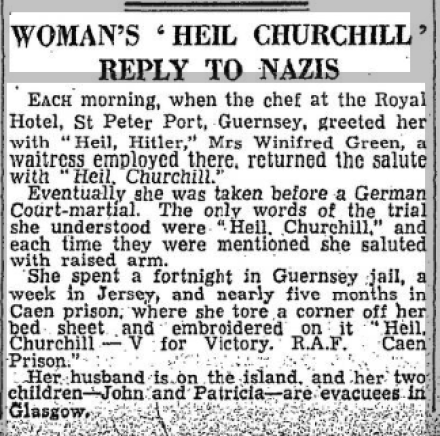
Probably one of the best known people for carrying out individual acts of defiance against the Germans during the occupation of the Channel Islands is Winifred Green. If you consult almost any book about the occupation Winifred gets a mention.
She became quite well known in the UK Newspapers in May 1945 when her story was widely reported. Some extracts below from a couple of newspapers.
Manchester Evening News 15 May 1945
The Scotsman 16 May 1945
Below is a photo of the display at the German Occupation Museum in Guernsey.
Display at German Occupation Museum
You can read more about Winifred at the Frank Falla archive here
I hope that you have enjoyed reading the blog post.
I also co-host a podcast with Keith Pengelley in which we talk about the occupation of the Channel Islands month by month using first hand accounts, diaries and our research in the archives. You can find us on all the major podcast services. Just search “Islands at War” or visit our podcast page here.
You can also follow the blog on Twitter at @Fortress_Island where I share other information and photographs. If you prefer Facebook I also have a page there.
If you would like to receive email notifications of future blogs, you can sign up to the right of this blog post or here. Feel free to look around the website, where I have categorised posts to make them easier to find and other resources such as tours, places to visit and films that may be of interest.
You can also find articles, podcasts, TV appearances and other social media etc here.
I will be adding more as time permits. Thank you for taking the time to read this, and I hope you enjoyed it. Please share it on social media or add a comment if you did. Feedback is always appreciated.
Also happy to be contacted with questions about the war in the Channel Islands, media appearances, podcasts etc.
Sgt. Stanley Ferbrache – You can see this and more information at the German Occupation Museum
This one is just a short blog to tie up the end of the Operation Ambassador story.
If you read my earlier blog about Operation Anger and Operation Ambassador you might be wondering why there was an attempt to rescue them on the 3rd of August when they became POWs on 28 July 1940. The earlier blog is here.
The answer to that question is that there was no way of getting a message out of the Guernsey other than if someone escaped or by the covert landings. Rumours abound on some forums that someone had a radio transmitter but this is simply untrue. All of the military equipment had been destroyed or removed prior to the arrival of the Germans.
Another Guernseyman Stanley Ferbrache volunteered to attempt to meet up with Mulholland and Martel and get them off of the island.
As with the previous raids he was landed at La Jaonnet Bay, this time having learnt of the issues with using other boats they used an MTB, on the 3rd of August.
Having met some of his family members he discovered that Mulholland and Martel had been left with no choice but to surrender the previous week. In order to avoid the mission being a waste of time he spent the next few days gathering intelligence on the German forces in the island.
He succeeded on leaving the island on 6th August. He was awarded the Distinguished Conduct Medal for this mission.
Churchill is reputed to have said ‘Let there be no more silly fiascos like those perpetrated at Guernsey.’ As it turned out there were plenty more missions to the Channel Islands to come and they were much better organised. More of those to come in future blogs.
I hope that you have enjoyed reading the blog post.
I also co-host a podcast with Keith Pengelley in which we talk about the occupation of the Channel Islands month by month using first hand accounts, diaries and our research in the archives. You can find us on all the major podcast services. Just search “Islands at War” or visit our podcast page here.
You can also follow the blog on Twitter at @Fortress_Island where I share other information and photographs. If you prefer Facebook I also have a page there.
If you would like to receive email notifications of future blogs, you can sign up to the right of this blog post or here. Feel free to look around the website, where I have categorised posts to make them easier to find and other resources such as tours, places to visit and films that may be of interest.
You can also find articles, podcasts, TV appearances and other social media etc here.
I will be adding more as time permits. Thank you for taking the time to read this, and I hope you enjoyed it. Please share it on social media or add a comment if you did. Feedback is always appreciated.
Also happy to be contacted with questions about the war in the Channel Islands, media appearances, podcasts etc.
Guernsey Policeman with a German Soldier – German propaganda photograph
Today is the 80th anniversary of the day that the German occupying forces arrested all of the Island’s police force. Their crime was stealing food from German stores and giving it to civilians. At this point in the occupation the Germans had plentiful supplies of food but Islanders did not.
The thefts of food were initially started by Constables Kingston Bailey and Frank Tuck. Bailey notes in his memoir that it started to get out of hand and practically the entire police force was involved.
Eventually Bailey and Tuck were apprehended on 3 March 1942 by German soldiers who were laying in wait. Subsequent to this the entire police force was arrested on 5 March 1942.
Accounts indicate that they were tortured and forced to sign confessions or be shot.
In May and June 1942 seventeen police officers were brought to trial. The sentences were severe and they were deported to Prisons and camps in mainland Europe. Many suffered life changing health issues from their time in the camps and sadly one officer Herbert Smith died whilst in detention.
18 May 1942 Guernsey Evening Press
Islanders were of course keen to know what was happening in the trial and were largely reliant on the Guernsey Press and The Star newspapers which was subject to censorship by the Germans. The editor Frank Falla managed to get approximately 1,500 copies of the newspaper printed with an uncensored version before the censor had redacted a large part of the article. Unfortunately for Falla one of the unauthorised copies was purchased by a German who was sitting on the bench for the trial.
The case had further impact on the local community as in late January 1943 former police officers and some of the family members of the imprisoned officers were deported to camps on mainland Europe for “military reasons”.
You can read more about the individual officers at the Frank Falla Archive by following these links to those that I have mentioned by name here Kingston Bailey, Frank Tuck and Herbert Smith. Thanks to Jenna Holloway who also pointed me in the direction of her great grandfather William Quin who was one of the Policeman and Adelaide Laine who lives in the house previously owned by Thomas Gaudion.
Recent attempts to clear the names of those involved have unfortunately been unsuccessful at the time of writing. The campaign to get an apology continues and well known historian Dr Gilly Carr is actively involved in this. You can read about this in a recent BBC article and an article from the Daily Mail.
I hope you have enjoyed this post. You can sign up for email alerts to new blog posts here.
The 25th of February is the anniversary of the death of Salvation Army Major Marie Ozanne in 1943.
Marie was incredibly brave and didn’t hesitate to challenge the occupying forces. Unfortunately this led to her paying the ultimate price.
The Island Archives acquired her diaries and this link gives a brief explanation.
There is also an excellent article about her here.
Below is a short video recorded by Dr Gilly Carr explaining more about Marie Ozanne.
If you have enjoyed this blog please sign up to email notifications on the right of this blog and give the site a follow on Twitter here
I hope that you have enjoyed reading the blog post.
I also co-host a podcast with Keith Pengelley in which we talk about the occupation of the Channel Islands month by month using first hand accounts, diaries and our research in the archives. You can find us on all the major podcast services. Just search “Islands at War” or visit our podcast page here.
You can also follow the blog on Twitter at @Fortress_Island where I share other information and photographs. If you prefer Facebook I also have a page there.
If you would like to receive email notifications of future blogs, you can sign up to the right of this blog post or here. Feel free to look around the website, where I have categorised posts to make them easier to find and other resources such as tours, places to visit and films that may be of interest.
You can also find articles, podcasts, TV appearances and other social media etc here.
I will be adding more as time permits. Thank you for taking the time to read this, and I hope you enjoyed it. Please share it on social media or add a comment if you did. Feedback is always appreciated.
Also happy to be contacted with questions about the war in the Channel Islands, media appearances, podcasts etc.